cape reviews
The Black Picket Fences of Jared Thorne's 'Black Folk'
Jared Thorne at Iziko South African National Gallery
By Anna Stielau28 November - 19 January. 0 Comment(s)
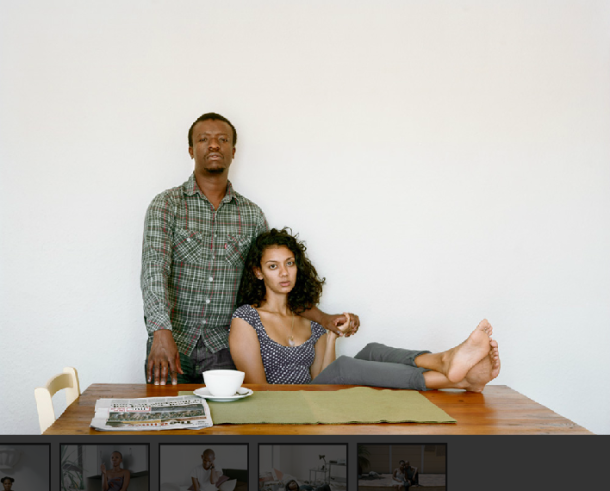
Jared Thorne
Kholofelo and Farhana,
2012.
Photographic Print
.
As I write this, debate rages on in the press around President Jacob Zuma’s latest proclamation: that dog-ownership is un-African, a hallmark of ‘white culture’ that necessitates loving an animal more than one’s fellow man. Un-African is one of very few words that make the hairs on the back of my neck prickle. Not only does it imply a correct way to uphold tradition and cultural identity, but embedded within it is the suggestion that those in power are duty-bound (and well within their rights) to police that culture. In 2012, single black women who did not prioritize marriage and childbirth were un-African. In 2011, media speculation about Nelson Mandela’s health was un-African. 2006 saw President Zuma publicly label homosexuality un-African - although he later withdrew that remark. What these instances seem to suggest is that the margins of ‘Africanness’ are narrowing with each passing year.
The minute Zuma’s most recent comment was publicized, Twitter was ablaze with puppy love. A flood of images of black suburban families and their pets swamped other social media platforms. Some were very endearing: who knew that Zwelinzima Vavi owned a Boerboel named Superhero? In the storm of the backlash, however, a common thread became increasingly apparent. The most vocal respondents, the angriest pet-owners, were members of the black middle-to-upper-class community.
art events calendar
VIEW FULL CALENDAR
buy art prints

edition of 60: R4,500.00
About Editions for ArtThrob
Outstanding prints by top South African artists. Your chance to purchase SA art at affordable prices.
FIND OUT MORE Editions for artthrob

Perhaps their rage was rooted in the fact that beyond framing pet ownership as a neocolonial practice, Zuma had given voice to a far more insidious trend: the equation of middle-classness with the emulation of whiteness. Sure, as he pointed out, skin lightening products that aim to achieve some unattainable ideal of Western beauty fall within the parameters of a neocolonial project. However, is pet-ownership not merely indicative of socio-economic standing; of living in a degree of comfort that affords one the outdoor space to sustain a domesticated animal? Is it not, as in the case of single women who choose career over family, as much a class issue as a race issue? And if so, does middle-class identity fall outside the strictly policed parameters of the African? There’s nothing like canine controversy to spark much-needed political dialogue.
Read in terms of this conversation, Jared Thorne’s 'Black Folk' at the Iziko South African National Gallery Annex has its metaphorical finger on the nation’s pulse point. Thorne’s exhibition interrogates the black middle-class experience in South Africa, foregrounding his ongoing research interest in how 'social class plays a significant role in defining how one witnesses blackness'. Through a series of large-format film portraits, he makes visible a social group that has so far eluded sight, receiving little scholarly or popular attention.
The culmination of Thorne’s year-long fellowship with the GIPCA Institute, 'Black Folk' is precisely what the title implies: pictures of black South Africans accompanied by extracts from audio interviews. Each photograph is eerily similar, emphasising the seriality of the project. The black subject (or in some cases, subjects) is situated in the centre of the frame in otherwise minimal surroundings, ranging from a dry suburban garden to a naked living room wall. This scenery is almost exclusively blindingly white - white walls, white furnishings, a white table cloth - making the 'blackness' of the photographed individual all the more visually apparent. As if to reinforce the disparity between subject and surroundings, many of Thorne’s ‘black folk’ make direct and uncompromising eye-contact with the viewer. They are not just seen, they are seeing, in possession of indisputable personal agency. In Kholofelo and Farahna (2012), the eyes of the young couple seem to follow one around the room. There’s something deeply powerful and slightly disconcerting about that returned gaze - I found myself constantly on the verge of averting my eyes.
The exhibition is framed by a bell hooks quote stencilled on the wall:
For some time now the critical challenge for black folks has been to expand the discussion of race and representation beyond debates about good and bad imagery. Often what is thought to be good is merely a reaction against representations created by white people that were blatantly stereotypical. Currently, however, we are bombarded by black folks creating and marketing similar stereotypical images. It is not an issue of 'us' and 'them'. The issue is really one of standpoint. From what political perspective do we dream, look, create, and take action?
Thorne aims to create images that unequivocally transcend good and bad, speaking to a universal black experience. We are reminded that this is a continuation of an older project, in which Thorne undertook to image an African-American middle-class in much the same manner. In the current political climate, though, his choice of this particular hooks quote is granted a new resonance. Zuma’s dog-ownership remark stumbles into the very pitfall proposed by hooks, setting up an 'us and them' dichotomy by detailing what is/is not appropriate for an African public and more than that, what is and is not African. Those same issues of representation and, indeed, self-determination are at stake.
Before I go further, I feel I need to acknowledge my own privilege in the interests of critical integrity. I’m a white Southern Suburbs Capetonian girl. I was a scholarship kid at a (predominantly white) private school in which my extra-curricular activities were, I kid you not, archery and fencing. As such, my position in terms of both Thorne’s project and his subjects is very much that of an outsider. It is important to recognise that my whiteness, in that it situates me in a very particular social framework, undoubtedly shapes my interpretation – for I am, after all, part of the ‘white culture’ that Zuma so avidly criticizes. That being said, I feel that I must also recognise Thorne’s position; a fact that I regard as relatively unacknowledged in the context of 'Black Folk'.
Thorne’s title bears witness to his nationality. In South Africa, we don’t really use the phrase ‘black folk’ - a turn of phrase that I strongly associate with hooks’ writings - perhaps because the word ‘folk’ is suspiciously close to volk and as such rings with dubious Apartheid connotations. Thorne is an African-American photographer, yes, but he aims to speak for (and to) a universal black middle class, both in the United States and in South Africa. But I wish that the show identified this as a potentially problematic relationship. A westerner representing black South African identity, African-American or otherwise, needs to navigate some dangerous hegemonic waters.
In its challenge to self-imposed constructs of black middle-class identity, 'Black Folk' is doing something genuinely interesting. It makes visible the invisible, awarding black South African citizens not only visual form and a unique identity but a cultural context; a sense of belonging to a broader community. To Thorne’s credit, his exhibition succeeds in challenging conventional notions of both race and representation. What is more, I wonder if he owns a dog?