
CAPE TOWN

The cover of Lisa
Brice's catalogue

Lisa Brice
Boyz to Men 1998
'Boy' cap, three-legged table,
ball - found object, linoleum
Lisa Brice
Carcool series (detail)

Lisa Brice's family of
pop-eyed beanbag people
Reviewed by Paul Edmunds
Lisa Brice has not shown much work in Cape Town in recent years, so her new show, 'In the Eyes' at the Hänel Gallery, was eagerly anticipated, particularly since the show also launched her catalogue. This documents Brice's work right from her prodigious high school output to her most recent work, excluding only part of the current show. Her productivity is astonishing, especially given the amount of travel and administration which her career demands. She designed most of the catalogue herself, and it contains her own texts on her various bodies of work, with concise essays by Sue Williamson and Malcolm Payne. Small multiples are available at a special price with the purchase of a catalogue.
Brice's new work examines gangs and the gang-related violence which has become prevalent in the disadvantaged communities of the Cape Flats and increasingly visible in Cape Town itself. Boyz to Men documents the typical rite of passage of a boy to manhood through the use of a found "weapon" - a crudely fashioned club which was formerly some kind of bat and, before that, the leg of a table. This journey from domestic object through plaything to instrument of violence parallels a young man's passage from child at home to gang member and possible criminal or perpetrator. Brice engages the commonly held view that gang membership offers an induction into manhood and provides an underprivileged individual with comradeship, power and status.
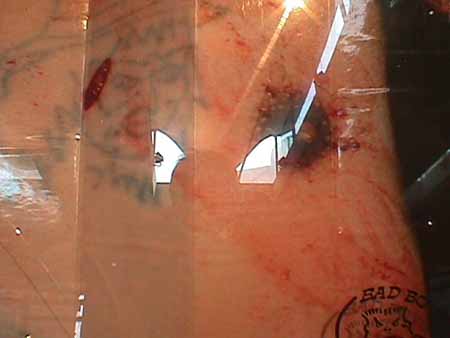
The Carcool series plays on the word "cool". On one side of the gallery are mounted four cracked motor car windscreens, covered in found and customised decals. Behind each is a folding cardboard screen, usually used to protect one's vehicle from the sun. Close-up photographs of knife and bullet wounds, sustained in gang violence, are laminated onto the card. On the opposite side of the gallery is a flaccid pyramid of pop-eyed beanbags representing, it seems, the general populace. They look on horrified yet fascinated by the gory details.
The beanbags draw on a Seventies aesthetic and seem to be stuck in some "sunny skies and Chevrolet" era when the apartheid machine was functioning smoothly, successfully isolating the white populace from the horrors of reality. These chairs, characteristic of the era of Brice's childhood, were easy and comfortable but notoriously difficult to get out of and, ultimately, bad for your back. Perhaps she is commenting on the blind eye which the advantaged communities have turned to the gang issue until it has spilled into their very neighbourhoods. Now they look on, terrified and fascinated, unable or unwilling to do anything about it.
The windscreen elements contain well-known logos (like "Adidas") as well as catch phrases and mottoes to be found on many cars around Cape Town ("I'm too sexy for my Ford", for example). The photos of stab wounds and gunshots (obtained from the police forensic department) reveal every blood-stained pore and provide close-up abstracted views of gang tattoos. Shadows of the decals fall on the skin and mingle with the faded tattoos. These images are quite captivating and repulsive at the same time. The form of these elements articulates the well-known association between vehicles and masculinity and power.
The two elements of this work seem to embody two stylistic modes in which Brice works - the visceral, expressive and emotive, and the cool, distanced and slick. The catalogue provides a window into this apparent contradiction. Brice's early work, particularly during her student days, was expressive and visceral and dealt with themes of violence, often in a very graphic way, gradually becoming "cooler" as she worked through her Sex Show period, and perhaps reaching its climax with Staying Alive of 1997. It is interesting to see a return to her earlier mode or style, and even more interesting to see how she has done it. The fleshy and expressive colours and marks are not her own, but belong to the reality with which she has chosen to engage.
The title 'In the Eyes' describes the impassive, indifferent gaze of the apathetic audience, horrified and bored into inactivity. We see this in the anthropomorphic, fashion-conscious beanbags soaking up TV, as well as in the ideal proportions and comfortable activities of the figures in her Staying Alive series. At the same time, 'In the Eyes' describes something more active and aggressive. It evokes horror, fear, assertion and action and serves well to describe the penetrating, incisive and hard-hitting nature of Brice's work.
The Hänel Gallery, 84 Shortmarket Street. Phone: (021) 423-1406.

Portrait by Abderramane Sakaly
Portrait by Cornelius
Yao Augustt Azaglo
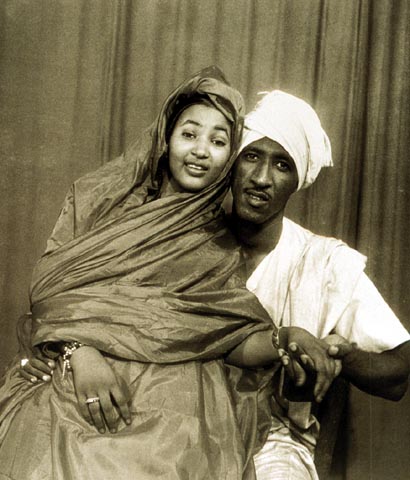
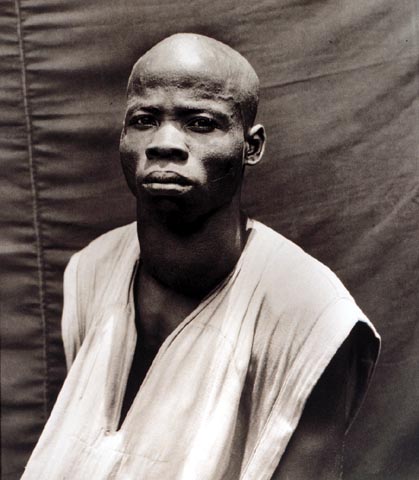
Curated by Revue Noire, the French-based cultural magazine which focuses on Africa, this large-scale show comprises images of the continent seen through the lenses of African photographers rather than from the outside. As such, the historical section belies the previously widely held notion that photography in its early days was not practised by the locals, and the glimpses given by this show into the other countries of the continent, other times, other cultures, are rewarding in the extreme. The focus is largely on studio shots, and the images we receive are quite intimate. Landscape photography per se, if it existed, is not represented here.
Most of the older photographs in the show are on at the South African National Gallery, with the more contemporary work to be found at the Cape Town Castle. Here are images of urban life on the streets, and here too is the work by most of the South African photographers to be found.
Definitely not a show to be missed, 'eye Africa' runs until the end of this month. For more, read Rob Meintjes' review in January ArtThrob.
Portrait by Lance Slabbert
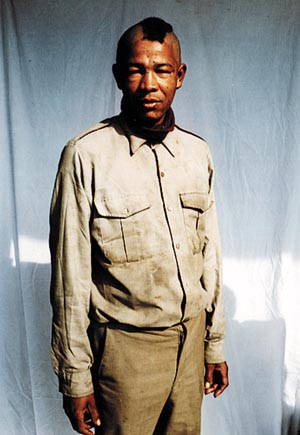
So much interest has this fine show of two very different but complementary bodies of portait work generated at the Area, the gallery has decided to extend the run until the middle of this month. The portraits from the Bobson Studios offer a unique opportunity to get an overview of Durban and its people over a 40-year period - or at least the people who would go, dressed for the occasion, into the studio on busy Warwick Avenue to have themselves photographed for posterity. Lance Slabbert's contemporary photographs are large scale, and concentrate on modes of street dress.
Area, 92 Loop Street. Phone (021) 422-1321.
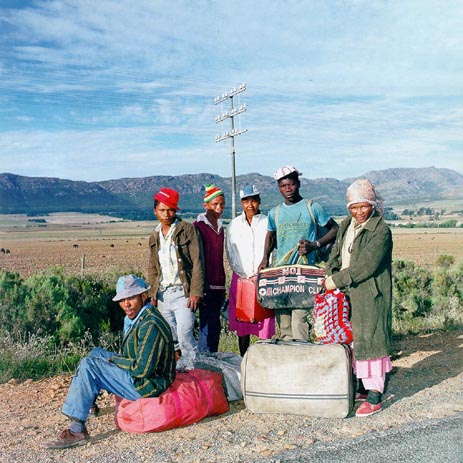
Darryl Evans
The Heart of the
Country series
Until February 6. Lipschitz Gallery, 138-140 Buitengragt Street. Phone: (021) 422-0280.
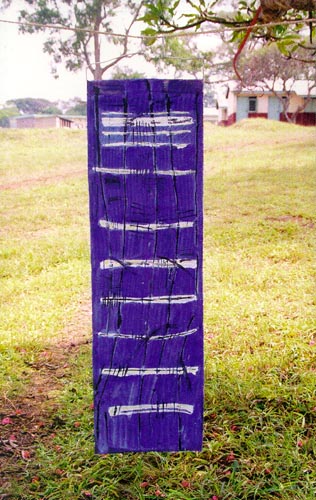
Jill Trappler
Ngoma Dreaming
Acrylic on canvas
40 x 136cm
Until February 6. Association for Visual Arts, 35 Church Street. Phone (021) 424-7436.
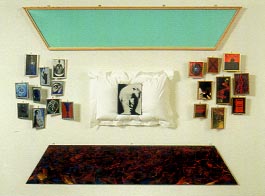
Gabriella Kaplan
Ex Voto 1998
Mixed media
160 x 190cm
Gabriella Kaplan presents mixed-media work at the João Ferreira Gallery, in which she explores the tensions and push-pull of human existence. The work fails to convince. One feels that the artist knows what the language of contemporary art is, but does not really know how to utilise this for herself, and the results are somewhat pedestrian.
Joao Ferreira Fine Art, 80 Hout Street. Phone (021) 423-5403; e-mail: joao@iafrica.com.

Stephen Hobbs
Cityscape Mural 1998
Found mural

Stephen Hobbs
Piss Figure 1997
Found graffiti
"It's not how cities work, it's how they don't work that interests me," Johannesburg artist Stephen Hobbs has said. In 'Torque of the Town', opening at the Mark Coetzee Fine Art Cabinet on February 3, Hobbs shares his fascination with us in a series of mixed-media, photographic and video works in the large space, and a postcard panorama assembled in the Cabinet.
For the opening night, Hobbs is planning a series of interventions in Bree Street, blocking off a section of street and temporarily removing road markings and signs. There will also be a video installation in this area.
Hobbs is this month's project artist.
Mark Coetzee Fine Art Cabinet, 120 Bree Street. Phone/fax (021) 24-1667.
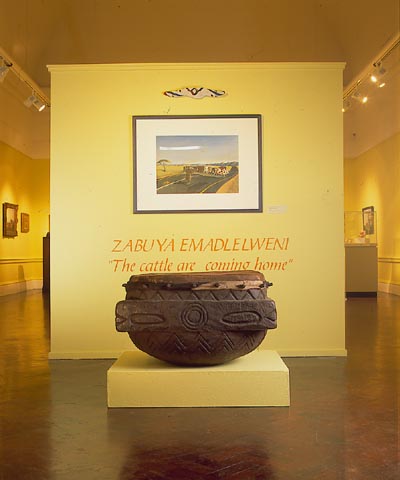
Installation view
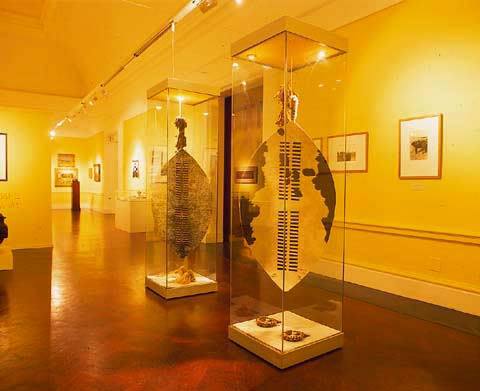
Installation view

Durban Ricksha Puller
c.1900s
Photographer unknown
Reviewed by Paul Edmunds
The role and importance of cattle in human culture is examined in 'Zabuya Emadlelweni - The Cattle are Coming Home', now on at the South African National Gallery. This is done through the presentation of a collection of objects and artefacts, mostly from indigenous Southern Africans but also from its colonial inhabitants. The line between art and anthropology is somewhat uneasy, and as such this exhibition is a brave undertaking.
It is established by various texts on the wall relating to the objects on display that cattle, both historically and today, serve as a measure of economic wealth, status and power. Work on show ranges from the earliest known Southern African clay ox to semi-traditional aprons with their strange hybrid Zulu/Western aesthetic. The exhibition includes also romantic paintings of cattle by Europeans and contemporary photographs of various issues relating to aspects of cattle in human culture.
Standout objects for me included a small clay ox-shaped snuffbox from the late 19th century and the most beautiful wooden carvings of a man plowing and another milking a cow, with her calf nearby, by Julius Mfete. There are some finely patinated wooden milkpails and clay storage pots. Curiously rich, naturalistic paintings of cattle in the English landscape by Henri Rousseau are included to investigate the relationship of the English colonisers to land and livestock..
The title is taken from a Zulu proverb, the text on the wall tells us. It is from a culture whose language is filled and rich with references to cattle. Disappointingly, neither this nor other proverbs alluded to in the various texts are elaborated on. They are barely contextualised, and don't really serve to enrich the work on view. Because of this the works don't, in turn, serve to describe or increase our understanding of the cultures from which they emanate. It seems that the work hints at possibilities which it doesn't quite attain.
Though the exhibition is sensitively laid out and the choice of artefacts quite fine, the thread linking them was left a little too vague. What do the Cooper paintings of cattle say about land and ownership? And why are the cattle coming home? Later, in discussion with curator Carol Kaufmann, I learnt that much of this is addressed in walkabouts of the show. While I don't think this is unreasonable, the information I desired could adequately have been given by some thorough text on the wall. The European paintings particularly lacked explanation and seemed almost an afterthought. In a show of this nature, which relies heavily on context and information and less on interpretation, I feel this kind of information is essential and should be readily available. Kaufmann did tell me, however, that there is the possibility of an expanded version of this exhibition and possibly even a catalogue. Both of these would be most welcome.
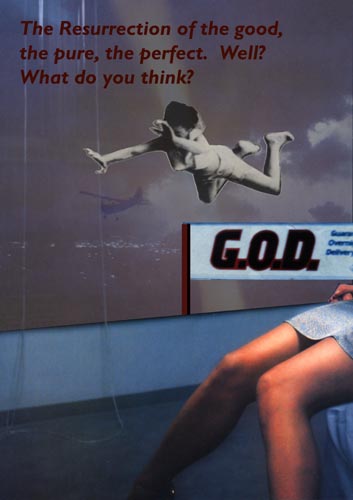
Veronique Malherbe
The Resurrection of the Good,
the Pure, the Perfect. Well?
What Do You Think?
Electronic collage
Jamal is the author of Love Themes for the Wilderness, shortly to be filmed, and co-author of Art in South Africa: The Future Present. Malherbe's work was last on view in the 'Bringing Up Baby' exhibition. Severance and Malherbe's exhibition are on at the Nico Malan until February 6.
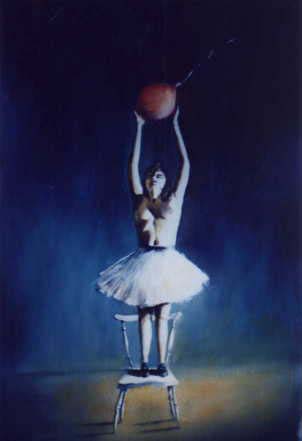
Vanessa Berlein
Going up at Bang the Gallery is a show called 'Punchdrunk' - in which participating artists Vanessa Berlein, Francois Irvine, Glynn Venter and Rowan Thompson explore the subconscious and the weird and whimsical world of dreamland to make their work. Opening February 1.
Bang the Gallery, 92 Bree Street. Phone (021) 422-1477; e-mail alexh@bangthegallery.co.za. Website: www.bangthegallery.co.za
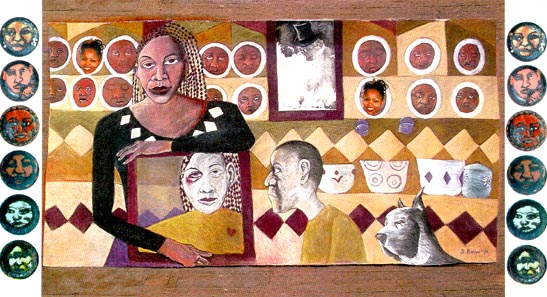
Bongi Bengu
Now on view at the AVA is new work by three artists: Bongi Bengu, with figurative work in charcoal and pastel, Medina Morphet with her investigative abstractions, and Hanno Kubler's "fotoobjects".
All three shows end on February 27. Association for Visual Arts, 35 Church Street. Phone (021) 424-7436; e-mail avaart@iafrica.com.
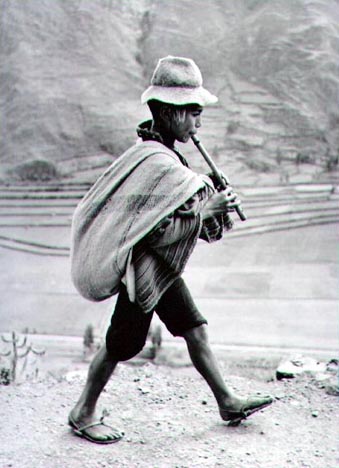
A photograph by
Werner Bischof
One of the most famous photo agencies in the world was Magnum, known for its stable of the top rank of photographers. One of these was Swiss-born Werner Bischof, who during a short career - he died in a car accident at the age of 38 - produced numerous classic images from the war-torn Europe of the Forties, and later from India, Korea, Japan and other countries through which he travelled. An exhibition of his work, shown first in New York, opened at the Cape Town Castle last week, and runs until mid-March. It portrays the successive stages in a career which led Bischof from studio photographer to committed photojournalist.
Underway, a film about the life and work of Werner Bischof produced by his son, Marco Bischof, and Rene Baumann, will be shown at the gallery throughout the course of the exhibition. Marco Bischof has also been running a workshop on photojournalism for children, and from February 18 the results of this will also be on show.
For more information phone Mirjam Asmal of Pro Helvetia, sponsors of the show, at 424-9110.
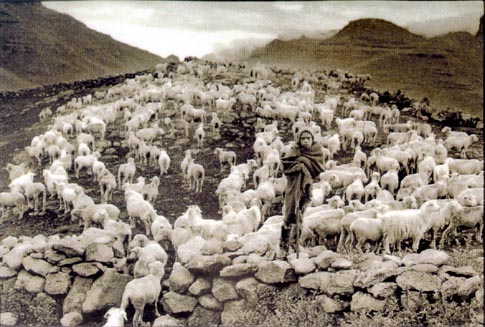
Nicolaas Hofmeyr
The Balisana Shepherds
Best known for his television documentary work, Nicolaas Hofmeyr here presents a photographic essay on the lives of shepherds in a remote valley high in the Drakensberg mountains in Lesotho. Hofmeyr made a number of trips to the area, and his images capture the ancient lifestyle of the shepherds against the bleak beauty of their mountain environment. Complementing Hofmeyr's work is a series of photographs by Jan Verboom on the landscapes and people of Namibia.
Opening at the Area on February 19. Until March 6. 92 Loop Street. Phone: 22-1341.
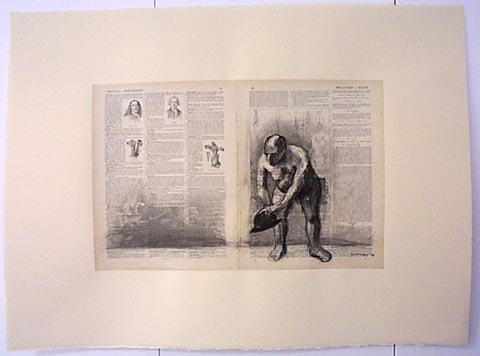
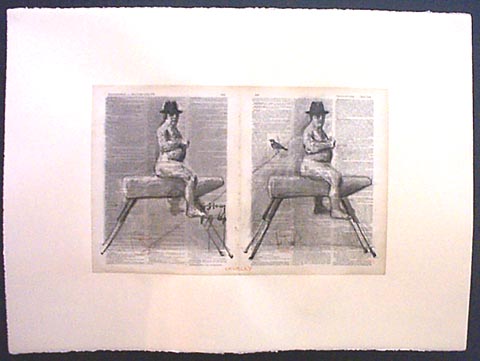
William Kentridge
Encyclopaedia Drawings
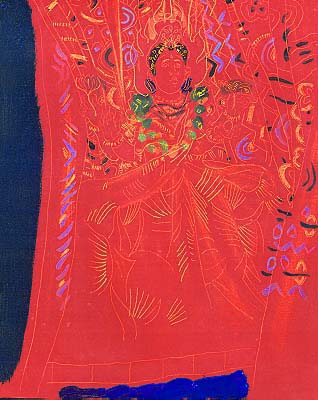
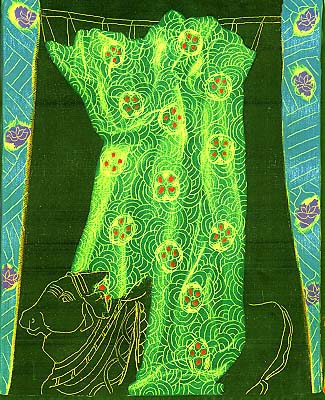
Andrew Verster
Sacred Works series
The Goodman has begun its 1999 programme with a handsome show by well-established artists. William Kentridge extends his drawing surfaces to the pages of the Larousse Encyclopaedia, thus enabling himself to make use of plays on the printed words exposed. The fluent charcoal drawings of the burly naked middle-aged man who is Kentridge's alter-ego interacting busily with a variety of props are made with the artist's customary wit and masterly finesse.
Mimmo Paladino, who exhibits regularly at the Goodman, shows immaculately executed prints on handmade paper with numerous superimpositions. Despite the relative complexity of the techniques employed, the images seem somewhat on the decorative side
The surprise on this show is new work from Andrew Verster - small (27 x 25cm) meditational paintings entitled 'Sacred Works', executed in the brilliant palette of India - searing pinks, saturated reds, sharp lime greens and jewel-like turquoises. Like Hockney and Rauschenberg on occasion, you can see where Verster has been travelling most recently by studying his latest work. Here, the Indian influence is clear. Finely detailed areas are balanced with the odd loose brushstroke to produce works on which one can dream indeed.
The Goodman Gallery, 163 Jan Smuts Avenue, Parkwood. Phone (021) 788-1113; e-mail goodman@iafrica.com. Website: www.goodman-gallery.co.za.
The lecturers of the University of Witwatersrand's department of fine arts show their stuff. Expect to see work by such established artists as Penny Siopis and Clive van den Berg.
Sandton Civic Gallery, corner Rivonia Road and West Street.
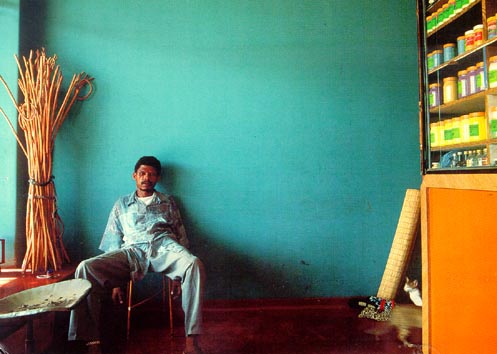
Thuthukani Herbalist
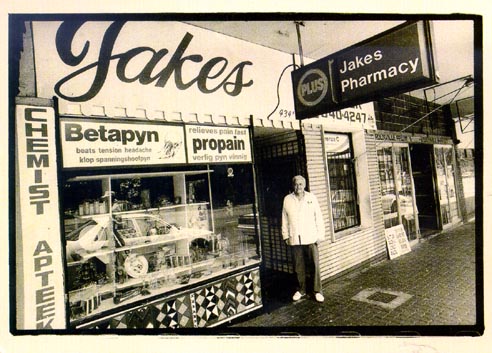
Jakes Pharmacy
Abrie Fourie writes about Doris Bloom's show
Doris Bloom's latest project, 'Apotek/Chemist', involved interventions in two different shops which dispense very different medications. On January 17, the first half of the exhibition opened at the Thuthukani Herbalist shop in Jeppe.
Here, Bloom exhibited five framed mixed-media drawings (incorporating
newspaper clippings) on one of the only vacant wall spaces in the tiny
shop, which is stocked to the brim with an assortment of dried herbs as
well as jars of potions, tonics and various other colourful contents.
These drawings were entitled Germany's Shame and Herero Women.
David, the proprietor of Thuthukani and resident sangoma, and
his colleagues greeted the "gallery"-goers dressed in typical African
garb. David also threw the bones and explained the function and meaning
of this. For lunch the visitors enjoyed a braai on the premises.
The vibe at Jakes Pharmacy in Louis Botha Avenue was altogether
different. The setting was one of a clinical, commercial but equally
overstocked shop. Here Bloom gave her drawings kitsch frames and
placed them among the other products behind the counter, where they blended
splendidly with the rest of the products on display. On the counter itself she framed some Prozac pills, some Valium and a text, reading "Viagra", all for sale.
For Bloom this was as much about drawing attention to these particular venues as it was about involving the community in the performance and art.
The exhibition closes February 6. For more info, contact 082-972-2750.
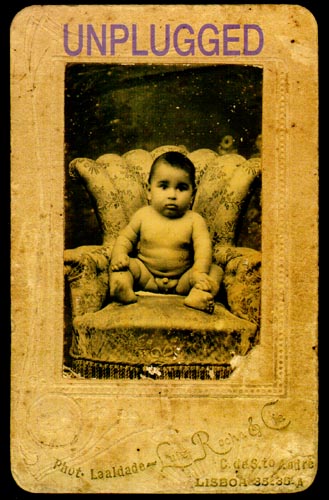
The invitation to 'Unplugged',
with an image chosen by
Terry Kurgan
The fourth phase of the Rembrandt's annual exercise in "soft curating" in which the last artist on the previous year's 'Unplugged' is the first on this year's manifestation, and selects the second artist, who names the third and so on. This year, it's largely a Cape Town line-up, starting with 1) Terry Kurgan and going on to 2) Julia Clark, 3) John Nankin, 4) Roderick Sauls, 5) Thembinkosi Goniwe 6) Nganeni Sobhopa, 7) Gregg Smith, 8) Dorothee Kreutzveldt, 9) Andrew Porter, 10) Kevin Brand, 11) Ena Carstens, 12) Walter Meyer, 13) Simon Stone, 14) Kate Gottgens, 15) Bridget Baker, 16) Senzeni Marasela, 17) Farrel Ngilima, 18) Robin Rhode and 19) Usha Prajpat.
A welcome plethora of new names, and with peers selecting work by peers, it should be interesting. Anyone wanting to know more about the past history of the show and previous lists can click through to the full text of the Rembrandt media release.
Opening February 21 and closing March 13. Market Theatre Complex, corner Bree and Wolhuter streets, Newtown. Phone 832-1641.
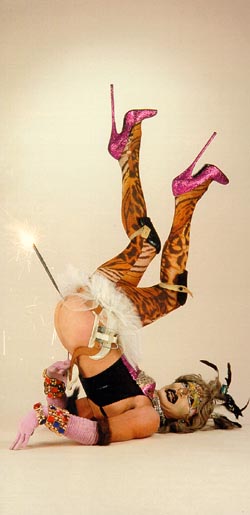
Steven Cohen
Nobody loves a fairy
when she's 40 1999
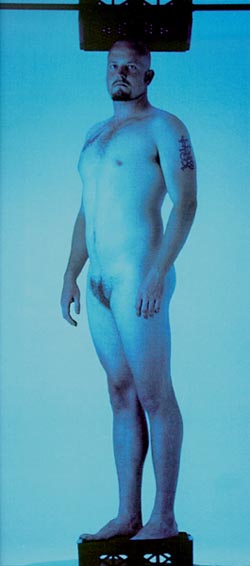
Peet Pienaar
Formstance 1999
The title of this show points to where we're headed: the stated art mission of both Peet Pienaar and Steven Cohen is to haul into the public spotlight significant issues formerly kept under wraps, and present them as provocatively as possible. No one can be more in your face than Cohen, winner of last year's Vita award, with his risky, near naked drag performances at such family events as dog shows or the Durban July. At the Goodman, Cohen will be presenting Nobody Loves a Fairy when she's 40, designed "to surprise everyone, including himself". And composed for the occasion, here's a poem by Cohen:
I'm a fairy and I'm 36
Pienaar covers similar territory in a very different way. He, too, has appeared at performances at sporting events - remember his glittering green lamé suit with a springbok embroidered on the pocket in which he posed motionless on the rugby field before a major match, alluding to the homo-erotic (heaven forbid) aspect of the sport. Cohen is a maverick in the art world, Pienaar is more cued in to the mainstream of young South African art, the questioning of the role of objects and rituals of popular culture and political symbols. Should be a good show.
Preview: February 27. Opens February 28 at the Goodman Gallery, corner Jan Smuts Avenue and Chester Road, Parkwood. Phone: (011) 788 1113; e-mail: goodman@iafrica.com. Website: http://www.goodman.com.
Gallery hours: Tuesday to Friday, 9.30am to 5.30pm; Saturday 9.30am to 4pm.
At my age, being honest is like making magic
I have learned to tell the truth
I fuck with beauty
I play with shame - I stick things up it
When my wishes don't come true, I cause them to
Now I can tell the make-up from the real
I can fly in a saddle and crawl in glitter
I know a lot about you
And I have found a way to reach you
I make art products for art vultures
I make art videos for art voyeurs
I do make performance for real
I trust you
And for you
I will dance inside out
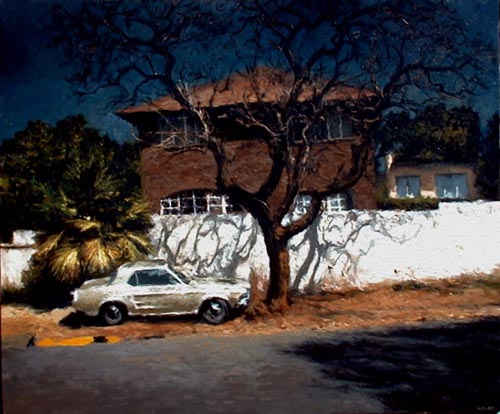
Walter Meyer
Bellevue
Oil on canvas
Trent Read, ex of Read Contemporary in Johannesburg, is beginning to hold regular exhibitions at his new venue, Knysna Fine Art. The gallery's first offering for the year is a show by sculptor Guy du Toit and painter Walter Meyer. Du Toit works with such imagery as bells, saddles, anvils and farmyard animals like cockerels, horses and goats, sculpting these into vigorous bronzes. Meyer's limpid eye falls on the corners and backroads of the platteland, taking pleasure in finding beauty in the commonplace.
Show ends mid-month. Knysna Fine Art, 8 Grey Street, corner Gordon Street, Knysna. Phone (044) 382-5846; fax (044) 382-6530; e-mail: k.finart@pixie.co.za.
contents |
listings |
artbio |
project |
exchange
...


news |
feedback |
websites |
archive |
home