



Current Review(s)
'Two Projects'
Mikhael Subotzky at Goodman GalleryFew buildings in Johannesburg, when seen from a distance, give one the feeling of being in Johannesburg quite like Ponte City does. Crowned with Vodacom’s flashing green and blue neon and sprouting from a rocky slope on the southern side of the Witwatersrand Ridge, it is visible from almost anywhere in the city. It is a landmark which from far directs one home, and from close warns one to stay away from Johannesburg’s most notorious neighbourhood: Hillbrow.
But Ponte is not only an icon of the city; since it was built in 1975 it has been the receptacle for so many Johannesburg dreams. Full wallets, success, urban sophistication, cosmopolitanism, and even love, have wafted through the building’s gaping core like spectres, luring tenants there for years.
In this light, it is easy to see why Ponte, particularly after its deterioration into a slum, has attracted the gaze of artists. In 1999 Stephen Hobbs dropped a digital video camera attached to a parachute down Ponte’s core for a video work titled 54 Stories. This work simulated one of the many suicides that took place in Ponte in the 1990s. In 2005, Guy Tillim painted a gloomy, de-saturated picture of Ponte in his photographic series ‘Joburg’, a project that now sits in book form on many a northern-suburbs coffee table.
29 October 2009 - 21 November 2009
Show 'n Tell
Mikhael Subotzky at Goodman GalleryA couple of years ago I became obsessed with conspiracy theory. Not because I believe for example that the Royal Family are secretly lizards, but because the leaps and acrobatics of conspiratorial thinking seemed interesting, and the characters invested in it had a certain stoic melancholy mixed with unbridled enthusiasm. I was particularly moved by a video I watched on YouTube - now lost to the ravages of the Internet - which featured a man showing evidence of life on Mars. He’d picked an image from the European Space Agency’s (awesome) collection of images of the surface of Mars, pushed up the contrast and brightness, zoomed in, and proceeded to give an illuminating half-hour discussion on Mars’ farms, store-houses and factories. Of course what he was actually looking at were compression artefacts; the results of an algorithm bundling pixels together into distinctive geometric patterns after an image is compressed as a JPEG. It struck me though, that he was so convinced of the illusion of photographic representation that he confused subject with the means of representation.
16 August 2014 - 13 September 2014
Listings(s)
Editions for ArtThrob Print Exhibition
Guy Tillim, Jane Alexander, Lisa Brice, Peet Pienaar, David Goldblatt, Penny Siopis, Hentie van der Merwe, Robert Hodgins, Tracey Rose, Mikhael Subotzky, William Kentridge, Zwelethu Mthethwa and Nontsikelelo Veleko at South African Print GalleryEditions for ArtThrob is pleased to announce an exhibition of all artist prints in our collection at the South African Print Gallery in Woodstock, Cape Town. You are cordially invited to attend the opening finger lunch at 11:30am on Saturday the 29th of August, where all available prints will be for sale.
Editions for ArtThrob, in collaboration with South Africa’s leading artists, has developed a series of specially-commissioned prints; these are sold to cover the running costs of the ArtThrob website. ArtThrob is South Africa’s leading website on contemporary art, and is an important point of reference worldwide for curators, dealers and those interested in South African art.
Artists who have participated in the in the print program include William Kentridge, Penny Siopis, Robert Hodgins, Jane Alexander, Willem Boshoff, Nontsikelelo ‘Lolo’ Veleko, David Goldblatt, Guy Tillim, Lisa Brice, Zwelethu Mthethwa, Mikhael Subotzky, Peet Pienaar, Hentie van der Merwe and Tracey Rose.
In addition, we will be launching a brand new print by Robert Hodgins. Hot off the presses at Mark Attwood’s studio, the image will be available for preview the at exhibition opening.
Please contact Natasha Norman from ArtThrob for online orders or Gabriel Clark-Brown at the SA Print Gallery for more information.
29 August 2009 - 28 September 2009
'Two Projects'
Mikhael Subotzky at Goodman GalleryHaving recently moved from Cape Town to Johannesburg, Mikhael Subotzky explores his new stomping ground in two distinct bodies of work. The largest, which is on show at the Goodman Gallery's Parkwood Space, is a collection of photographic and textual traces of a prolonged exploration of Ponte, arguably Johannesburg's most mythologised building. The second, at the Goodman's Arts On Main project room, is a collection of photographs that look at conspicuous security and paranoia in Johannesburg.
29 October 2009 - 21 November 2009
'Breaking News: Contemporary Photography from the Middle East and Africa'
Bob Gosani , Guy Tillim, David Goldblatt, Jodie Bieber, Daniel Naude, Pieter Hugo and Mikhael Subotzky at Fondazione Cassa di Risparmio di Modena'Breaking News' presents the third group of acquisitions for the international contemporary photography, art film and video collection of Fondazione Cassa di Risparmio di Modena. Curated by Filippo Maggia, this major survey features 21 artists from 12 countries. 'As the title suggests,' says Maggia, 'the idea for this exhibition is to use a selection of emblematic works that recently became part of the Fondazione di Modena collection to shed light on a part of the world that only makes the news with conflicts and bloody events. "Breaking News" is the journalism launch - typical of TV news - that announces the latest news'. Dominated for more than a century by the views induced by colonialism, Africa now expresses a variety of creative voices investigating not only the legacies of the past but also the complexities of the present.
28 November 2010 - 13 March 2011
'Beaufort West'
Mikhael Subotzky at Magnum GalleryFor some two or three kilometres, the N1, the great highway that traces South Africa’s north/south axis, becomes Beaufort’s West’s main street. About a million people pass through each year, and in the evenings, an assortment of the town’s 37 000 residents come out to meet them. They offer all the commodities a night traveller might want: food, drink and petrol, a place to stay, an hour’s worth of sex.
In exchange for their wares, Beaufort West’s people are preserving a frail connection with the world. Without its national road, this town, some three-quarters of its residents unemployed, would surely be lost unto itself. Like many small South Africa towns, Beaufort West is still highly segregated. The quiet streets of the town itself are clustered around the main road and still house an almost exclusively white population. They go their daily lives largely unaware of what goes on in the outlying townships where the majority of the population live.
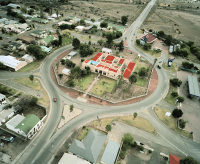
The local jail, too, is on the main road, and it is what caught Mikhael Subotzky’s attention: ‘I was drawn to Beaufort West because its prison is bizarrely situated in a traffic circle in the centre of the town in the middle of the N1 highway’, Subotzky says. ‘Most South African prisons are hidden from view on the outskirts of our towns and cities. I was interested in this image of the prison at the centre of the town’.
Excerpt of text by Johnny Steinberg
03 November 2011 - 10 December 2011
'Out of Focus: Photography'
Mohau Modisakeng, Oliver Chanarin and Adam Broomberg and Mikhael Subotzky at Saatchi GalleryThe Saatchi Gallery's first major photographic exhibition since 2001's ‘I Am A Camera', ‘Out of Focus' is a wide-ranging exploration of photography at a time when the medium is in the midst of a complicated but rich moment in its history and old assumptions are being challenged. The exhibits range from classic documentary to collaborative set pieces, with featured artists offering an international perspective on recent trends in photography.
25 April 2012 - 22 July 2012
III Moscow International Biennial of Young Art 2012
Athi Patra-Ruga, Lerato Shadi, Pieter Hugo, Mikhael Subotzky and Nandipha Mntambo at Various venuesThe 'III Moscow International Biennale for Young Art 2012' focuses on a young generation of artists aged up to 35 years. Titled 'Under A Tinsel Sun' and laid out as a multimedia project, it portrays the heterogeneity of subjects, languages and styles which are so urgent in this generation, and at the same time looks into the content-related positioning of these artists born between the mid-1970s and the mid-1980s, as well as into the conditions for their development.
'Under A Tinsel Sun' assumes that, despite the cultural, economic and social differences that may exist between the participants from different countries, there is a common factor in the impossibility of locating oneself by belonging to certain peer groups (whether in the ideological or in the artistic sense).
Cultural science often refers to this as an "almost desperate isolation" (Wolfgang Kaschuba), as the final state of a development in the field of art that had already begun in the mid-1970s, manifesting itself in the end of the historical avant-gardes and in their reassessment as part of a dominant canon. The collapse of ideologies at the end of the 1980s and the dawning of the post-ideological age both play a role within this mesh.
In this state of infinite possibilities, free decision and development and in the absence of a communal "we", the self-positioning of the (artistic) individual becomes the pressing imperative of the present. With the increasing medialization of the world the long established polarity between reality and virtuality gives way to the consciousness that "reality" as such is constructed, subjective and fragmented.
This realization becomes the drive for the artists' self-positioning and for their production of works that no longer describe the phenomena surrounding them as "objective", but that aspire to catalyze a multidimensional and alternative perception of the world. Poetic shifts, emotionality and subjective appropriation are the tools which the artists of this generation operate with so as to faciliate new ways of seeing.
Kathrin Becker
01 July 2012 - 31 August 2012
'Surfacing'
Liza Lou, Johan Thom, Haroon Gunn Salie, Mounir Fatmi, Alfredo Jaar, Candice Breitz, Kendell Geers , Mikhael Subotzky, William Kentridge and Kudzanai Chiurai at Goodman Gallery
'Surfacing' is a group exhibition which allows for an exploration of the transient space between destruction and (re)construction. The exhibition aims to bring to light the fragments and residues that remain after destruction, and linger beneath a new form. In the preface to the 1961 edition of Frantz Fanon’s 'The Wretched of the Earth', Jean-Paul Sartre writes “violence is man re-creating himself.” Although Sartre speaks of violence as a necessity for overthrowing colonial power, “no gentleness can efface the marks of violence; only violence itself can destroy them.” This exhibition understands Sartre’s notion to address culpability, selfhood and violence and trauma involved in the process of becoming, scrutinizing and (re)creating.
22 March 2014 - 19 April 2014
'Other People’s Memories'
Liza Lou, David Goldblatt, Mounir Fatmi, Oliver Chanarin and Adam Broomberg, Candice Breitz, Kendell Geers , Mikhael Subotzky and Moshekwa Langa at Goodman Gallery'Imagine them reconstructing the conceptual framework of our cultural moment from those fragments. What are the parameters of that moment, the edge of that framework?' K Eshun (2003)
'Other People’s Memories' is a group show which explores the ways in which history and memory exist in the process of making, as well as the process of viewing, and by extension, the relationship between the artist, the artwork and the viewer. ?The works included in the exhibition are the result of the artists’ relationship to something which has already happened, so that the artwork becomes an act of insertion, where the artists’ personal history becomes part of the historical, social or cultural moment which is referenced. In some instances the physical presence of the artists and their surroundings is consciously transferred to the artwork.
Participating Artists:
CANDICE BREITZ / ADAM BROOMBERG AND OLIVER CHANARIN / NOLAN DENNIS / MOUNIR FATMI / KENDELL GEERS / DAVID GOLDBLATT/ HAROON GUNN SALIE/ ALFREDO JAAR / MOSHEKWA LANGA / WILLIAM KENTRIDGE / LIZA LOU / MIKHAEL SUBOTZKY /
28 January 2015 - 26 February 2015
Paris Photo
Jodi Bieber, Joel Andrianomearisoa, Billy Monk, David Goldblatt, Santu Mofokeng, Andrew Tshabangu, Cedric Nunn, Pieter Hugo, Mikhael Subotzky, Viviane Sassen, Moshekwa Langa, Zwelethu Mthethwa and Nontsikelelo Veleko at Grand PalaisThe annual Paris Photo will celebrate its 15th anniversary at the Grand Palais, featuring 117 galleries from some 23 countries presenting the best of 19th century, modern and contemporary photography in the heart of the French capital. This year's special focus is on African photography from Bamako to Cape Town, with several South African artists in the spotlight in the main venue as well as on other shows around the city (such as the skyroof of the Gare du Nord station). South African galleries STEVENSON, Goodman Gallery, Bailey Seippel, and Gallery MOMO will be exhibiting.
10 November 2011 - 13 November 2011
'Apartheid & After'
Jo Ractliffe, David Goldblatt, Santu Mofokeng, Daniel Naude, Pieter Hugo, Sabelo Mlangeni and Mikhael Subotzky at Huis MarseilleHuis Marseille in Amsterdam presents 'Apartheid & After', a photography exhibition taking the work of David Goldblatt as its starting point and focusing on his successors, among them Jo Ractliffe, Guy Tillim, Pieter Hugo, Zanele Muholi, Sabelo Mlangeni and Daniel Naudé.
The exhibition 'Apartheid & After' reveals how powerfully the recent past can colour our perception of the present; this theme runs through the work of all twelve participating photographers after 1990. However powerful the individual images may be, this is photography with a hidden agenda – in a positive sense of the word. Knowledge of the past brings the present into sharp focus, and vice versa. It’s a tightrope act. Being a photographer in South Africa demands a sober, articulate, and skilled approach to the country’s burden of memory, trauma, and resulting guilt, as well as to the mysterious colouring and extravagant beauty of Africa so eagerly exploited by today’s tourist industry.
The exhibition 'Apartheid & After', which is based on an idea by David Goldblatt, aims to display the quality, diversity and dynamism of contemporary South African photography to a Dutch audience; there are, after all, historic links between the two countries. Today, twenty years after South Africa’s first-ever free elections were held in 1994, Goldblatt is not alone in having a solid international reputation; he is joined by Guy Tillim, Jo Ractliffe, Santu Mofokeng, Zanele Muholi and Pieter Hugo, as well as by a new cohort of younger photographers such as Mikhael Subotzky, Daniel Naudé, and Sabelo Mlangeni. The dynamism and breadth of contemporary South African photography is due in no small part to the Market Photo Workshop in Johannesburg, where – under John Fleetwood’s leadership – many remarkable talents have emerged over a comparatively short period of time.
‘It is astonishing to think that until the beginning of the 1990s, merely two decades ago, modern and contemporary African photography was largely in the shadows.’ Okwui Enwezor in ‘Events of the Self: Portraiture and Social Identity: Contemporary African Photography from the Walther Collection’, Steidl 2013 p.23.
The show includes work by: Paul Alberts, Hugh Exton, David Goldblatt, Pieter Hugo, Santu Mofokeng, Sabelo Mlangeni, Zanele Muholi, Daniel Naudé, Jo Ractliffe, Mikhael Subotzky, Guy Tillim, Paul Weinberg, Graeme Williams and the Market Photo Workshop in Johannesburg
15 March 2014 - 08 June 2014
‘Show ‘n Tell’
Mikhael Subotzky at Goodman Gallery‘Show ‘n Tell’ at Goodman Gallery Cape Town presents a number of new works by Mikhael Subotzky, alongside a work that he made over ten years ago. At the heart of the exhibition is the psychological disparity between what it means to “show” something, and what is implied in “telling” about it. This subject has been central to Subotzky’s work, to varying degrees, since graduating from The University of Cape Town in 2004.
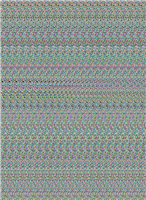
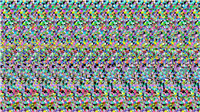
Subotzky writes: ‘ ‘Show ‘n Tell’ builds on the concerns of my previous body of work, Retinal Shift. I’m interested in situations where two opposing things can both be true, or at least coexist. And I’m interested in the psychology of this, the psychological need to split those things off from one another,” Subotzky explained in an interview with Valérie Labayle of Musée MAC/VAL. 'In Show ‘n Tell this plays out largely in the relationship between abstraction and representation. Of course, artists have been interested in optical illusions almost for as long as artworks have been made. My interest in this is specif¬ic to my experience. Autostereograms were a popular craze of the 1990s when I was a kid. So on the one hand they are a historical illustration of my early visual experiences of duality. But they are also interesting in relation to vision. The 3-D image that one ‘sees’ in the autostereogram doesn’t exist on our retinas. It is created entirely in our brains as a result of a repeated pattern, which takes advantage of our binocular vision in order to trick the brain into seeing three-dimensional form. Part of trying to understand how two opposing things can both be true is necessarily about the nature of truth itself, and thus about perception, memory and ontology too. This is why the imagery in ‘Show ‘n Tell’, both abstract and representational, draws from a wide range of scientific and mythological sources – two realms where truth and the nature of reality are thought about and contested.’
16 August 2014 - 13 September 2014
'Structures'
David Goldblatt, Carlos Garaicoa, Jeremy Wafer, Oliver Chanarin and Adam Broomberg and Mikhael Subotzky at Goodman GalleryGoodman Gallery Cape Town presents 'Structures', a group exhibition bringing together works by Adam Broomberg and Oliver Chanarin, Carlos Garaicoa, David Goldblatt, Mikhael Subotzky and Jeremy Wafer. The exhibition is concerned with structures both monumental and mundane, and aims to examine the ways in which they inform the environments we inhabit, and what they suggest about the underlying systems that give rise to them.
David Goldblatt's series 'South Africa: The Structure of Things Then' deals in part with the architectural landscape of Apartheid South Africa and the relationship between the governing ideology of the time and its physical manifestations across the country. Mikhael Subotzky's ongoing 'Security' series is in some ways a contemporary response, documenting the surveillance cameras, security huts and electrified fences of the modern suburban landscape, and examining the links between poverty, race, crime and the effects of a legacy of discriminatory spatial planning.
Bertolt Brecht's 'War Primer' is a book of what Brecht called 'photo-epigrams': newspaper and magazine clippings of images of the Second World War, each captioned with a 4-line poem. In 'Poor Monuments', Adam Broomberg and Oliver Chanarin juxtapose pages from Brecht's original book with images of modern conflicts (in particular the so-called War on Terror) to look at the changing (and sometimes unchanging) narrative of war, and the systems responsible for crafting and disseminating it.
Cuban-born Carlos Garacioa's 'Para transformer la palabra polv?tica en hechos, finalmente II' (To transform political speech into facts, finally) takes as its subject the city as a site for collective memory and imagination, while a new floor sculpture by Jeremy Wafer contemplates abstract and physical notions of space, and the degree to which a space is produced by the structures it contains.
04 May 2013 - 01 June 2013
'Retinal Shift'
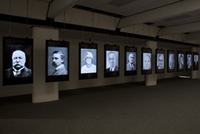
Mikhael Subotzky at Iziko South African National GalleryMikhael Subotzky's Standard Bank Young Artist 2012 exhibition 'Retinal Shift' investigates the practice and mechanics of looking – in relation to the history of Grahamstown, the history of photographic devices, and Subotzky’s own history as an artist. The works in the show draw on archival portraits from the last century, found surveillance footage, and Subotzky’s own photographs from various series’ that are re-contextualised.
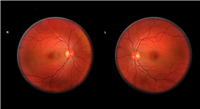
The opening work on the show is a self-portrait that Subotzky made with the assistance of an optometrist. High-resolution images of his left and right retinas are placed side by side. “I was fascinated by this encounter. At the moment that my retinas, my essential organs of seeing, were photographed, I was blinded by the apparatus that made the images. So it is a self-portrait of myself, the photographer, at a moment that I could not see.”
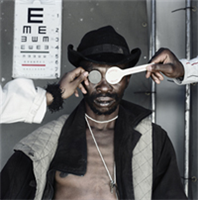
'Retinal Shift' extends this motif of looking while not seeing – exploring it through Grahamstown’s history, our contemporary surveillance society, and the artist’s personal attempts to see.
Subotzky’s photographic work combines the directness of the social documentary mode with a questioning of the nature of the photographic medium itself. He is concerned with the structures of narrative and representation, as well as the relationship between social storytelling and the formal poetics of image making.
28 November 2012 - 09 January 2013