gauteng reviews
'Two Projects'
Mikhael Subotzky at Goodman Gallery
By Anthea Buys29 October - 21 November. 0 Comment(s)
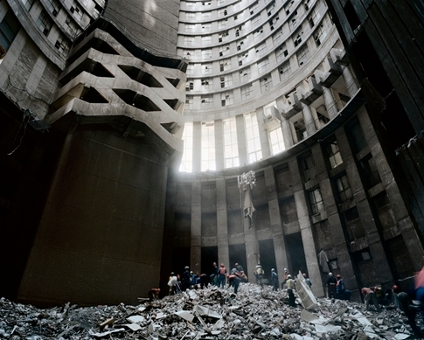
Mikhael Subotzky and Patrick Waterhouse
Cleaning the Core, Ponte City, Johannesburg,
2008.
c-print mounted on dibond
.
Few buildings in Johannesburg, when seen from a distance, give one the feeling of being in Johannesburg quite like Ponte City does. Crowned with Vodacom’s flashing green and blue neon and sprouting from a rocky slope on the southern side of the Witwatersrand Ridge, it is visible from almost anywhere in the city. It is a landmark which from far directs one home, and from close warns one to stay away from Johannesburg’s most notorious neighbourhood: Hillbrow.
But Ponte is not only an icon of the city; since it was built in 1975 it has been the receptacle for so many Johannesburg dreams. Full wallets, success, urban sophistication, cosmopolitanism, and even love, have wafted through the building’s gaping core like spectres, luring tenants there for years.
In this light, it is easy to see why Ponte, particularly after its deterioration into a slum, has attracted the gaze of artists. In 1999 Stephen Hobbs dropped a digital video camera attached to a parachute down Ponte’s core for a video work titled 54 Stories. This work simulated one of the many suicides that took place in Ponte in the 1990s. In 2005, Guy Tillim painted a gloomy, de-saturated picture of Ponte in his photographic series ‘Joburg’, a project that now sits in book form on many a northern-suburbs coffee table.
art events calendar
VIEW FULL CALENDAR
buy art prints
edition of 60: R4,000.00
About Editions for ArtThrob
Outstanding prints by top South African artists. Your chance to purchase SA art at affordable prices.
FIND OUT MORE Editions for artthrob
Mikhael Subotzky, newly a Johannesburg resident, has begun his work in the city with an intensive photo-documentary of Ponte, or rather, the persistence of Ponte’s mythologies. This already-sprawling body of work was shown at the Goodman Gallery in Parkwood for the month of November in anticipation of a book project on Ponte scheduled for publication in 2010. This show, and another that looks at security suburban mythologies installed at the Goodman’s Arts on Main Project Space, constitute an exhibition across two venues, simply titled ‘Two Projects’.
Subotzky’s explorations of Ponte, together with fellow photographer Patrick Waterhouse, are represented in the Parkwood space by large-scale high-quality photographic prints, which consume the walls in the central atrium of the gallery. The subjects of these photographs range from portraits of Ponte residents shot in a lift to atmospheric scenes of the mountains of rubble accumulated at the bottom of the core. Occasionally we are also privy to Subotzky’s view of an apartment interior, a move which - since Guy Tillim’s ‘Joburg’ - unfortunately feels very Guy Tillim rather than very Joburg.
These photographs, for the most part, are beautifully composed, executed and finished. Here I think especially of an image called Cleaning the Core, which shows the magnificent scale of the building in relation to its human inhabitants. In this wide-angle shot, a group of cleaning staff stands atop the mounds of detritus left over inside the building from the multiple attempts over the years to redevelop it and restore it to its original grandeur. Another, Ponte City from Yeoville Ridge, shows, with the sweeping breadth of David Goldblatt’s most recent colour photography, Ponte looming in the background of a religious ceremony on Yeoville Ridge.
What is not well-established in these photographs, however, is the importance of narrative - and particularly the possibility of fictional narrative - that comes to the fore in two book-dummies on the periphery of the gallery. These flank the main display on either side in a trailing concertina of double page spreads, and collate Subotzky and Waterhouse’s own photographs with found images, personal letters, advertising material and digital renderings of Ponte after its most recent attempted development in 2007 (which terminated later that year). These sprawling archives suggest that Ponte is a place where grim reality, aspiration, escapism and lies intermingle and stories abound.
The story of Subotzky’s project unfurls between the text and images displayed in juxtaposition. By the time I had perused each train of pages adequately, I had the sense that Subotzky was onto an interesting project – an ambitious work that sought to tackle the relationship between reality and unreality in Johannesburg in a resolutely complex way. But stepping back out of the bookscape and looking again at the large-scale images, it became unclear which was meant as a footnote to the other.
Obviously, Subotzky’s association with a major commercial gallery dictates that primacy is given to individual images: they have to be big and beautiful and expensive. This sacrifices somewhat both the meat of the exhibition as well as the artist’s freedom to deliberate over curatorial decisions and indulge in the process of building and gleaning from an extensive visual and narrative archive. What stands out in the Parkwood leg of ‘Two Projects’, more so than the contested character of Ponte, is the uncertainty, or maybe even the vulnerability, of the artist’s own voice.