
Current Review(s)
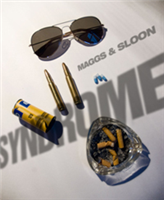
Syndrome
Robert Sloon and Charles Maggs at Whatiftheworld / Gallery
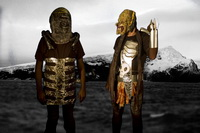
Robert Sloon and Charles Maggs are clearly not well. In ‘Syndrome’, the pair’s two man show at Whatiftheworld, Sloon is alternately possessed by the spirits of dead authors, transfigured into a hovering bloodied zombie and convinced that “the Illuminati must be destroyed”. Maggs is not much better off; raving incoherently in ‘Ram’, and threatening benign landscapes with psychotic urges elsewhere.
What then, is this strange ‘Syndrome’ troubling the two artists?
In a catalogue essay for Maggs, critic and theorist Bettina Malcomess poses as his shrink, attempting to understand his neuroses. ‘He was generally fine,’ writes Malcomess the therapist, ‘and could operate more or less normally on a day to day basis. He had a job, a wife, two children, and functioned in his various roles as father, son and professional. He explained that in spite of this, a series of coincidences had led to him beginning to question whether he was in fact himself, or rather another character called Ron Beck.’ Later, in a note to his therapist, Maggs claims; ‘The twin towers were not destroyed by terrorists. They imploded themselves. It was suicide.’ (Malcolmess 2009: online). And here we have a clue: this reading of the collapse of the twin towers as suicide is a reference to Baudrillard’s ‘The Spirit of Terror’, a seminal work which positions terror as something of a zeitgeist of our times, a condition which lies dormant in all of us, ‘ready to activate itself anywhere like a double agent.’ (Baudrillard 2003:10). Is this perhaps the syndrome bothering our artists?
In Maggs case, the panicked ‘double agent’ is personified in Ron T Beck, a paranoid, secretive individual, whom Maggs has been animating for some time on social networking sites, Facebook and Twitter.
01 July 2009 - 25 July 2009
Listings(s)
Syndrome
Robert Sloon and Charles Maggs at Whatiftheworld / GalleryA syndrome is a pattern of several recognizable features, signs, symptoms, phenomena or characteristics that often occur together, so that the presence of one feature suggests the presence of the others.
The title points to a nexus of related concerns for both Maggs and Sloon: conspiracism, terror, the projection of identity, iconography of power and acceleration manifest in popular, media and Internet culture. Rather than being a mere reflection of these concerns, Syndrome is instead fueled by their materialisations in everyday life, in history and in media narratives.
While there exists a commonality of concerns, both Maggs and Sloon employ different strategies, means and modes of production. The bodies of work are connected by the dialogues they suggest more than they are by their relative aspects.
01 July 2009 - 25 July 2009