cape reviews
Syndrome
Robert Sloon and Charles Maggs at Whatiftheworld / Gallery
By Katharine Jacobs01 July - 25 July. 0 Comment(s)

Robert Sloon
Syndrome 1st July at Whatiftheworld,
2009.
Invite
.
Robert Sloon and Charles Maggs are clearly not well. In ‘Syndrome’, the pair’s two man show at Whatiftheworld, Sloon is alternately possessed by the spirits of dead authors, transfigured into a hovering bloodied zombie and convinced that “the Illuminati must be destroyed”. Maggs is not much better off; raving incoherently in ‘Ram’, and threatening benign landscapes with psychotic urges elsewhere.
What then, is this strange ‘Syndrome’ troubling the two artists?
In a catalogue essay for Maggs, critic and theorist Bettina Malcomess poses as his shrink, attempting to understand his neuroses. ‘He was generally fine,’ writes Malcomess the therapist, ‘and could operate more or less normally on a day to day basis. He had a job, a wife, two children, and functioned in his various roles as father, son and professional. He explained that in spite of this, a series of coincidences had led to him beginning to question whether he was in fact himself, or rather another character called Ron Beck.’ Later, in a note to his therapist, Maggs claims; ‘The twin towers were not destroyed by terrorists. They imploded themselves. It was suicide.’ (Malcolmess 2009: online). And here we have a clue: this reading of the collapse of the twin towers as suicide is a reference to Baudrillard’s ‘The Spirit of Terror’, a seminal work which positions terror as something of a zeitgeist of our times, a condition which lies dormant in all of us, ‘ready to activate itself anywhere like a double agent.’ (Baudrillard 2003:10). Is this perhaps the syndrome bothering our artists?
In Maggs case, the panicked ‘double agent’ is personified in Ron T Beck, a paranoid, secretive individual, whom Maggs has been animating for some time on social networking sites, Facebook and Twitter.
art events calendar
VIEW FULL CALENDAR
buy art prints
edition of 60: R7,000.00
About Editions for ArtThrob
Outstanding prints by top South African artists. Your chance to purchase SA art at affordable prices.
FIND OUT MORE Editions for artthrob
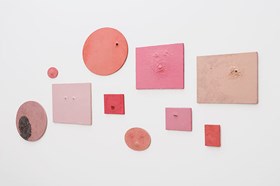
Beck’s neuroses are made visible in Ron T Beck Forensic Board (2008), a work in which a selection of mundane photographs of aeroplane meals, dogs and landscapes, have been linked to more suspicious ones with red string and pins, in a web of associations of the kind one stumbles upon when surfing the internet for too long. Reminiscent of the walls of Jerry Fletcher’s flat in ‘Conspiracy Theory’, or the shed of the brilliant, and schizophrenic, John Forbes Nash in ‘A Beautiful Mind’; the connections, though sometimes clever, and humorous, ultimately point to a deeply paranoid, disturbed individual.
Elsewhere, this sense of paranoia is undermined. The video Ram (2009), captures an incensed Maggs hectoring the viewer in a harsh, guttural dialect, which suggests a threatening, even dangerous character. In fact, Maggs is merely reciting ‘Mary had a little lamb’, the benign child’s lullaby transformed into the generic language of a spy-film villain by technological trickery. On discovering this, (which you won’t, unless you ask) one cannot help but feel a little guilty for pre-judging the man as villain, fearing him because of his accent.
This, perhaps, is the crux of the matter. We are none of us innocent, but are all caught up in the web of paranoia, prejudice and brutality which drives the terror machine. In Guard #1, Inmate #1 and Inmates #2-4, this is made all the more apparent, the artist’s own face literally merging with the faces of a guard and detainees from Abu Ghraib and Guantanamo Bay. Noting the pointed curly black beard, the sweaty, nervous looking face, and the orange inmate’s t-shirt, one cannot help but feel guilty, complicit in the cycle of prejudging and paranoia which gives rise to both terrorism and the torture of prisoners.
Sloon of course, is the double agent. The other half of artist and critic Chad Rossouw, Sloon is the editor of blog ArtHeat.net, a role, which, when founded in 2006, required a certain amount of anonymity to allow for journalistic freedom. Perhaps, as a result of this secretiveness, there is a sense of loneliness and mournfulness about the alter-ego, appropriate to one who must work tirelessly and anonymously, never receiving acknowledgement for their work.
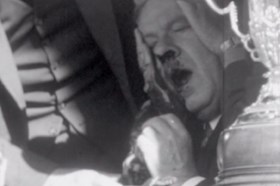
In You Only Live Twice (2008), and In a Glass, Very Darkly (2009), the ArtHeat editor identifies his plight with that of fictional spy, James Bond, who, in order to carry out his job, must reveal his true identity to no one, and functions always as a lone agent. For Bond, this means drinking vast amounts of alcohol, alone. In You Only Live Twice, Sloon claims to match Bond’s fictional ingestion of ‘35 flasks of sake, half a bottle of pink champagne, a pint of Jack Daniels and 8 double brandy and ginger ales’.
Whether Sloon actually achieved such a feat without needing his stomach pumped seems unlikely, and a photograph documenting the performance hardly proves anything. But this, perhaps, is the point. One of the reasons for our collective anxiety, after all, is the profusion of untrustworthy images available in the media and online, which mean we must be constantly alert, looking for disaster.
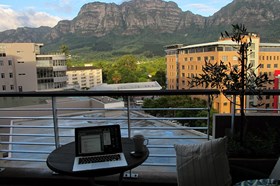
Sloon, certainly, displays symptoms of paranoia. In Watching the Detectives (2009), a suspicious Sloon is photographed in a scruffy office, spying on the street below through a chink in his blinds. Elsewhere he is photographed as a lone paranoid protester, cutting a pathetic figure outside the houses of Parliament in the rain and the dark, waving a rather abject little cardboard sign, warning the public that ‘The Illuminati Must Be Destroyed’.
Although this paranoia, and secretiveness may keep Sloon safe, (both from the Illuminati, and irate artists unhappy with his reviews of their work) it could also account for the sense of mournfulness which follows the character like a shadow. Paul Virilio - another theorist who labelled the 21st century one characterised by panic - suggests that as we ‘strive to expect the unexpected’ our anxiety, fear and terror also give rise to a ‘collective anguish’, and a ‘depression’ (2005: 4).
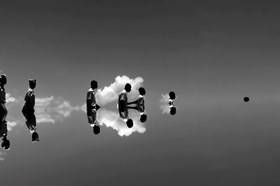
Whilst Maggs’s work retains some of the seriousness of the subject matter, Sloon attempts to combat this depression with laughter. Posing as a hovering, bloodied zombie in Unloved, Undead (2009), and dressing up as ‘predator’ for a cringing rendition of the Smiths ‘Ask’, with an equally ridiculously attired ‘alien’ Andrew Lamprecht in Whoever Wins, We Lose (2009), Sloon pokes fun at our outlandish conspiracy theories and paranoias.
Whilst this can all get a little silly at times, the laughter ultimately serves a purpose. As we all know from the advice given to those with a fear of public speaking, laughter is a great antidote to fear. And, in a century which has thrown up such horrifyingly contradictory phrases as ‘War on Terror’, tinfoil alien outfits and Darth Vader analogies are perhaps a refreshing antidote to this syndrome.
Images courtesy Whatiftheworld gallery and the artists.
References:
Baudrillard, J & Turner, C 2003. The Spirit of Terror. London, New York: Verso
Camus, A. 2005. Camus at Combat. Princeton: Princeton University Press
Malcolmess, B. 2009. A patient analysis: The case history of Patient M of Ron T. Cape Town: Whatiftheworld
Virilio, P. 2005. Art as Far as the Eye can See. Oxford: Berg