cape listings
Keren Cytter
The Hottest Day of the Year,
2010.
Digital video, colour, sound
Duration 12 min 55 sec.
The Hottest Day of the Year
Keren Cytter at STEVENSON in Cape Town
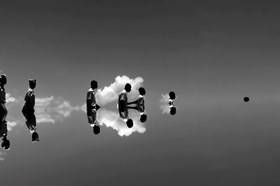
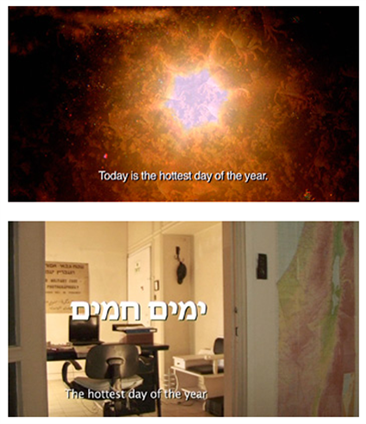
Keren Cytter's video The Hottest Day of the Year is part of the FOREX series. Filmed partly in South Africa, the film uses the tradition of the romantic anthropological documentary to make an argument about the present.
The first part of Cytter's 'documentary' tells the story of the imaginary Anne-Marie Baptist, born in 1917 in France. This section follows a logical narrative recounting Baptist's escape to Paris during World War II and subsequent travel to South Africa to find the mythical location of a Khoi and San battle. After approximately 10 minutes the second part of the film begins, shifting to another narrator and set of circumstances set in the Israeli Defence Force. The second chapter is connected to the first one by association. The mythical location Anne-Marie Baptist searched for in Africa was cursed a long time ago: at this place, all actions lose their meaning.
Cytter was inspired by Chris Marker's monumental film Sans Soleil (1983) as well as the work of Vietnamese theoretician and filmmaker Trinh T Minh-ha. In their documentaries and travel reports, both directors are concerned with colonialism.
08 September - 15 October
also showing
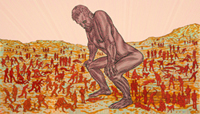
Conrad Botes
Origin,
2011;
Acrylic on canvas
© Copyright 2011, STEVENSON. All rights reserved
'The Temptation to Exist'
Conrad Botes
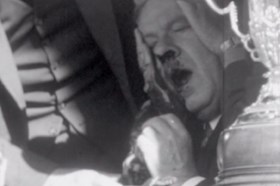
For the first time in many years Conrad Botes returns to painting on canvas in this exhibition along with his distinctive reverse-glass paintings. The new body of work began with a series of self-portraits; as the artist humorously says, it is easiest to be one's own model. In these head-and-shoulders images, Botes overlays the image of his face with his characteristic scrawl of anarchic figures running amok. Rather than tattoos, he describes these figures as representations of the ideology and hatred that inevitably contaminate the human condition.
The title of the exhibition, The Temptation to Exist - a reference to the Romanian philosopher EM Cioran's collection of essays of the same name - is seen by Botes to suggest the possibility of a life unbounded by the constraints of Calvinistic values, and paradoxically also to question our very desire to exist in the world as we know it.
'Side Gallery Installation'
Igshaan Adams
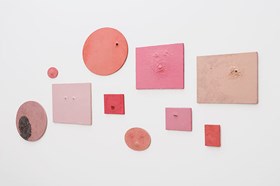
Igshaan Adams presents an installation in the Stevenson side gallery:
Adams writes:
It is my intention to create a holy space by covering the floor with Islamic prayer mats, stitched together in a quilted fashion, all facing the direction of Mecca. To create a sense of comfort I will add a layer of thick blankets underneath, a practice employed by local Muslims when making Thik'r (the chanting of the holy names of God and Quranic verses in unison, usually performed on Thursday evenings).
During Islamic prayer, worshippers prostrate on the ground in humility before God. The only requirement in Islam, besides the body being cleansed, is that prayer be performed in an area that is clean. Traditionally the prayer mat has become a means of ensuring the cleanliness of the place of prayer and to create an isolated space to concentrate in prayer.
The rug designs are often geometric, floral, arabesque, or depict Islamic landmarks such as the Ka'aba in Mecca or Al-Aqsa Mosque in Jerusalem. The image of a large snake cut into and stitched across the floor-covering/garden will serve as an antagonist in this sacred environment.