‘Khumbula Ekhaya’
Bambo Sibiya at Gallery2As a student, Bambo’s work mainly dealt with issues regarding households with single parent mothers.
It is common practise for men to leave their homes in the rural areas, to seek employment on the mines.This left many households with an absent father, leaving the mothers and other women of the family to raise the children.
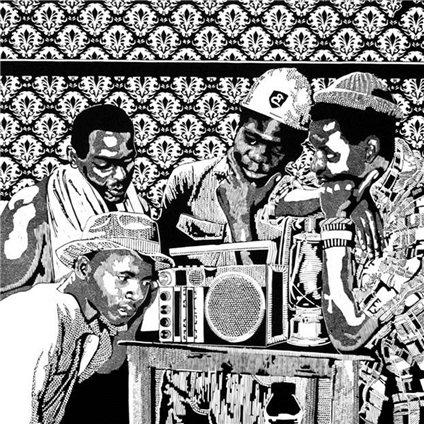
In his current work, Bambo’s focus has shifted to the culture and lifestyle that developed around the mining communities, encompassing dance, music, fashion and language.
Pubs and bars were reserved for whites during the Rhodesian and apartheid era and consequently gave rise to the advent of the home-shebeen. Mostly located in the black townships, the shebeens were originally operated illegally. Selling homebrewed and home-distilled alcohol, they provided patrons with a place to meet and discuss political and social issues.
Music and dance played very important roles in the early days of the miners. 'Isicathamiya' embodies the Rhythm of Resistance against apartheid, although not all black South African performance portrays resistance against white domination.
Gumboot dancing emerged in the 1880s among the Bhaca migrant workers, travelling between KwaZulu Natal and the gold mines in Johannesburg. The dancing commonly took place in the compounds where miners lived. Dance served as both relief from stressful, dangerous work, but also as a satirical commentary on the relationship with their overseers. Mining teams typically had a ‘boss-boy’, who served as the leader and functioned as an intermediary between the black workers and the white bosses. The leader of a Gumboot dance team mimics the boss-boy and satirizes the symbols of his control, e.g. the police whistle and the shouted commands. Many of the commands used in the mines are in a pidgin language called Fanakalo, which mining companies encouraged and standardized as a lingua franca. Black South Africans typically regard it as a defilement of Xhosa and Zulu and a language of subservience. The tensions of mine labor and racist social relations embodied in the commands, inform the performance and reception of Gumboot dancing.
The miners were often conflicted by the sense of pride in the courage necessary to work in the mines on the one hand, but by the constant fear for their lives on the other. They resented the mines that separated them from their families, but simultaneously depended on them to provide for their families. This also found expression in their dances.
The exhibition is titled ‘Khumbula Ekhaya’, which can be interpreted as ‘I’m homesick, I’m longing to go back home and I’m missing home’.
02 March - 28 March