'Kgoro ya go tŠwa: even ?if you fall from a circle'
Dineo Seshee Bopape at STEVENSON in Cape Town
Stevenson present a solo show by Dineo Seshee Bopape. In the artist's words - (an extract)
Even if you fall off a circle
The exit- kgoro ya go tswa.... I first heard this term recently, I read it off a board at the joburg botanical gardens, it is so formal.... kgoro is like a court.... so the meaning would be - or
the direct translation into English would be : the court for exiting...
Even if you fall off a circle-
Featuring the works
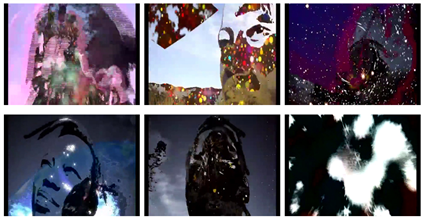
:"why do you call me when you know I can't answer the phone" and "is I am sky" and other pieces, contemplating the idea-
the titles, of the show and of some of the works in the show are sourced/inspired by various sources...
a line from a poem by sun ra, a line from a text by andile mngxitama and a song by joan armatrading
It is not so much the song that gripped me, but that line- that line for some reason stuck in my head- resonating with particular moments in some of my current and older videos - where phones ring/a phone rings constantly without an answer, door bells, alarm clocks, bells etc.
.... like an invitation/ an unsettled proposal
an invitation that cannot be accepted: an invitation signalling a suspension of this (segment)
a call that goes unanswered...
(Who has to answer it? The protagonists in the video? Is it there to be answered or is it part of the cacophony)
The protagonists if any are oblivious to it
Oblivious to the oblivion
People always go crazy when there is an external something that begs for too much attention, but if it remains unanswered/if it is unacknowledged it also signals an agitated/numbed mind or emotional state:
06 June - 20 July
'La Monde en Miniature'
Meschac Gaba
Stevenson announces Gaba's third solo show at the gallery, comprising works that he made for the recent Benin Biennale as well an installation titled 'La Monde en Miniature'.
'La Monde en Miniature' takes the form of a shop of babies' and children's clothes, made in Cotonou, Benin, and displayed on painted dummies, also from Contonou. At first glance, the installation appears childlike and sweet, yet a closer look reveals that the embroidered texts on the colourful clothes are violent, disturbing and disconcerting words and phrases, a reminder of children's vulnerability to certain phenomena in our society. The context of a shop-like space is a thread that runs through Gaba's work, in which he repeatedly explores issues of cultural exchange and value.
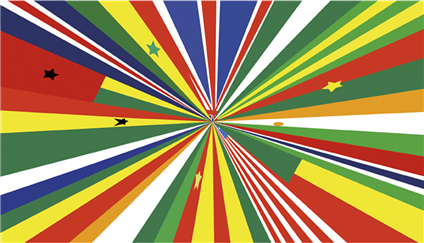
The works on the Benin Biennale evolved out of a huge composite flag that Gaba made for a recent survey exhibition of art from West Africa held in Manchester. As the artist explains, he fused all African flags together as a symbol of unity, solidarity and friendship, elongating each flag into a narrow triangle converging on a central point. The resulting optical spectacle inspired him to create a world flag fusing all countries' flags, and again symbolic of a togetherness that could resolve the crises that proliferate across our world. For Gaba, the singularity of each flag is lost in the rhythm of the composition, as is the case with countries in the age of globalisation where the national is absorbed in the international. The idealism and humour of these two huge flags characterise Gaba's desire for his art to infuse a playfulness in our perceptions of the world which would, in turn, make the world a better place for us all.
The Cape Town exhibition also includes a floor installation entitled 'Voyage'. Here Gaba wraps flags around bundles of old clothes; each is tied to a wooden cane and laid out on the wooden pallets he often uses in his installations. The flags, some of which are made by women dress-makers from Cotonou, are all from countries and confederations that have worldwide influence: the European Union, USA, African Union, Vatican, NATO, Russia, China, Union Jack, United Nations, Arabic League, Israel, Brazil and Tibet.
Gaba will also exhibit elements of his 'Moving Library (Bibliothèque Roulante)' which he conceived for Cotonou at the time of the recent biennale, coinciding with the opening of his MAVA Library, the first contemporary art library in West Africa. MAVA, short for 'Musèe de l'Art de la Vie Active', and which in Benin's Mina language means 'Come on!', has as its principal goal the promotion of contemporary art and art education in Benin. The project was initiated in December 2010 as a performance and exhibition across Cotonou when Gaba declared the entire city the Musèe de l'Art de la Vie Active. For his 'Moving Library', he asked curators, critics and artists across the world for short quotations and phrases about contemporary art, in English or French, to be presented on the license plates of motorbike taxi drivers in Cotonou, replacing their registration numbers. The taxis drove around with these quotations during the whole period of the Benin Biennale, with the idea of making the city of Cotonou participate in contemporary art through discussions between the taxi drivers and their passengers about the project and the biennale. Here, these 'quotation plates' form part of a new installation.