gauteng reviews
'City and Suburban'
Karin Preller at Standard Bank Gallery
By Murray Kruger04 May - 19 June. 0 Comment(s)
Karin Preller
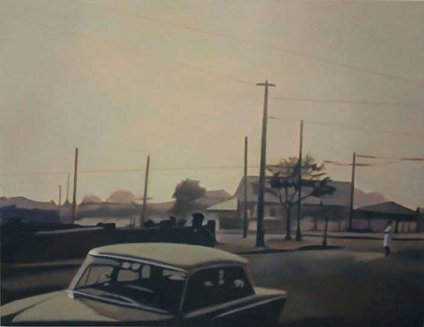
Brixton 1,
2010.
oil on canvas
.
Karin Preller’s ‘City and Suburban', an exhibition of new paintings and a film projection, occupied the downstairs section of the Standard Bank Gallery concurrently to Nicholas Hlobo’s headline show ‘Umtshotsho’, a body of work made after he won the Standard Bank Young Artist of the Year Award in 2009. Preller and Hlobo share an interest in representing identity, but Preller’s view is far more detached than Hlobo’s. For her, ‘identity’ is elusive, inseparable from memory, and located somewhere between the public and private geographies of Johannesburg in the 1960s and 1970s. The locations around which she centers her enquiry are the city and suburban settings that are recorded in her personal pictorial archive, and she explores the potential of the medium of oil on canvas to complicate notions of memory and history within these locations.
art events calendar
VIEW FULL CALENDAR
buy art prints

edition of 60: R7,500.00
About Editions for ArtThrob
Outstanding prints by top South African artists. Your chance to purchase SA art at affordable prices.
FIND OUT MORE Editions for artthrob
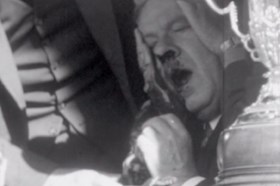
Admittedly, when I visited the exhibition for the first time, I walked right past the projection set up in one of the glass vitrines that flanked the entranceway to the exhibition space. This projection seemed to recede alongside the striking paintings that dominate the exhibition. In hindsight, it is important to consider that the projection played footage that Preller’s father had filmed during her childhood. She would ultimately sample imagery from this resource for the creation of the smooth surfaces and muted colour palettes of the oil paintings on show.
The first painting I encountered in the room, Brixton (early morning) 3, was intriguing in its creamy, seductive depiction of a banal street scene – a pale blue car parked outside a suburban dwelling – but it was the formal qualities of the painting that caught my attention most strongly. Preller wields her brush as if it were the spray nozzle of an airbrush. She minimizes her autographic mark in order to suggest that her own mediation of the content she acquires from her source images is reduced. The presence of the projection in the exhibition is a reminder of the fact that the viewer is twice removed from the original experience depicted in her paintings. Her subject matter has been transformed from an image on film into an image on canvas. In yet another step of exchange, the viewer interprets the painted interpretation of the filmic image. This remove echoes the temporal distance implied in the painted scenes. There were moments in which I caught myself pausing over the uniform tone of an expanse of colour, a muted turquoise that seems to come from another time, one that I have not experienced first hand. By eliminating all delineating line in her paintings, Preller seems to age her paintings. They look as if they are coated in dusty brown haze and seem to offer a view through a neglected window that one often looks at ,but rarely through.
The template of this first painting is continued throughout the exhibition. All the paintings maintain the same square format, just large enough to remove any sense of intimacy with the viewer, but not large enough to be overwhelming. The four walls of the exhibition space are used as narrative planes or storyboards, each presenting the viewer with a sequence of three to four paintings that form a narrative. These narratives, in their painted form, provided a more focused look at a selection of moments in the accompanying film projection.
In the second set of paintings, a dark car is parked in the road and centrally within the composition. The interior is concealed by a heavy shadow. Who is the passenger waiting in the back seat? Where did the shadowy figure that appeared in the first frame disappear to in the second or third canvas? The power lines in the background become the only source of certainty within the series, precariously connecting Brixton 5, Brixton 6, and Brixton 7.
Next, four panels show three male figures, all dressed in dark suits, narrow ties and white shirts. They are positioned between two cars, one of which could very well be from the previous sequence. They are engaged in conversation, gesturing and laughing in one panel, while in another the central figure seems to be looking over in the viewer’s direction. Their location is disclosed in the title of the series, Queen Elizabeth Bridge (1, 2, 3 and 4). One can just make out this central Johannesburg bridge in the background beyond the sea of parked cars.
Brixton 2 and 4 picture the same three figures from the Queen Elizabeth Bridge series moving hastily across a suburban lawn to the black car featured in the previous two sequences. There is an ominous sense of purpose that pervades their movement. Their departure is swift; a final encounter that passes me by.
Preller notes that ‘the paintings chronicle ordinary lived moments of individuals, paused and rewound’. This captures eloquently the viewer’s process of discovering and re-discovering elements whilst moving back and forth within the exhibition, trying in vain to solve the sets of visual clues within the banal narratives she has put before the viewer. There is a sense of irony that underscores the deceptively explicit identities of the characters that populate her narratives. It is behind those generic sunglasses and suits that they hide their individuality from the viewer, who is forced continuously to probe the images.
Karin Preller’s paintings in ‘City and Suburban’ mask themselves as something other than what one expects to find when approaching them. One is forced to look more attentively at their textureless surfaces just in case they might dissolve under your gaze to reveal something unexpected. Robyn Sassen noted this before in a review of Preller’s paintings: 'It is like other people's dreams, or love letters, replete with connotative associations and nostalgic keys that have scant meaning to an outsider.' This is a crucial component of Preller's production to take into consideration. Preller seems to be encouraging those who feel distanced by her work to look for reassurance in embracing what it withholds. This deliberately elusive reconstruction of meaning is analogous to the work of memory, which can be both distinctive and elusive. That said, I was left with a set of ambivalences and ambiguities which I think Preller did not intend to convey to the viewer. Her formal process of reconfiguring personal archival material into distinctive painted surfaces was not enough of a reward for the exertion it took to engage with the exhibition. Despite this reservation, there is something about the nostalgic veneer of her paintings that has the potential to be truly affective and even unsettling.