international reviews
Ampersand A Dialogue between Contemporary Art from South Africa and the Daimler Art Collection
Various Artists at Daimler Contemporary
By Clare Butcher10 June - 10 October. 0 Comment(s)
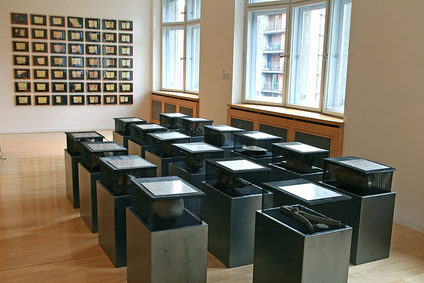
Various Artists
Installation view with Willem Boshoff's 'Blind Alphabet' and Sue Williamson's 'For Thirty Years Next to his Heart',
.
Boshoff: Wood, steel, aluminium; Williamson: Colour laser prints
.
I am constantly amazed by the TV generation’s ability to speak across borders and across backgrounds of growing up (in vastly different contexts and at different speeds) alongside the A-Team, The Bold and the Beautiful and Patrick Swayze.
These pseudo-collective experiences, within what Dutch art historian Camile van Winkel calls a ‘regime of visibility’, have become markers of contemporaneity. This is particularly evident in societies catching up with broadcasting protocols, joining global flows of visual culture and participating in the politics of presenting/producing ‘reality’.
The ‘Ampersand’ group show at the Daimler Art Collection, Berlin, attempts a show-and-tell of this TV generation: tuning in and out, changing channels between one bureaucratic, political, visual reality and another, and finding flickers of sameness and difference in what they call ‘the contemporary’.
art events calendar
VIEW FULL CALENDAR
buy art prints

edition of 60: R11,000.00
About Editions for ArtThrob
Outstanding prints by top South African artists. Your chance to purchase SA art at affordable prices.
FIND OUT MORE Editions for artthrob

Framed by the 2010 FIFA World Cup, ‘Ampersand’ features what Renate Wiehager, writing in the show’s refreshingly substantial catalogue, calls a ‘friendly match’ between recent South African and non-South African acquisitions in the Daimler Collection and additional works from a number of partners such as Goodman Gallery and the Gordon Schachat Collection. This departure from the collection seeks to fill certain visible and non-visible gaps in the Daimler collection.
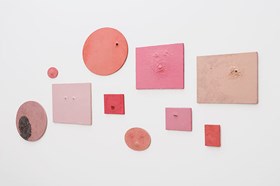
The more ‘ocular’ statements of a younger generation reflect on a global economy of highly visual and visible culture. These range from Dineo Seshee Bopape’s Bird’s Milk (2009), to Polish artist Alicja Kwade’s vanitas-inspired Watch (2009) works. Bopape’s somewhat overwhelming piece draws on various associations from the Turkish term ‘uskada’ which inspired the work’s title, to Eartha Kitt’s song of love and loss by the same name; in Kwade’s series each work has the time concealed by a curved mirror in the style of atomic clocks. Both hanging silently and timeless in the gallery space, the clocks warp and throw the image of the viewer and the surrounding works back.
In contrast to these works are those balancing a tension between concealment and revelation, by artists whom Wiehager designates as ‘pioneers’. Sue Williamson’s hallmark passbook homage, For Thirty Years Next to His Heart (1990) is presented alongside Willem Boshoff’s Blind Alphabet (begun in 1990, ongoing). This combination tethers the notion of sightedness with privilege, drawing out an untouchable, unseeable critique on the contexts of, as Boshoff puts it, ‘vision [and] visionlessness’.
The execution of the Daimler exhibition by Wiehager and Christian Ganzenberg is in keeping with their chosen title: an old English contraction of the phrase ‘and per se and’, which used to be uttered before any letter used in its own right, such as ‘I’ or ‘A’. When the alphabet was recited it would always end with ‘X, Y, Z, &’. The Afrikaans meaning for the word ‘amper sand’ is not so tangential: almost sand. Inherently conditional, both definitions of the term challenge the seeming ubiquity of a thing like the alphabet, or the ‘regime of visibility’, making the point that there is always room for another perspective, for substantiation, for the premise which emerges when one visual statement is put next to another. The acts of showing, qualifying and juxtaposing are key in the multiple realities brought together within ‘Ampersand’ and the acknowledgement that, like grains of sand, each visual encounter in the exhibition is shaped and added to by an innumerable set of factors.
Mikhael Subotzky, collaborating with Patrick Waterhouse, contemplates the structures of external, mediated and internal lives inhabiting Johannesburg’s Ponte Tower in the photographic/architectural installation Ponte City (2008). Displayed in a panoptic style reminiscent of the internal view afforded by the iconic building’s spatial arrangement, a circular wooden frame supports a visual archive of photographic, bureaucratic and narrative material, arranged in concertina format. While the revisiting of Ponte Tower after Guy Tillim’s Jo’burg exegesis from 2004 seems a surprising subject for Subotzky, the intimate sobriety of the latter’s ongoing project is in keeping with his rigorous observational engagements in 'Die Vier Hoeke and Umjiegwana' and 'Beaufort West'.
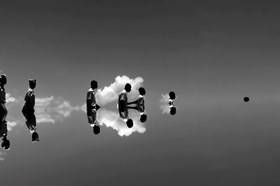
Further blurring the lines between the panoramic view (upon which the documentary genre tentatively balances) and specific, personal perspective is Robin Rhode’s photographic performance Pan’s Opticon Studies (2009). Here the artist pits himself against the very traditions Subotzky touches on; of top-down spatial control and politically motivated pseudo-science. Shadowed, reflected and invisible in black and white against a number of surfaces, Rhode’s doppelg änger and he are separated only by measuring instruments – an architect’s compass, a scientist’s pair of forceps. If we are to return to van Winkel’s premise, Rhode’s work uses a contemporary lens on the practices of the colonial project to refocus the relationship between art/visual production and presentation today – a different kind of ‘regime of visibility’.
Potentially oppressive, Rhode’s polemic is then subverted by Brazillian video artist, Marcellvs L., whose primary concerns include the production of subjectivity and the means of distribution. In reference to Deleuze and Guattarri’s conception of the rhizomatic, Marcellvs L. disperses his films containing hand-held or fixed camera footage of everyday poetics to random addresses (now totalling 2500) in his continuing project, VideoRhizome. Whether it be a man crossing a flooded street in 0778 (2004) or a person disappearing into overexposed light on a country road in 3195 (2005), L. sets out to involve himself in the flow of time and what he calls, ‘accidents of perception’. These ‘accidents’ are the interruption in the inexhaustible slipping of sand through the hourglass of contemporary visual production.
In the catalogue essay ‘The End of the Rainbow’, Marilyn Martin details the shifting sands of current structural and ideological conditions on the ‘home front’ in South Africa. She remarks, amongst other things, on the conservative framing of work by a number of black female artists such as Zanele Moholi and Nandipha Mntambo by the current Minister of Arts and Culture Lulama ‘Lulu’ Xingwana and the DAC, as well as the noncommittal financial positions taken in supporting South African art’s circulation on a global playing field. Significantly, she maps how these meant that the original exhibition exchange between German and South African artists (intended for this year) never came into being.
In addition to the ‘Ampersand’ opening in the context of this year’s somewhat unclear, hyperopic Berlin Biennale, the advent of the Daimler Collection (plus some extras) exhibition serves, then, to linger upon the ‘&’. Or, to use a television metaphor, the moment of static electronic ‘noise’; the black and white fuzz on a TV screen between channels as the tuner adjusts from one signal to another. Modestly handling multiple perspectives, shifting between the collective and personal experiences of one television generation and another, ‘Ampersand’ provides a true reflection of the global contemporary, iterated in the words of Marcellvs L.:
‘there may be a quest for an encounter... for history. for a misgiving. or for a picture… a place where everything is a jumble… where everything slips. and produces new meanings… in the present. in the indicative mood. from singular person of the subject to plural verb. i are.’
Clare Butcher is a Zimbabwean/South African guest curator at the Van Abbemuseum, Eindhoven, Netherlands where she runs an interdisciplinary platform for young artists in and around the region, which takes place in the city. Clare is part of the editorial board of the Autonomy Project - a collaboration between a number of institutions and academies from the UK, Netherlands and Germany - and has also worked as editor and writer on a number of publications.