cape reviews
Permanent Error
Pieter Hugo at STEVENSON in Cape Town
By Sue Williamson29 July - 04 September. 0 Comment(s)
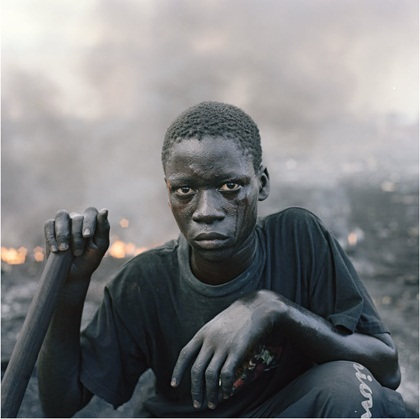
Pieter Hugo
Abdulai Yahaya, Agbogbloshie Market, Accra, Ghana,
2010.
C-print
82 x 82 cm and 152.6 x 152.6 cm.
In what seems the accepted current format for South African photographers, a Pieter Hugo exhibition takes the form of an extended essay in which the photographer turns his camera on a subject of interest, and stays with it. In this way, his audience is provided with a long, slow look at a particular corner of the world, a specific group of people. This is very different from the approach of a Wolfgang Tillmans, say, a former Turner Prizewinner, whose antic camera seems to light on whatever catches his eye at any particular moment, constantly calling on the viewer to assess each new image for what it is.
Last time around, Hugo gave us his Nollywood series, a progression of extraordinary images in which actors in the Nigerian film industry posed in full cimematic costume for Hugo. The melodramatic situations were based on the kinds of plots built around ritual murder, voodoo worship and the belief in zombies.
Arresting, highly colourful and memorable, opening up fascinating narrative possibilities for the viewer, these were for me amongst Hugo’s strongest images. The criticism that the series reinforced negative images of Africa seemed to me misplaced: the series gave an insight into a film language about which not much is known in many parts of the world, and in so doing produced a number of striking images in gorgeous colour, worthy of their provenance. And the actors were doing what they always do anyway – posing in character for the camera in exchange for a fee.
art events calendar
VIEW FULL CALENDAR
buy art prints
edition of 60: R4,000.00
About Editions for ArtThrob
Outstanding prints by top South African artists. Your chance to purchase SA art at affordable prices.
FIND OUT MORE Editions for artthrob
Hugo’s latest exhibition, ‘Permanent Error’, shown recently at the Michael Stevenson Gallery, presents a dystopian world of a different kind – and in a greatly reduced, sombre colour range. Against a background of smouldering rubbish dumps, heaps of recycled electronic equipment sent from western countries and ostensibly intended to bridge the digital divide between aider and aidee - in this case, Ghana - are set alight. The portraits in this series are of the red-eyed men who engage in this toxic and exhausting labour. The desperation and misery of these men who must spend their lives burning the plastic in order to extract minute scraps of valuable metals is palpable.
A generation ago, the men would have been eking out their living on the same land by subsistence farming, and the cows which wander over the rubbish heaps sustained by goodness knows what are sad echoes of this agrarian past. Life may not have been easier then, but at least it was free of the pollution of air, soil and water caused by the poisonous heavy metals of discarded first world technology.
In the first gallery, the viewer was surrounded by large-scale prints of the men, their cattle, and details of these dumps. In the next, Hugo set up a video installation in which a dozen or so monitors formed a parabolic curve around the room, each monitor showing one of Hugo’s workers standing still against a background of the burning activity.
Having spent a considerable time looking at the large number of photographs in the first gallery, the video installation felt to me rather like more of the same, just slightly animated and without the crystalline detail characteristic of Hugo’s photographs. Projected at a life-scale size in a larger space, without the photographs, I think I would have reacted to the videos differently. But as exhibited at the Michael Stevenson, this double presentation of the same subject material seemed to detract rather than add to the overall impact of ‘Permanent Error’.
The subject of the life sustained by the rubbish dumps of Africa is not new. One thinks here of Zwelethu Mthethwa’s child scavengers in Mozambique, and Mikhael Subotzky’s Beaufort West series. For years, the rubbish dump which flanks Crossroads in Cape Town has been known as ‘the free O.K.’ and people wait daily for the arrival of the garbage trucks with weary anticipation.
Nonetheless, there is something very disturbing about a situation in which the rubbish is not even locally generated, but has actually been shipped in in what seems a spirit of deep cynicism, or of dumping old technology under the guise of ‘helping Africa’.
Hugo’s bleakly evocative photographs, taken over the period of a year, make it clear why the locals call the area of the dump 'Sodom and Gomorrah'. The ‘Permanent Error’ series deserves to be widely shown, not only because the photographs themselves exude a dark power, but also for the issues they raise. In 2011, the series will be published in book form by Prestel.