other reviews
Lingua Franca
Richard Hart at KZNSA
By Rike Sitas17 August - 05 September. 1 Comment(s)
Richard Hart
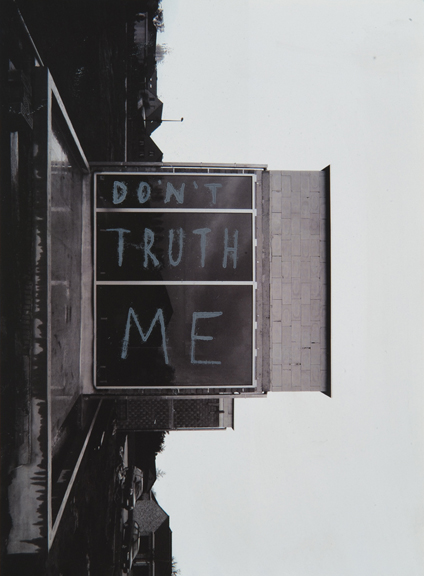
Don't Truth Me,
2010.
Monoprint, watercolour, ink, pencil, charcoal
various dimensions.
Richard Hart just wanted to design record covers. And draw.
Fine art not being an option, he decided the best way to keep doodling after school was to study graphic design, where he graduated from Natal Technikon (now Durban University of Technology) in 1989. For the past 21 years, Hart has worked as a graphic designer, the bulk of that time at Disturbance Design, the agency he started in 1997 with his sister, Susie Hart. In 2009, growing frustrated with fulfilling an increasingly managerial role at Disturbance, Hart started painting in the evenings. These paintings culminated in his first solo exhibition: ‘Kind Pockets’ at Whatiftheworld in Cape Town in 2009.
Whereas ‘Kind Pockets’ was a distinct shift from Hart’s world of graphic design, ‘Lingua Franca’ sees him exploring the intersection of his skills as a graphic designer and what he describes as his ‘unexpected love affair’ with contemporary art. Hart’s fascination with words, language and letterforms underpins this collection of sculptures, assemblages, drawings, paintings, photos and installation. He made a conscious decision to restrict the terrain covered by this exhibition to the relationship between words and images, and words as images, as for Hart, ‘each is less without the other’.
What results is a collection of typographic moments, pushing the boundaries of contemporary graphic design into the realm of visual art. The exhibition demonstrates the artist’s keen sense of play with communicating ideas through the combination of images and words, and the show holds an intricate experience of moments as one moves through the gallery.
art events calendar
VIEW FULL CALENDAR
buy art prints
edition of 60: R40,000.00
About Editions for ArtThrob
Outstanding prints by top South African artists. Your chance to purchase SA art at affordable prices.
FIND OUT MORE Editions for artthrob
On entering the main gallery at the KZNSA, the words ‘so into you’ are embroidered onto the opposite wall. As one approaches, the detail of the work becomes more apparent, and you notice that this embroidery is constructed from around 1500 .357 magnum bullet casings: 357 of them are spent and spell out the words. This whimsical and somewhat macabre approach to words is echoed throughout the rest of the exhibition.
This can be most explicitly seen in Hart’s sculptures utilising wood and light. There are three carved word sculptures placed around the centre of the gallery. On the floor is a sculpture titled It all comes down to this, with the words 'SINK' and 'SWIM'. Suspended from the ceiling is One-Another, a sculpture which, from one side reads 'HURT', and from the other 'HEAL'. Opposite this sculpture Duh is suspended, from one side reading 'WAR' and the other 'RAW'. These all speak of inherently human tensions. Two light sculptures titled Teen Dream flicker the words 'ONE LOVE' and 'LUV U LUV ME'.
Included in the exhibition is a series of photographic experiments. In one of the series, More or less everything, Hart designed a collection of boards with statements starting with the word ‘everything’, and photographed people holding them in a variety of different contexts. A kid lies amongst Lego pieces, toys strewn around, with a board reading ‘everything is just as it should be’. A naked couple in bed are concealed by a board reading, ‘everything can kill you’. A family portrait reads ‘everything is fucked’. Prominent local writer, Neil Coppen, who also collaborated with Hart in this exhibition, lies amongst a collection of colonial artefacts (such as typwriters and globes), captioned ‘everything is a cliché’. The result is a collection of subtle critiques and comments on place, people and objects.
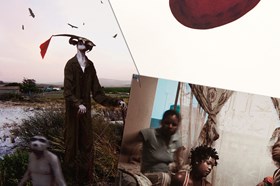
Hart invited Coppen to work in response to a series of paintings. Spending a week with the paintings, Neil wrote short statements which were then included in the paintings. The series is titled The Others. These paintings are both poetic and somewhat absurd, and seem to be spilling out of either side of a boy’s head. This human bookshelf of a boy is standing on a pile of books, holding another collection with his head against the wall, dreaming of a wide-eyed bunny saying ‘Seriously I’ll be fine, I just need some sleep’ alongside someone who would like ‘to sleep in your hair’.
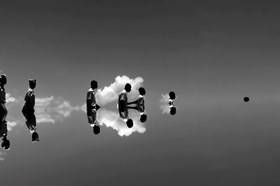
Hart also collaborated with Disturbance co-conspirator, photographer Roger Jardine. He gave Jardine two sentences, each word appearing on a separate board. Jardine took the words and through a series of black-and-white portraits taken in and around Durban, added visuals to the statements: ‘delight in the crushing weight of your own mortality’ and ‘we did what we thought was the right thing’.
Also included on the show is a series of Doodles. A tree has fallen onto someone: the image says, ‘nature is so over you’. Doodles is a collection of thoughts; a series of moments comprised of Hart’s illustrations, which all include text. Fanciful and, at times, grisly, these thought bubbles provide a snapshot glimpse of some of the artist’s daily musings about the world. A telescope wonders whether ‘stars dream of telescopes’ alongside severed fingers after an ‘incident with a cheese grater’, captioned ‘I really don’t want to talk about it’.
In many ways each of these works, or collections of works, are singular, and in some instances insular – each has its own unique interplay of words, pictures, shapes and references. Unlike many other exhibitions that are curated along a singular narrative or theme, ‘Lingua Franca’ is collated much more like an ‘anthology of poems’, as one viewer asserted. Each can be read on its own, but together they become a compilation of related ideas; again, ‘each is less without the other’.
Hart may not realize how close he is to his dream of designing record covers. More than being a collection of poems, ‘Lingua Franca’ is more akin to an album, at once playful and melancholic, hilarious and morbid: each a still from a music video. Although disparate in many senses, there is a distinct visual and conceptual signature that underpins this exhibition. At the intersection of graphic design and visual arts lies a meticulous craftsman.