international reviews
Five Themes
William Kentridge at Albertina
By Amy Halliday29 October - 30 January. 0 Comment(s)
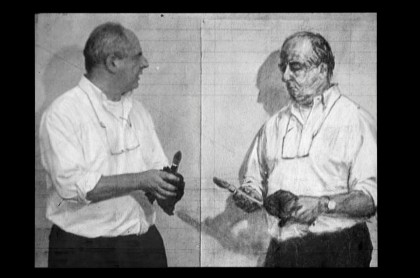
William Kentridge
'Invisible Mending' from '7 Fragments for Georges Méliès',
2003.
Film still
.
Variations on a Theme: ‘William Kentridge: Five Themes’ and the Curious Dynamics of the Travelling Show
Originally conceived of and organised by the San Francisco MoMA in 2009, the massive travelling Kentridge retrospective ‘Five Themes’ has been on a sojourn through Fort Worth, West Palm Beach, New York and Paris to its current destination in Vienna, with stopovers in Tel Aviv and Amsterdam still on the itinerary for 2011. The scale and scope of the show is unparalleled and its production slick, including over 130 works of drawing, sculpture, film, print, tapestry, anamorphic installation and theatre maquette, variously selected and shown by each institution (according to space requirements and curatorial decision), and all coalesced around five central themes developed in collaboration with the artist.
art events calendar
VIEW FULL CALENDAR
buy art prints

edition of 60: R8,000.00
About Editions for ArtThrob
Outstanding prints by top South African artists. Your chance to purchase SA art at affordable prices.
FIND OUT MORE Editions for artthrob
These five, roughly chronological, themes, range over more than twenty years of artistic production, and the attendant flux of historical and formal exigency. ‘Occasional and Residual Hope: Ubu and the Procession’ (1989-2002) focuses on the conflicts, challenges, and changes of immediately pre- and post-apartheid South Africa; ‘Thick Time: Soho and Felix’ (1989-2003) explores the legacy of Kentridge’s best-known characters; ‘The Artist in his Studio’ immerses the viewer in the artist’s creative processes; ‘Sarastro and the Master’s Voice’ (2003-2007) deals with works related to Kentridge’s production of The Magic Flute; and ‘Learning from the Absurd’ examines Kentridge’s most recent project, the staging of Shostakovich’s opera The Nose, as well as the artist’s ongoing interest in Soviet history and the utopian impulses enfolding art and language.
The diverse and specific localities hosting ‘Five Themes’ call into question, however, the curious dynamics of a travelling show. How might the exhibition – as well as the reception thereof – be differently articulated in and through each context in which it is installed? Casting an eye to the New York reviews, I discovered, for example, that of the exhibition’s ‘Five Themes’, the first that viewers encountered was ‘Occasional and Residual Hope’, centring around the animated films Ubu Tells the Truth (1997) and Shadow Procession (1999), and associated prints and drawings. They had clearly made a profound impact on viewers.
The films are heavy works, accompanied by dense, evocative musical scores and peopled with torn-paper forms or crudely rendered figures: Shadow Procession pans seemingly endless ranks of the protesting, dispossessed, and migrant, while Ubu Tells the Truth includes harrowing serial images of those interrogated and tortured in the looming high-rise of Jan Vorster Square, interspersed with documentary images. At one point, Ubu’s mind’s eye becomes a camera on a tripod, before transforming into the wider screen itself, reminding the viewer that the camera and the eye are instruments simultaneously of witness, surveillance and spectacle. This was (and remains) a particularly cogent message at a moment in South African history – alongside the Truth and Reconciliation Commission’s proceedings – when these threads were at their most entangled. In the US, however, the impact of the works – shot through with notions of hope deferred and truth dispersed – is heightened in the wake of Guantánamo Bay and the increasingly panoptic regime catalysed by the Patriot Act.
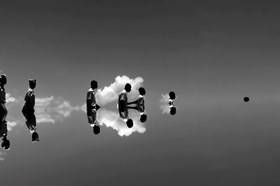
How different, then, is the initial curatorial frame constructed by the Viennese exponent of the show, which begins with ‘The Artist in his Studio’. In the first room of the exhibition, surrounded on all sides by aesthetic evocations, as if transported into the artist’s mind, the viewer is enraptured. Kentridge’s 7 Fragments for George Méliès is always exhibited as a multi-image environment, contained and complemented on either side by Journey to the Moon and Day for Night. The nine projections form a heady cocktail of conjuration and control, chance and contradiction, transformation and illusion, in which an espresso pot can be launched into space, the negative impression of ants’ journeys constitute a constellation, or a torn drawing is sutured and recomposed in reverse.
As the artist has pointed out, ‘the studio is an enclosed space, not just physically but psychically, like an enlarged head’, and it is into this studio-brain that the viewer is drawn. While providing an accessible and compelling introduction for first-time viewers unfamiliar with Kentridge’s work, as well as invaluable insight into the artist’s formal and imaginative processes, the room frames Kentridge as a depoliticised and avuncular artist-magician whose formal sleight of hand will ‘astonish and amaze’. And amaze it certainly does, but in framing Kentridge’s poetics in these terms the exhibition runs the risk of reading as a conservative, Vasarian ‘Life and Works’ model – all the more fitting given that a large Michelangelo exhibition is being shown alongside it – in which the artist’s unique identity, subjective experience and mythic genius become the limiting locus for an interpretation of his works.
That said, subsequent rooms provide a broad survey of the significant drawings and prints (many never before exhibited together), as well as the odd tapestry, sculpture or anamorphic work, through which one can read beyond the reductive narrative imposed at the outset. Self-Portrait (Testing the Library), for example, provides a counterpoint. Kentridge’s visage emerges from a collaged surface of archival fragments: extracts of a French encyclopaedia, Virgil’s Aeneid and a treatise on Logic and the Structure of the Universe. Like many of his drawings from the late ‘90s to today, the spectre of the archive – as both the physical residence of history and law, and (following Foucault) the discursive limits of what can be said and seen at any one moment – becomes simultaneously surface and subject.
A series of marks and meanings – in Kentridge’s trademark graphic technique – are overlaid, erased and reinscribed on top of the archival documents themselves, such that no single trace can be read in isolation from the others. Knowledge (of both the self and the world) is revealed, like drawing, as essentially contingent. In layering his portrait over archival material as ground, Kentridge infers his own imbrication in producing forms of knowledge, suggesting that the viewer can likewise never stand apart from the construction of meaning.
This self-reflexivity adds a significant layer to the figure of the artist-as-conjurer, asserting an unequivocally ethical dimension to the work of both image production and its reception. Unfortunately, the exhibition’s layout and curation does not encourage lengthy meditation on individual drawings or series of prints in their own right. Instead, the rooms and passages follow in a relentlessly linear fashion – such that it is impossible to move laterally among themes – and with the sound and glimpse of another film always lingering just beyond, there is a strong sense of momentum gathered towards them.
As a result, the drawings appear to most viewers as minor milestones, graphic ephemera en route to the major destinations of the projected works, where audiences gather in bunches before moving to the next. This reinforces the easy assumption that so often occurs with Kentridge’s work; that the drawings are merely the by-products of the animation process that results in the finished films. It would be refreshing to see a large-scale Kentridge exhibition which was able to subvert this expectation, revealing the palimpsestic drawings as the ultimate outcome of the process of film-making. For, while the charcoal residue of previous incarnations is interred (yet hauntingly present), it is only the final shot of each series of drawings on a single ground that remains of the animation process.
While it is an incredibly rare opportunity to see all ‘9 Drawings for Projection’ under one roof in the area dedicated to the saga of Soho and Felix, the high point of the show – and its spatial centre – is the three works and associated drawings and prints related to Kentridge’s production of Mozart’s Magic Flute (Preparing the Flute; Learning the Flute; and Black Box/Chambre Noire). In a city in which you can’t walk three steps without hearing or seeing some reference to their most fêted historical citizen, the theme of ‘The Master’s Voice’ is, perhaps, most poignant in the Viennese installment of the show. In many ways, the works around The Magic Flute function as a microcosm of the artist’s ongoing intellectual and formal concerns.
The magic and mastery of ‘The Artist in his Studio’ finds its echo in Kentridge’s bird-catching and conjuring sequences in Preparing the Flute, for example, while the files of people in Shadow Procession are displaced into the single automated figure of a burdened Herero woman in Black Box, who crosses the stage as the death lists of those killed in battle and concentration camps during the Herero genocide (1904-7) in German South-West Africa scroll down endlessly behind her. Each of the three main pieces explores the mutable nature of light and dark, the manipulation of technologies of vision, and the Platonic and Enlightenment legacies underpinning attendant notions of sight, insight and knowledge that have nonetheless also informed the worst excesses of colonialism. But, while the works are informed by grand themes, historical traumas, and philosophical traditions, the artist’s presence – as the silhouette of a bird-conjuring Papageno in Preparing the Flute, or the shadowy hand that interacts with the drawn projections in Black Box – is always there to remind the viewer that their enchantment is, itself, a trick of the light.
In looking to the shadows – the adumbration of history and the inevitable blind spots in our vision – as productive of new ways of seeing and knowing, Kentridge’s work, as evidenced by the exhibition in its entirety, remains a powerful manifestation of what archive theorist Charles Merewether refers to as ‘art’s potential to open up a world beyond an empirical or manifest order of knowledge... opening up possibilities for new ways of writing histories'. Perhaps, even, of new ways of understanding and operating in the present.