other reviews
frequency, lumens, space
Vaughn Sadie & Dean Henning at Durban Art Gallery
By Rike Sitas28 October - 28 November. 0 Comment(s)
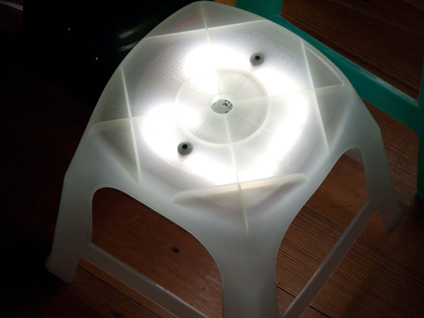
Vaughn Sadie & Dean Henning
frequency, lumens, place,
2010.
Light object
.
‘frequency, lumens, place’ is the latest collaboration between light enthusiast Vaughn Sadie, and sound fanatic Dean Henning. For the past few years, Sadie has been exploring the role and function of light and public and private space. Working predominantly with a combination of everyday light sources and sculptural objects, Sadie constructs experiments and comments on the production of space through light. Henning is a musician, composer (who has worked extensively with Cameron Platter) and sound artist. Much of his work has revolved around interactivity as an important component – where audience involvement is crucial. For Henning, ‘the amazing thing about sound is that it explains our world and allows us to see around corners. We can’t see out neighbours, but we can guess what they are doing by the sounds they make’.
It is the everydayness of light and sound that underpins this exhibition, a collaborative spatial exploration of gallery 3 at the Durban Art Gallery. The installation involves an interactive sound piece developed by Henning, accompanied by a series of light objects using plastic stools and compact fluorescent bulbs by Sadie. The starting point for this show was the space itself. For Henning, it was the frequency of the room, and the feedback loops that emerge as objects occupy, and people move through a space. For Sadie, it was the lux lighting formula used as a ‘universal’ standard by galleries to light exhibitions.
art events calendar
VIEW FULL CALENDAR
buy art prints

edition of 60: R7,500.00
About Editions for ArtThrob
Outstanding prints by top South African artists. Your chance to purchase SA art at affordable prices.
FIND OUT MORE Editions for artthrob
‘It’s like singing in the bath – certain pitches sound louder than others’, says Henning. All objects have resonance – plucking guitar strings against a wooden cupboard will respond to a different frequency to that of a concrete wall. Some frequencies are more ‘friendly’ than others. We hear this when we set up sound equipment and the mic gets too close to a speaker. The feedback screeches until we move the mic away from the speaker again. It is the combination of these two phenomenon that Henning explored in this installation.
He started by recording the sound of the empty room over the course of a few months. He then analysed the sound recordings to figure out the frequency of the room. Technology has become so advanced that this has become easy to do: many musicians calculate the pitch of drums in order to establish the optimum frequency. Henning then developed a programme that generated a feedback loop to work with the frequency of the room. The installation involves quadraphonic speakers and two microphones. The microphones pick up the sound of both the room and the action happening in the room, as well as the sound coming back out through the speakers. Essentially, the usually inaudible frequency and feedback in and of the room becomes audible.
The purpose of this was to develop an interactive experience, where the audience’s movement would alter the sound being pushed around the room. As you walk around the room, the sound shifts and changes. If you clap next to a microphone, something different happens than when you slide your finger around the rim of a wine glass (which became a fascination at the opening). Whispering into the microphones and touching the speakers also audibly alter the sound in the space, as does sitting on Sadie’s stools and having a conversation.
Sadie took the lux measurements (a measurement of the intensity of illumination on a surface) for the gallery space and calculated the optimal lighting solution as per the gallery norm. Instead of lighting from the ceiling, Sadie worked out the exact lumens needed according to the formula (light emitted by light fitting and dimensions of the space), and bought the exact number of compact fluorescent bulbs that would emit this light.
He attached these bulbs to the underside of a range of plastic stools. There is a technical component to this decision – the compact fluorescents are cold to the touch and therefore wouldn’t melt the plastic of the chairs. There is also an extension of Sadie’s interrogation of the mass-produced lights and objects that punctuate our urban spaces. These lights are usually found in corridors or outside to light a driveway. They are used so often that we hardly ever notice them any more, despite them shaping our experiences of many of the spaces we inhabit. The plastic stools, which are also moulded and mass-produced, are a common site in most African cities. For Sadie, the stools allow the light a certain physicality, while the light in turn highlights the materiality of the stools.
Together there is something intriguing yet haunting about the sound of a room and the well-lit feet and floor. There is also something essentially performative and playful about the exhibition. The audience members at the opening spent a great deal of time clapping, ringing wine glasses, singing, shouting and whispering into the microphones, and stroking the speakers to hear the aural response. Adults still like to play and work things out, and the generous interactivity of the space allowed this to happen.
One audience member felt surprisingly alienated in the space. Another tiptoed into the room and stood immobilised for a few minutes against the wall, wide-eyed, before singing into one of the microphones. Another giggled like a child and ran around the space touching everything and making a racket. Yet another just sat on a chair and watched for over 45 minutes. It’s in these instances that that the strength of the installation is revealed. This is contrary to the norm (especially in national galleries), where the art is hung on the wall, and lit just so. Whereas sound usually performs a supporting role in exhibitions, and is always carefully controlled, here the sound is centre stage and takes on a life of its own. And whereas the lighting in a gallery usually comes gently from above, here the light spills onto our grubby shoes and pedicured toenails, fluorescence bleeding out across the floor. A usually controlled space is transformed into an interactive experiment, the work being produced as much by those in the space and the space itself, as the artists.
Ultimately the exhibition challenges us to question the spaces we inhabit, and the sounds and light that inform our everyday lives.