cape reviews
Maybe Your Magic is Working
Daniella Mooney at Whatiftheworld / Gallery
By Chad Rossouw29 January - 19 February. 1 Comment(s)
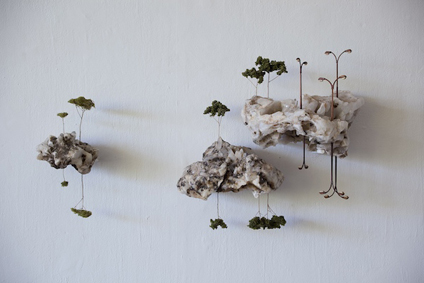
Daniella Mooney
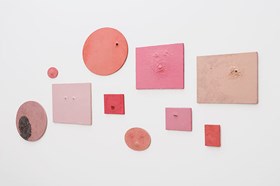
Obscured by Clouds,
2010/11.
Mixed media
.
Recently Chad Rossouw and Daniella Mooney sat down to chat about her new show, 'Maybe Your Magic is Working' at Whatiftheworld. We talk about alchemy, nature and solidifying wishes.
Chad Rossouw: The title of your show is ‘Maybe your magic is working’. Tell me a little bit about magic and what it means.
Daniella Mooney: I had a bit of a problem with the word 'magic', because it's quite stereotyped, and there’s some stigma attached to it. It conjures up images of magicians, and a frivolous side to magic, which is not really what my show entails. But I needed the title to be light-hearted, because the works themselves had a heavier content. I needed the light-heartedness as a balance. The word magic was a reference to alchemy. ‘Maybe your magic is working’ also allowed it to be more open to interpretation. Other titles I was thinking of were like ‘ The Black Mirror’, heavier stuff.
art events calendar
VIEW FULL CALENDAR
buy art prints
edition of 60: R70,000.00
About Editions for ArtThrob
Outstanding prints by top South African artists. Your chance to purchase SA art at affordable prices.
FIND OUT MORE Editions for artthrob
CR: What do you mean by 'alchemy'?
DM: I guess a lot of the works have the undertone of alchemical importance because I see the stuff I have made as undergoing a transformation. As much as it is about making these objects that incorporate perception and light and natural phenomena, it's about the inner transformation as well. Instead of changing base metals into gold, which one normally understands alchemy to be, there is a very Jungian aspect, which is about transforming consciousness, transforming the self. It’s about a duality, which is not overly apparent in the works, but that is where I was coming from. And also my own transformation through the process of making. Alchemy is all about process, about going through different stages and reaching some end result. Mostly, the alchemical quest was to find the philosopher’s stone, the elixir of life, it was ongoing. There was no one treasure to be found. I guess because the self is constantly shifting. I guess that’s the alchemy behind it.
CR: In your transformation of material there is an element of taking something ephemeral, like light, and making it into something quite solid.
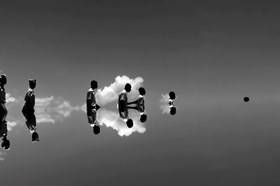
DM: That’s where my fourth year work (last year at Michaelis) really did start off. Sometimes quite literally, a lamp with a wooden beam of light or a crystal beam of light. But from there, and where this new body of work was heading, it was more about perception, trying to create a space that was perception, instead of it being about perception. I really wanted to create an environment in the space, so the works would be permeated with a type of tangible essence. It was about the light that affected the work, not so much about the light.
CR: Although you are still taking things like wishes and light and making them into something solid.
DM: Yes, the crystal beam of light references a crepuscular ray which sometimes appears at twilight. It references a specific time of day. What do you mean by the wishes?
CR: You have taken something very ephemeral, the idea of wishes, and found a way of transforming them into something tangible. And then collecting those coins one by one from fountains, and turning it into something lumpen.
DM: The wishes acted as an important entry point into the rest of the works in the show. Alchemically, they needed to undergo some transformation, a heat or chemical process. The interesting thing is, as much as I tried to transform it, it seemed to resist in some way. It was meant to be cast into a perfect sphere, a beautiful round orb. It exploded in the kiln. Obviously because coins are an unknown alloy, it has nickel and copper and a whole bunch stuff. I asked them to send down every last scrap of metal, which they did, though they were very perplexed. I, of course, stuck it together. Then during installation, it got knocked over and it broke into pieces again. It was a reluctant artwork. Its almost like it has a magic of its own. That’s where the power of intention is interesting. When you take something like a coin for instance, and imbue it with something. Whether it’s closing your eyes or squeezing it in your hand and wishing, the object becomes filled with that intention. That’s where the transformation takes place. It’s within the person casting the spell or wish or whatever. It’s almost not a coin anymore. If anyone came to me and told me I’m destroying money, which is illegal, I’m sure I could find a way of justifying it: 'They’re wishes!' It was important that I collected them from around the city, at different locations in local spots. That specific piece creates the potential for the other works to become something other than what they appear. The light in the space does this as well, the way it permeates everything.
CR: What is the importance of the natural in your work?
DM: With natural materials I think we all have some kind of remembrance for them. It’s a relationship that’s always been there. And specifically how natural cycles affect us. For instance, the phases of the moon, the passing of the sun, it all makes an impact. I wanted to use raw materials like wood and stone as a way of articulating these natural phenomena and processes we don’t necessarily understand.
CR: There is a very clear romance in your work, which is perhaps at odds with the contemporary world of technology.
DM: I think it’s because there is a disconnection from nature, from natural spaces. I think it tells us so much about ourselves. And I think technology takes us away from ourselves. It has become quite apparent to me, after having grown up on a farm. I don’t want to say that this is the reason I use the materials I do, but growing up on a farm and then moving into the city into a small apartment produced a feeling of loss, for me at least. The romantic aspect I think comes from the idea of the unknown and the mysterious in nature. The belief in possibilities, the possibility of many realities, not just one.
CR: Where to from here?
DM: I’ve still got lots to learn. I need more skill. Maybe hopefully work for a carpenter.