cape reviews
Cumulus
Gerhard Marx at Goodman Gallery
By Renee Holleman22 January - 12 February. 0 Comment(s)
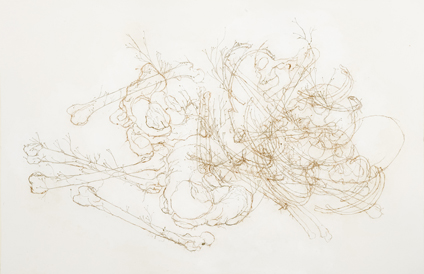
Gerhard Marx
Cumulus III,
2011.
Plant material, acrylic paint and glue on cotton paper
153 x 103cm.
Gerhard Marx's new body of work is an incredibly delicate, impossibly intricate affair. ‘How on earth does he do it?’ I wondered as I pored over the surface of one of the six drawings created from fragile strands of decaying plant matter. 'Ah, skulls!' sighed a fellow writer happily as she appeared next to me. Skulls? I looked at the detailed network of fine lines again. Of course, it’s a drawing of a skull!
Thankfully, what could have been an embarrassing gallery faux pas is in fact a very intentional element of Marx's visual strategy in this exhibition, one in which the play between form and formlessness is crucial, as is a concern with the viewer's ability to look and create cohesion between disparate parts.
art events calendar
VIEW FULL CALENDAR
buy art prints

edition of 25: R3,500.00
About Editions for ArtThrob
Outstanding prints by top South African artists. Your chance to purchase SA art at affordable prices.
FIND OUT MORE Editions for artthrob
In ‘Cumulus’, Marx draws together a diverse body of work with the central allegory of a massive cloud formation whose logic of accumulation, he suggests, is also the cause of its disintegration (saturation which leads to rain) and transformation. Categorised for the first time in the early 1900s, the inherently shifting, nebulous nature of clouds became fixed by definition and labelled. Throughout the show, Marx explores the dynamic of indeterminacy and boundlessness and the threat of diffusion in relation to the desire for structure, with a specific focus on surface and boundary as 'that which simultaneously defines and separates form from its environment'.
To this end the works themselves are made through a careful, painstaking process of gathering small things, be they fragments of South African road atlases, twigs and weeds found on pavements, curbs and in garden refuse, or a variety of standard black rulers. For Marx this process is critical to the dialogue that arises between material and image, with each work (or series) an intense exploration of a specific technique that enables or opens up a conversation with a particular 'field of thinking'.
In the case of this body of work, Marx's concern with mapping and boundaries has extended into the physical environment of Johannesburg's suburbs - specifically the uncultivated areas between roads and properties and the gardens their walls enclose. On the sidewalks and road edges which exist at the margins of these orderly, controlled environments - these urban paradises - weeds grow and garden refuse is dumped. It is in the disorderly and discarded bits of foliage that Marx is most interested. In Scion (a horticultural term for a young shoot spliced onto another plant) he has created, by carefully grafting together pieces of stick and twig retrieved from piles of garden rubbish, a delicate ribcage branching outwards, cast into bronze.
The fragmented skeleton that appears here, and in the Skull and Cumulus series of drawings on paper using plant material, is for Marx an object of curiosity. This is because the skeleton is a strangely difficult thing to look at - not because of what it is, he maintains, but because of the way in which it functions as an indexical object, pointing away from itself towards the body it once inhabited. It also acts as a site of both imaginative and logical projection: one can’t help but think of the person it belonged to, who they were and how they lived, at the same time as grappling with the finitude of their death. While the idea of a sublime impasse may inform the making of these works, the experience of viewing them is imbued with a different kind of wonder. Yes, there is a kind of grasping for cohesion as the eye sifts through a tangle of bones from skull to rib to hip bone and back again in the Cumulus works, trying to fathom the body without borders, without skin or surface. But added to this, one can’t help but marvel at the delicacy and precision with which the fine, papery, dried strands of weed are arranged upon the page to produce an image of mortality. This is made all the more poignant by the works’ reference to the horticultural tradition of pressing plant specimens onto a page in an effort to record, name and preserve them. It must be said that it’s not often that I find myself using words like 'wonder' and 'marvel' when writing about art, but Marx has produced some very beautiful works, and this is part of the way in which Marx engages with his concerns.
Weeds appear not only as material matter on this show, but also as the subject of Marx's Hortus Siccus series of images, crafted by cutting and pasting together tiny pieces of road map. It’s significant that the weeds here remain unnamed and uncategorised, relegated to the same kind of undefined conceptual space in which they are found in real life. The Hortus Siccus, directly translated as 'dried garden', but otherwise known as a 'Herbarium', has an interesting history. As a collection of specimens it was preceded by Dürer's watercolours and observational drawings which had already been printed and distributed throughout Europe. This sense of the representational preceding the real is reinforced by the material with which the works are constructed. The map as index points towards a territory both real and imaginary. As an image it presents a fictional space (the land from above, reduced to lines and colours) that is then superimposed upon the real physical terrain it references. Marx's reconstituted map drawings explore this dynamic, dissolving and transforming the original terrain of each map into an illusionary image as scale and measure shift, and highway, river and road merge to become a boundary line delineating a new form.
In such a way the process of accumulation, disintegration and transformation comes full circle, and takes us back to the notion of the Cumulus cloud, an image of which Marx has constructed by carefully layering ruler upon ruler in both Weather I and II. These typical instruments, seemingly objective tools, have a bodily relation derived from their connection to early forms of measurement (thumb, hand and foot for example) and in the intimacy of their use: in order to be made use of, a ruler both touches and must be touched. Marx brings a poignant futility to this meditation on human efforts to define and control the perilously unbounded. And yet a curious thing happens in the making of the works that elevates this endeavour into something quite magical.