international reviews
Alias - Photomonth Krakow 2011
Various Participants at Various venues around Krakow
By Sue Williamson13 May - 12 June. 0 Comment(s)
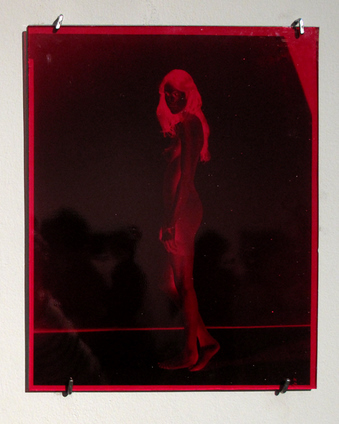
Dora Fobert
Untitled (from the archive of adela k circa 1942),
.
Black and white photograph
.
You know how the art world works. You walk into a show and unless the artist concerned is exhibiting for the first time ever, you are already familiar with the name, the reputation, and something of the artist’s previous work, and you bring all this knowledge to bear when looking at this new display. You may even be aware of the artist’s precise position in the precarious hierarchy of critical acclaim, and also in which important collections the artist’s work is held.
All of this carefully acquired information is very helpful when forming an opinion of the new exhibition. It also acts as a comforting buffer against looking foolish when another viewer asks you if you think the work is good, or, perhaps… So how does one react when one enters an exhibition space and hears one of the curators declaim ‘None of the artists in this exhibition exist. All of the works are copies’ ?
South African born, London based photographers Adam Broomberg and Oliver Chanarin came up with the theme of ‘Alias’ when invited to curate Krakow Photomonth 2011, and in so doing made a radical departure from previous editions of the event which divided the main programme into blocks by topic and nationality.
For the central exhibition of ‘Alias’, held in the Bunker Sztuki gallery, the curators hunted down work already made under pseudonyms by artists, including Marcel Duchamp as Rrose Sélavy, Andrew Moletse (readers might remember work by this fictional character being included in the Standard Bank Drawing Competition of 1991) and William Kentridge, who appears in a short film in which three irritable versions of himself pick up horns and blow a cacophonous chorus.
art events calendar
VIEW FULL CALENDAR
buy art prints
edition of 60: R70,000.00
About Editions for ArtThrob
Outstanding prints by top South African artists. Your chance to purchase SA art at affordable prices.
FIND OUT MORE Editions for artthrob
Isn’t identifying Kentridge by name against the defining concept of ‘Alias’? It would be difficult indeed to call such a well-known artworld figure by any other name when he appears as the main character, three times over, but since there are three Williams, which is the real one, and which the aliases? In the catalogue, the curators explain: ‘ it would be almost impossible to describe Kentridge in the singular. He is generally to be found … engaged in highly spirited arguments with his favourite adversary – himself.’
In the catalogue of the main show, the works shown are identified both by pseudonym and by the artist’s real name. Aalam Wassef, an Egyptian artist and blogger whose tireless campaign against President Mubarak helped to bring the regime down worked previously under the online name Ahmad Sherif, revealing his true identity only after Mubarak was deposed. In the collateral shows, in venues around the city, the viewer is on shakier ground. Here, the catalogue lists the 23 writers paired with 23 artists only in brief biographies at the back of the 'Alias' catalogue, giving no indications as to who did what in partnership with whom.
This is how it worked. Broomberg and Chanarin invited the writers to invent a fictitious character and story. The artist then had to make a piece of work appropriate to the character. The story and the work appear in the catalogue. In the Guide to Photomonth in Krakow, there is also a separate bio for the fictional artist. For example, ‘Ivan P’’s bio tells us he is a former (‘lapsed’ he insists) art critic based in Johannesburg and Cape Town and working now as a journalist. In the ‘Alias’ catalogue, a sharp piece of writing describes his boredom at the task he is carrying out on behalf of a dead friend – undertaking a road trip to try to identify the location of landscapes which inspired the paintings of Pierneef. Abandoning his task, he heads for a casino across the border in Zimbabwe. In inhabiting the persona of ‘Ivan P’, the artist’s response was to take a series of photographs with her i-phone while on a road trip in Zimbabwe, and to stick these up with masking tape on the gallery wall. US dollars, brown and softened by endless handling, are formally mounted in a frame on the opposite wall.
Example number two: The account written by ‘Ignatius Sancho’ describes New Lagos, perhaps 100 years hence, when the city is now 800 miles wide and there is a neo classical revival in fashion, in which ‘the young beaux dress in woven robes with heavy gold anklets’ and ‘travel with a retinue of bodyguards and praise singers and videographers filming and live-streaming the passage of the figure at the centre’. A British artist took the role of Ignatius Sancho, placing gold embellished paintings of these young beaux in the recessed niches of Krakow’s Historical Museum, and printing posters of a black St Maurice of Krakow the artist intended to be pasted up all around the city. Although the payment had been made, the posters were not put up around Krakow. Or, perhaps they had been put up, and removed again by people who did not think that Krakow should have a black saint. It was noticeable that the artist was the only African face seen in all my time in Krakow.
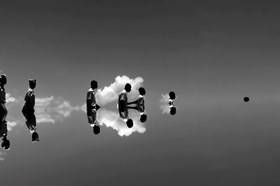
A third example: ‘Dora Fobert’ is presented as a photographer whose work survived the Warsaw ghetto of the second world war, though Dora did not. The story tells us that Dora photographed her friends, undressed, playacting their dreams of the future. The black and white photographs of the girls and women are shown in the negative behind ruby coloured glass, their unstudied poses adding to the authenticity of the story.
You will gather from all of this that the ‘Alias’ catalogue goes far beyond the conventional catalogue, and is an excellent read in its own right, providing new contemporary writing of the liveliest variety along with the high quality reproductions of the artwork on the different shows. For the artist partners, the necessity of having to step outside their own practice and come up with a convincing new body of work for ‘Alias’ was a condition which some participants found liberating and intriguing (the photographer who took the role of Dora Fobert does not normally take photographs of nudes). Others, however, found it constraining and difficult to imagine themselves as a different persona.
And perhaps the same might be said of the viewer: if one is prepared to set aside all preconceived notions and read the work against the background of the fictional bio, there is a series of pleasant surprises. For those who do not have a catalogue in hand to read up on the bios and backstories, the exhibitions may seem a little baffling. At that point, bereft of all information except a fabricated name, the only recourse left open to the viewer is to allow herself to respond openly, purely and simply to the image.