
international reviews
A Change of Heart
Various Participants at Victoria and Albert Museum (V&A)
By Clare Butcher24 June - 25 June. 0 Comment(s)
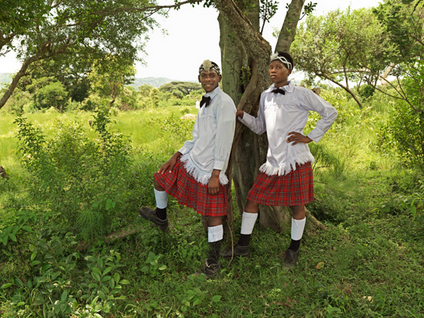
Zwelethu Mthethwa
Untitled (from 'The Brave Ones' series),
2010.
C-print
.
'Artist-slash-photographer' was a contentious double act which slid in and out of focus at the highly-charged ‘Ethics and Poetics of Photographic Depictions of People’ conference at the Victoria and Albert Museum in June. A discursive ancillary to Tamar Garb’s ‘Figures and Fictions: Contemporary South African Photography’ exhibition housed down the vaulted passageway, the conference aimed to dispense with default positions in ways of framing South African photography: getting it, in a sense, to sit still long enough for us to observe its contemporary manifestations in sharper detail. One of the exhibition’s main trajectories was to trace the simultaneity of South Africa’s re-emergence into international cultural economies and photography’s entry into the global circuits of contemporary art as a recognised, and indeed valorised medium which was doing something more than ‘just document’. It seems, however, that the shutter speed has been somewhat slow on a localised level, resulting in a blurry conception of how to approach a context-heavy historical archive of documented social realities and the affective, highly-saturated sophistication of itinerant contemporary art-photography.
art events calendar
VIEW FULL CALENDAR
buy art prints
edition of 25: R4,500.00
About Editions for ArtThrob
Outstanding prints by top South African artists. Your chance to purchase SA art at affordable prices.
FIND OUT MORE Editions for artthrob
Garb compellingly opened the conference with two questions – ‘What did the documentary story fail to tell?’ in terms of the aesthetics, particularities and peculiarities weaving in and around the grander national histories being captured; and ‘What is [now] at stake?’ when the materiality and contingency of those ‘never-just-documents’ is exposed – calling for a personal/political engagement with the future of photographic production and circulation.
This was the ‘work’ of the works represented in the 'Figures and Fictions' exhibition, set against and within the canons of ethnographic, documentary and portrait configurations, and all produced over the last ten years by South Africans still living in the country. Garb hoped that these works, shown to a largely British audience, would illuminate those ‘configural filters’ via which the now of South African photographic practices negotiate the past. This overarching historicity and explicit localism could have been a somewhat constricting frame, given the impressive international posturing of those same practitioners (such as Zwelethu Mthethwa), and others who have chosen to live and produce abroad (Candice Breitz for instance).
The conference responses to Garb came in as many undisciplined and conjuctional forms as our starting contention. Whether it was Achille Mbembe and Sarah Nuttall’s bookend addresses which keynoted and closed the three-day session, or Ashraf Jamal’s call for art history to look more lovingly at the ‘illicit intimacy’ of Billy Monk’s Catacomb oeuvre (in response to which audiences were torn as to whether Jamal could legitimately occlude issues of gender and power with uninhibited empathy, or whether his approach was refreshingly unencumbered), what became clear in the contributions of the 25-plus speakers and respondents was the need for a change of heart as South African photographic praxis steps into the future.
‘What is it that we desire?’ asked Mbembe, after bemoaning the country’s absorption of present-day reality within obsessive museological tendencies – seeking to preserve, or rather, freeze-frame everything. ‘What are the specific things we wish to own? 'Is it possible to love after apartheid?’ The kind of self-curatorship Mbembe seemed to be calling for (curate coming from the Latin curas or curatis, meaning ‘to care’) implies a process of identification and responsibility that would ultimately shift photography’s position from one of objectivity to subjectivity. As narrative, artefact, and projective device – photography (particularly that of people) was instrumental under apartheid as a form of surveillance, reportage and now archive – reconfiguring modes of assembling and activating not only historical but also contemporary photographic bodies is imperative. The empathic suspension of the ‘pathologies’ of the past, as stated by Garb in her description of the contemporary moment, could lead to a new kind of ethics and poetics of depiction, called for in the conference title. An ethics that reaches beyond the realm of ‘art’ and ‘cultural’ discourse, feeding into societal performances of what one could call ‘post-post’ figures and fictions.
A number of these new modes surfaced within certain presentations. Sean O’Toole’s sensitive and salient novelistic biographical approach to the work of Santu Mofekeng, for example, brought about a much-needed ‘anyway’ moment: ‘Anyway…’ he said, ‘let’s change the subject, let’s move on…’ With this shift in tone, other speakers, such as Andrew van der Vlies, were at liberty to dwell on the exorcising quality of the ‘literariness’ lingering on the bodies and skins of the subjects in Zanele Muholi’s portraits – the faceless but also very singular victims of homophobic attack. And like scars on skin, Jo Ractliffe articulated the ways in which a seemingly barren landscape is capable of figuring an always-occupied territory of portrayal in her Angolan series, 'Terreno Ocupado'. Perhaps this is the space of, what Sarah Nuttall in her closing address described as, a ‘space of generative loss’ – of heartbreak, to use the register of Mbembe’s opening inquiry.
As a kind of interruption into this space, Professor Darren Newbury of Birmingham City University introduced the figure of the ‘Excuse me’, from 1950s Windermere in Cape Town. An ‘Excuse me’, he explained, was the name given to an individual wishing to transcend their class. They would perform this desire via dress-code, posture, and in this case, through their interaction with photographer Bryan Heseltine, whose work is the subject of Newbury’s research. Heseltine’s stark aesthetics, use of high flash and low camera angles create a kind of drama around his subjects – making ‘Excuse mes’ of each muscular man, pouting young girl, and in a sense, of us as viewers. The powerful monochrome shots were beamed wide on the wall of the V&A room where we convened – a room far away from Windermere, a time far away from the immediate effects of the Group Areas Act. The gestures, occupations, and indeed the ways of image-making, suggested by Heseltine and his ‘Excuse mes’, project a different set of values and expectations distinguishable even within, or rather between heavy historical classifications.
An image of a cloaked figure appeared before us during Newbury’s presentation, wearing a gaucho-style Corodobés hat, amidst the smoke of a street-side brazier. ‘My students call this image The Black Zorro’, said Newbury. Not wishing to neutralise the politics and mechanics which facilitated Heseltine’s presence and selection as a professional practitioner in that setting, or the place of these ‘specific things’ within the archive, the Black Zorro cut through both the diseased and the overly-honorific orthodoxies plaguing the desires of a contemporary, heart-broken viewer. Is this the unlikely hero of the story elaborated by Professor Michael Godby? A story of the love lost in current South African photographic practice – one that is afraid of committing to the political subjectivity of the specific things being portrayed?
These subjectivities could be seen to emerge blurrily from the brazier smoke, and as in Heseltine’s portrait, their faces are obscured. These new figures and fictions are suspended, poised to excuse themselves from the immediate truth of the photographic event. These figures – the subjects and objects, love and loss of photography – must find the ‘Anyway’, the change in posture, the reconfiguration necessary to transcend iconic regimes and visual economies. These figures-slash-fictions are the beating heart of an ongoing archive, curated not in terms of political correctness and especial classification, in a register of self-recognition and desire.