international reviews
Variants
Robin Rhode at White Cube
By Sean O'Toole08 June - 09 July. 0 Comment(s)
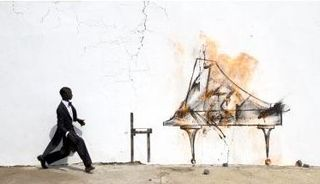
Robin Rhode
Piano Chair,
2011.
Digital animation. Duration: 3 minutes 50 seconds
.
Ten years ago Robin Rhode made his first trip to London: he attempted to hijack a car, failed, then promptly ran away, leaving behind the sound of an alarm and confused applause. A few months later Rhode returned to Tony Blair’s capital, attempted to kick-start a lifeless motorcycle outside the Gasworks artists’ studios where he was doing a residency, failed, and again ran away from his wall-drawn fiction, the applause this time a little louder. A decade later Rhode is now exhibiting his scored digital animations and monochromatic still life photographs at one of London’s premier commercial galleries. What happened? Progress.
art events calendar
VIEW FULL CALENDAR
buy art prints
edition of 10: R20,000.00
About Editions for ArtThrob
Outstanding prints by top South African artists. Your chance to purchase SA art at affordable prices.
FIND OUT MORE Editions for artthrob
Over the last decade Rhode has transformed his speculative, performance-based output into a generative practice that now encompasses performance, painting, still photography, film and sculpture (also an unclassifiable bit of wheel spinning in a BMW roadster). Rhode’s practice has made the turbulent passage from agitated experimentation to settled resolution, crucially without snuffing too much of the angry insistence and youthful confidence that marked his early, street-inspired work. Style is a dirty word to encapsulate all of this, but it nonetheless speaks directly to the recognisability and endless adaptability of Rhode’s mature work. If style is the fulcrum on which his success is based, it however also defines the narrow space within which he must constantly innovate.
For his second solo outing at London’s White Cube, Variants, Rhode presented five new digital animations that, in their bracketed familiarity, revealed his capacity for invention and imagination as an artist. Shot on location in Johannesburg, the short animations (the longest is just shy of four minutes) see Rhode using familiar surroundings to frame a controlled fictional environment in which an autonomous event is choreographed. The action in his subtly scored animations has always been driven by the way his live actors engage their fake props, memorably a chalk-drawn rocking horse and bicycle on his 2005 Venice Biennale contributions, and now chairs.
The archly modernist chair designs of Gerrit Rietveld are the defining leitmotif of Rhode’s new show. Rhode first encountered the Dutch architect and designer as an art student visiting the Johannesburg Art Gallery, which has a replica of Rietveld’s career defining Red Blue Chair (1918-23). More than just props to be sat on or thrown as weapons, Rietveld’s rectilinear chairs function as an iconographic device that enables Rhode to endlessly construct and disassemble the rationalism of western modernism, here fractionally exemplified by this key figure from the De Stijl movement. The action is rarely as glum or overbearing as Rhode’s underlying thesis of subverting the canon of western modernity might suggest.
In the split-screen animation, Kinderstoel (2011), two child performers dressed in grey and white school clothes interact against a vivid green backdrop with the white painted outlines of Rietveld’s rectilinear kiddies' chair from 1918. A similar whimsicality defines the action in Zig Zag (2011), where a uniformed child sits on a 1934 chair defined, in profile at least, by the simple geometry of four connecting lines. As in Rhode’s earlier works Horse (2002) and New Kids on the Bike (2002), Kinderstoel and Zig Zag eschew narrative. The animations are also possessed with an impish quality, which is perhaps unavoidable given Rhode’s use of child performers.
The show’s two standout works however feature adult performers, doppelgangers in blackface whose masquerading performances are marked by strangeness and violence. In Arm Chair (2011), a young man in a sober grey suit, white shirt and black tie stands next to a red suburban wall overlaid with a coating of white. The young man wears a phonoscope, a quixotic piece of headgear pioneered in the 1920s and used to measure the phonetic wave of the voice. Tubing from the apparatus connects to a graphic depiction of Rietveld’s Red Blue Chair, which the artist conceived as a democratic, mass-producible furniture item.
While the figure in Arm Chair is unavoidable and compelling, it is the innocuous tiled roof and overhead street lamps in the background that signal a curious shift in Rhode’s animation. They gesture to new possibilities beyond the autonomous, self-invented world he has insistently framed in his films and storyboard photographs (of which there was one new series on display, Typing Steps, 2011, a series of 15 prints that playful enact the Fibonacci numbering system; the show also included 15 black and white still life studies of triangular forms that in their dispassionate arrangements share affinities with Hiroshi Sugimoto’s monochromatic 2004 study of conceptual forms).
At three minutes fifty seconds, Piano Chair (2011) is Rhode’s longest animation. In its movement from composure to erasure and violence, Piano Chair recalls the absurdity of his 2000 performance Car Wash outside the National Gallery, in which Rhode attempted to wash a wall-drawn VW Golf, also the fake car break-in he staged outside Frances Goodman’s curated group show 'Juncture' in London in 2001. A frustrated composer wearing black coattails and bowtie is shown standing in front of his piano, a large crack in the whitewashed wall frozen like lightning above a graphic depiction of Rietveld’s stained mahogany and leather piano stool from 1923. The angry composer initially throws stones at the grand piano, then stabs at it with a panga and strikes it with an axe. He also attempts to smother it with a pillow and burn it with fuel before, finally, resolving to hang it.
A melancholy score by the Berlin composer Arenor Anuku accompanies the absurd action in Piano Chair. It is not the first such collaboration, Rhode two years ago teaming up with Norwegian classical pianist Leif Ove Andsnes to remix the Russian composer Modest Mussorgsky’s piano suite Pictures at an Exhibition (1874) for a performance in New York. This sort of curious excavation of the early roots of modernism recalls William Kentridge, whose re-imagining of Dmitri Shostakovich’s opera The Nose last year similarly grew out of his curious insistence in repurposing western modernism. Rhode’s interest in doing the same (just differently) is marked by a maturing style that is exploratory and open-ended, also seemingly immune to the calcification of formalism.