gauteng reviews
Other Faces
William Kentridge at Goodman Gallery
By Michael Smith10 November - 23 December. 0 Comment(s)

William Kentridge
Drawing for Other Faces (Red Text),
2011.
charcoal and coloured pencil on paper
.
The city looms large in the headspace of its inhabitants, underpinning our sense of ourselves both as individuals and as part of a collective. The force and nature of the city is so compelling (the CIA’s World Factbook in 2010 estimated that 61% of South Africa’s population lives in cities; other sources estimate that this figure will rise to around 75% by 2030) that it induces an increasing number of artists to deal with its fabric, its terms and its effect on the psyches of those that live there.
In particular, Johannesburg seems to lay bare many of the conflicts at the heart of global diaspora and migration: economic competition, redefinition of space and territory, and a constant white noise of cultural friction. In his paper The Johannesburg Moment Professor Karl Von Holdt speaks of two major ways of thinking of Johannesburg. The first is as a contestation of ideas and power for influence, and control over spaces, institutions and sectors. The second way he views the city is as an intellectual and cultural project to reconfigure the lenses of Western ideology through which we make meaning of the city.
art events calendar
VIEW FULL CALENDAR
buy art prints
edition of 60: R4,000.00
About Editions for ArtThrob
Outstanding prints by top South African artists. Your chance to purchase SA art at affordable prices.
FIND OUT MORE Editions for artthrob
Indeed, this notion of the city as a site of contestation is possibly the one thing common to the way each generation has chosen to represent it: from Mongane Wally Serote’s ‘dry like death’ landscape of ‘neon flowers’ and ‘electrical wind’, and Warrick Sony’s paranoid dystopia peopled by ‘gentlemen in gun black suits’, to David Goldblatt’s restless tracing of its competing inhabitants across the length and breadth of the city over five decades.
In the visual arts it is arguably possible to trace a contemporary fascination with Johannesburg back to two major trailblazers: Goldblatt and William Kentridge. And as much as Kentridge’s focus has shifted away from direct engagement with the city in the past five or so years, during which he was concerned with Nikolai Gogol’s The Nose, a narrative of power gone awry in post-Revolutionary Russia, this latest show proves that his has always been a project of redefining the manner in which we make meaning of Johannesburg.
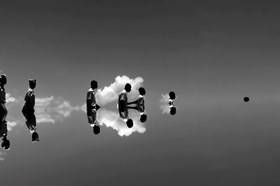
His most recent exhibition, ‘Other Faces’, shown at the Goodman Gallery Johannesburg during November and December 2011, extends on the narrative terms established by films like Mine, Johannesburg, 2nd Greatest City After Paris and Felix in Exile. In those films, Kentridge pictures Johannesburg as a city of industry, but also as the backdrop against which apartheid’s death-throes and the accompanying social shift occurred. In this latest body of work, a film and the drawings used in its making, he returns to the dichotomous relationship between the city centre and its outskirts, and also between the races of its inhabitants.
Where the crowd in Kentridge’s films once functioned as a softened yet enveloping presence, moving across the landscape and through the city to deliver messages, sonic and visual, of resistance and paradigm shift, in Other Faces the crowd is less symbolic and more real: and really threatening for the figure of Soho Eckstein, who crashes his car against that of his black counterpart protagonist in the city centre. The CBD, which Randlords like Eckstein once dominated, has morphed into an altogether different landscape, someone else’s turf. The black, often foreign inhabitants now herald their presence with a new generation of signage - SURGERY DOKOTELA, HORN OF AFRICA and ADDIS ABABA WHOLESALE - and are none too pleased with Eckstein’s presence there. Their words spew forth in support of Eckstein’s rival, culminating in the appellation ‘You fucken white man!’
Some heavy-handed metaphors are deployed in this film: a text drawing with the words ‘Drawn Overdrawn’ is as much a self-conscious explication of Kentridge’s process as it is a play on the notion of fiscal imbalance. Similarly, the use of the ledger, with its unequivocal headings of Debit and Credit seems like a fairly obvious manner in which to signal post-apartheid social indebtedness and the paradigm shift.
And, of course, the perennial bugbear of Kentridge’s take on Johannesburg is his depiction of the black subject. Somehow, in a city where the contestation of which Von Holdt speaks is beginning to radically benefit many nouveau riche recipients, Kentridge continues to represent the black subject as downtrodden and embittered.
But ultimately the poetry of the sparse sections of the work, scored by Philip Miller’s music and soundscapes, makes the excesses forgivable. Kentridge’s gift, beyond his endlessly charming technique of animation, is in rendering the anonymous spaces of this fundamentally ugly city with reverence, gravitas and, dare I say it, beauty.