cape reviews
Second to none
Guy Tillim at STEVENSON in Cape Town
By M Blackman29 February - 30 March. 1 Comment(s)
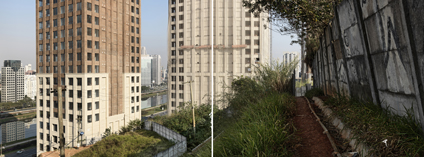
Guy Tillim
Avenida das Nações Unidas,
2011.
photograph
image size 108 x 144cm each.
'I know Tillim as a war photographer, so I’m just trying to get used to this,' says a tall blond man to an equally tall blonde woman in heels standing near me in the front room of the Stevenson gallery in Cape Town. The man is right – there are certainly some things to get used to. To be sure Tillim has again, in the second chapter of a body of work he has entitled ‘Second Nature’, moved away from the themes of his earlier work. However, like the previous rendition of this series, shown at Stevenson last year, the forms and subjects are not wholly unfamiliar.
art events calendar
VIEW FULL CALENDAR
buy art prints

edition of 60: R11,000.00
About Editions for ArtThrob
Outstanding prints by top South African artists. Your chance to purchase SA art at affordable prices.
FIND OUT MORE Editions for artthrob
If the first chapter contained the quasi-romantic landscapes of Tahiti, Tillim now exhibits what seems like generic urban tableaus, subjects immediately recognisable to anybody with a passing interest in the visual arts. Simply put, Tillim’s images, on a surface level, document the urban peculiarities of the city; in this case the city of São Paulo, with its decay, its modernist past, its contemporary burgeonings and a kind of updated Eliotesque exploration of a quotidian capitalist drudgery.
But this is a premature interpretation. In actual fact what is so unfamiliar about Tillim’s latest works is precisely the lack of ‘subject’. It is this lack that so disturbs and defamiliarises an audience aware of norms within South African photography. But this seems to be precisely the point of ‘Second Nature'; that the images are entirely devoid of the usual contextualizing elements. There is no post-colonial anxiety, no reportage, no sense of bearing witness, no depiction of abject poverty, no signs of a delusional or brutalizing totalitarianism in these works. The quietness of Tillim’s latest work is what seems to shock a local audience.
In taking Tahiti and São Paulo as his focal points, Tillim has shaken off the stultifying concerns of subject and freed himself to explore form. After all, his landscapes of Tahiti could have been done as effectively in the Eastern Cape or Mozambique, and his urban images could have been shot in numerous cities on the continent. But it is significant that Tillim chose not to use an African backdrop.
For the artist, ‘Second Nature’ has been an escape, not only from place, but also from the overbearing themes that so many South African photographers today feel constrained by. The title itself plays on the sense that Tillim is doing something that does not come naturally, documenting the disturbing proclivities of Africa. Tillim is relinquishing ‘subject’, which is his ‘first nature’, to focus on a secondary concern – a ‘second nature’. That is to say that Tillim is furthering his interest in how the camera can capture the arrangement of abstract shapes. One need only look at On the Road Between Mazar-I-Sharif and Kabul, Afghanistan (1996) an image taken through a fractured windscreen, or at Mateus Chitangenda, Fernando Chitala and Enoke Chisingi from Tillim’s ‘Kunhinga’ (2002) series, to realise his indebtedness to abstract art and cubism.
It is this indebtedness, in conjunction with the technological developments of digital Hasselblad, which lie at the centre of ‘Second Nature’. The vertical lines of the buildings are stretched outwards by the lens creating a sense of surreal tension and estrangement. The rich and deeply contrasting colours create an almost three-dimensionality reminiscent of cubism. The figures that appear on the streets of São Paulo are starkly contrasted against their backgrounds, so as to seem almost cutouts that have been placed onto the image. In Rua Sete de Abril several of the figures walking on the street seem to be backlit while one man, by an unusual trick of natural lighting, is spotlit – the colour of his jacket rendered a striking red. Another man’s plastic shopping bag becomes an unusual white translucent rhomboid in Viaduto do Chá. In Avenida das Nações Unidas the diagonal lines of long grass and vegetation, all in perfect focus, create a painterly effect that disturbs the image when set next to the uniform shapes of the buildings behind. In the same diptych, an old vibracrete wall seems to lean into the photograph’s surface itself, forcing one’s eyes to engage with an empty focal point.
Tillim’s painterly frame of reference is brought to the fore with figures and shapes, similar to those of Gauguin, which seem to be outlined. The electricity cables in an image like Rua da Consolação intersect and disturb the natural flow of the perspective, similar to branches in a Cézanne landscape. And the more one encounters Tillim’s prints, the more they become mesmeric in their formalism. The subject, one begins to realise, has no primacy here. Tillim’s works, simply put, unite post-impressionist and abstract art with the medium of photography.
The result is not as trite as it may sound. There have of course been attempts in the past to merge the concerns of abstract painting with those of photography. But Tillim is not trying to find peculiar abstract forms to photograph, he is taking photographs of urban environments and, with the use of an almost infinite depth of field, rich colours, and heightened contrast, he achieves a formalist effect that is refreshingly unique.
I still have the concerns that I brought up in my review of the first chapter of ‘Second Nature’ (in 2011, Art South Africa): that Tillim’s images themselves may be slightly clichéd and that, perhaps, ‘Second Nature’ is a case of old wine in new bottles. Another issue is the slightly twitchy feeling one gets when South African artists turn their backs on subject to concentrate on form. The Greenbergian concerns of easily digestible kitsch may at times be found circling about the rooms of the Stevenson. But having named Clement Greenberg, one realises that perhaps subject does not have to be the driving force of art and that Tillim is not frivolously turning his back on his previous considerations of reportage’s relationship to art – they are, after all, present in his other works. Rather, Tillim is closing a chapter, but not the book, on a certain manner of addressing photography and is tentatively moving forward.