cape reviews
Revenant
Minnette Vari at Goodman Gallery
By Hope de Klerk21 April - 19 June. 0 Comment(s)
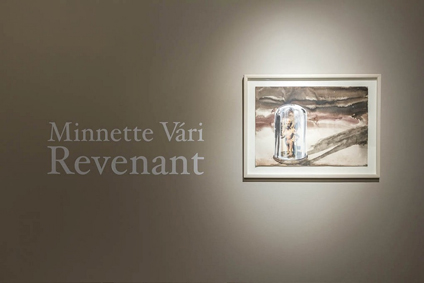
Minnette Vari
Revenant exhibition view,
2012.
various
variable.
Baubo is the embodiment of positive feminine energy, sexual liberation, and seemingly unattainable glee. She symbolises above all else the healing power of jest, inappropriate at times, as can be seen in the Greek myth of Demeter. While mourning the abduction of her daughter, Persephone, by Hades, Demeter - the goddess of the Harvest - let the crops die and the earth suffer. Her sorrow was only eased when she met Baubo, whose jesting caused Demeter to laugh. Historical depictions of Baubo have taken the form of figurine sculptures, traceable back to the fifth century BC. In these representations a female head sits atop a proportionally impossible pelvis and legs. Baubo’s vulva is emphasised as it amalgamates with her face, forming the chin. This juxtaposition leaves the contemporary viewer aware of certain unsettling absences.
art events calendar
VIEW FULL CALENDAR
buy art prints
edition of 60: R5,000.00
About Editions for ArtThrob
Outstanding prints by top South African artists. Your chance to purchase SA art at affordable prices.
FIND OUT MORE Editions for artthrob
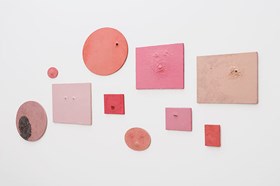

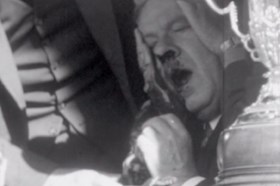
And in Minette Vári’s recent show, 'Revenant' at Goodman Gallery Cape, it is Baubo who greets you upon entering. The first wall of the exhibition features four large drawings, an unusual medium for Vári, which vividly depict The Life of Baubo (Apotrope Series) (2011). The series moves through a variety of expressions, from sorrow to trepidation, to outright ecstasy, all in the absence of Baubo’s vital organs! Without a certain background knowledge, Baubo’s irrational figuration in a contemporary composition could be interpreted as the artist’s own manufacture rather than a more astute citation of the absurd ancient icon. The choice to present the works without titles also leaves the viewer stranded in a sea of floating signifiers. The only mediation of the work in relation to Baubo history is an A4 print-out placed next to the price list at the front desk: another disorienting figuration perhaps. One has to wonder whether Vári’s decision to begin producing drawings (an easily packaged and consumable medium) has resulted in the absence of her work’s former experimentation.
In any case, Baubo appears in two more bodies of work within the exhibition. Two much larger drawings – an extension of The Life of Baubo (Apotrope Series) – depict the figure playing in front of a mirror. Surrounding these compositions are five smaller pieces, in which the Baubo figure is surrounded by an assortment of other icons such as a skull and a donkey, while in others she is seen traversing various spatial contexts.
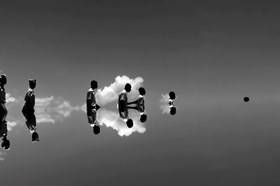
The mirror seen in the Baubo drawings recurs in Vári’s Revenant series (2012) which makes its eerie presence felt in the remainder of the gallery space. On one wall, a haunting video projection presents the filmic version of the seven black and white oval stills, framed on the opposing wall. Present in each of the stills is the same Victorian mirror, which, as in the Baubo drawings, functions as a reflective device of the figures within the frame while also alluding to the presence of something unseen and otherworldly. The unassuming oval frames could be hung in any stereotypical family home.
That familiarity however is ultimately estranging, and in a truly Freudian gesture Vári furthers that sense of the uncanny by placing a chaise longue in front of the projection wall. Combined with the ghostly chant accompanying Vári’s video piece, the Revenant (meaning: a person who has returned, supposedly from the dead) affirms the artist’s return since her last solo show in Cape Town five years ago.
In the centre of the gallery is the Charm Series (2012), marking Vári’s collaboration with designer and goldsmith Cronjé Grobbelaar. Each of the objects in the Charm Series is made out of space debris, a fact that is completely elided by the elegant display on a long plinth, underneath glass bell cases. There are seven charms, one for every day of the week, and each relating a specific metal to a specific deity. The display, once again, misses the thematic mark as the viewer is left unaware of this series’ connection to the apotropaic capacity of Baubo. An apotrope can be understood as a symbol, object or ritual used to ward off negative spirits.
The final part of the exhibition comprises a row of LCD screens showing a sequence of seven videos. Here, the Baubo figure makes her final appearance crossing from one screen to the next, backgrounded by a recognisably South African landscape. The work’s skilful installation is to be congratulated, and Vári’s use of multiple media to represent her recurring motif is interesting. The soundtrack, however, conflicts with the eerie chant of the Revenant work, and together with the visual strength of the LCD wall, the former diminishes the affect of the latter.
Overall, it is evident that Vári is still experimenting with ways of representing her deeply-researched subject matter. Unfortunately, the configuration of themes present in the Revenant exhibition leaves a number of vital organs overexposed and disoriented.
Hope de Klerk is currently completing her Honours degree in Art History at the University of Cape Town.