cape reviews
The factums of a South African emigre returned
Candice Breitz at Iziko South African National Gallery
By M Blackman25 April - 22 July. 0 Comment(s)
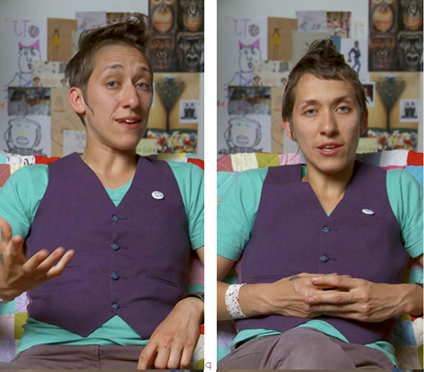
Candice Breitz
Factum,
2009.
Video Still
.
Is South African art merely the addendum to pudendums and race? One would hardly be at fault for thinking that at least the second part of this was true when listening to some of what Candice Breitz said while talking to a group of young students at her exhibition 'Extra' now on at the National Gallery. ‘White South Africans,’ she stated, at the walkabout, ‘have caused all the problems, as you know’.
Happily for South African art, Breitz’s own work complicates this over-simplified sentiment. In Breitz’s talk she had previously suggested that identity is a complicated and faceted construction. Her intimation seemed to be that identity is relative to the time and to the social forces that are at play, and that these fluid ideas should constantly be under the microscope of reinterpretation.
This is, in fact, one of the conceits that seems to underpin the first of Breitz’s works one encounters at her exhibition at the National Gallery. Ghost Series, a work from 1994, displays the Tipp-exed out bodies of figures on postcards dressed and photographed in a tribal idiom. On one level it questions (or protests against) the heteronymous relationship Europeans have had with African identity. But this whitewashing is not merely a protest against ‘white’ hegemony over African representation. The work goes much further than that, despite Breitz’s own suggestion to the contrary.
art events calendar
VIEW FULL CALENDAR
buy art prints

edition of 60: R7,000.00
About Editions for ArtThrob
Outstanding prints by top South African artists. Your chance to purchase SA art at affordable prices.
FIND OUT MORE Editions for artthrob
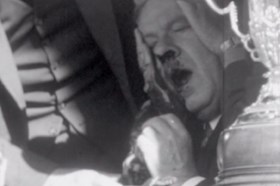
On one level the work questions one of art's most enduring and noisome debates. That is to say, who is constructing the image of the artwork and to what degree is the subject’s own agency actively engaged in this construction? But its whitewashings also go deeper than that. For they not only wittily reference the cultural practices of initiation but also put into focus those ‘cultural’ practices of censorship and self-censorship that have always affected South Africa. Ghost Series, although it can be read as a brazenly simple statement, is also a work of extreme subtlety whose reading produces as many questions as it does answers. With its use of humour, satire and irony, it queries the broader complexities of identity and its construction.
This examination is taken further in the next room in the work Factum. Here, in a series made in Canada, video portraits of twins are mirrored by two conjoining screens. Edited and reconstructed by Breitz to create the effect of a dialogue, the work is perhaps one of the most engaging video pieces to be shown at the National Gallery in the last few years. The series documents identical twins, dressed in identical clothes, talking about their lives and their understandings of their personal identities.
What is present in all of the pieces are the weaving narratives that, at times, stray from a single identity into separately developed characteristics only to return again to homogeneity. Of course Breitz is playing with the idea that there are several people involved in this construction: the person asking the questions, the video editor, the viewer and, of course, not least the twins themselves. Like in Ghost Series, the notion of both verbal and visual language never ceases to complicate and explicate the construction.
Her final work Extra, however, is perhaps the most difficult with which to come to terms. In it Breitz inserted herself into an episode of the soap opera Generations: each scene is shot with her posed in either a position of eavesdropper, disinterested viewer, or as a physical impediment for the actors to ignore. On the whole, Breitz’s use of humour to communicate her feelings of both irrelevance and obstruction in the country she left in 1994 is entertaining.
However, for this reviewer at least, Breitz’s interventions are a little too constructed and their symbolic meaning is a little too obvious to be interesting. Throughout the piece, one cannot help feeling that what carries the work is the television series itself rather than Breitz’s intervention into it. As a first time viewer of the programme, I couldn’t help but be impressed how well the writers of Generations had adapted the soap opera trope to a South African context. However, like the soap opera itself, Breitz doesn’t offer anything new to a person well versed in South Africa’s concerns. In fact, her positionings are all too often an over-simplification of what she is trying to explore: the role and complications of white identity in a contemporary South Africa.
Throughout one can’t help but feel that her physical posturings are something relative to her own emotions - having lived outside the country - and not the ones of those who have grown with South Africa’s post-1994 construction. This in itself would be fine were it not for the clear indication in the work, and confirmed at her walkabout, that Breitz is standing in for what she believes to be a white ‘everyman’. Certainly the issue of white guilt remains relevant, but it is more nuanced than Breitz’s pensive ruminatings in corners or her physical hindrances will allow.
Surely one just needs to pick up a newspaper to discover that the ‘whites caused all of the problems, perpetuated all the violence, should feel awkward and must go and stand in the naughty corner’ discourse is only one of the many dialogues that informs the new South African identity. In fact, Generations’s appropriation of the soap opera trope is testament to this complication. However, this idea is not one that Breitz seems comfortable addressing and this is perhaps the work's major failing. Simply put, Brietz’s intervention in Extra is ill-suited for its time and vastly over-simplified when compared to her other works in the exhibition.