cape reviews
The Worship of Worthless Things
Michael MacGarry at STEVENSON in Cape Town
By M Blackman24 May - 07 July. 0 Comment(s)
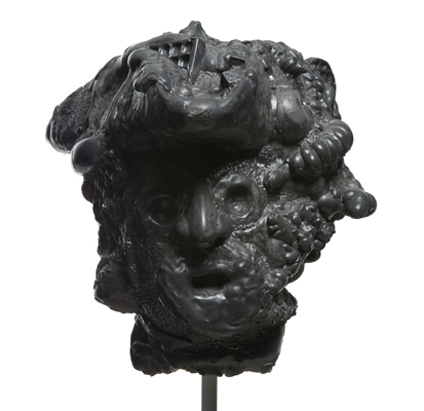
Michael MacGarry
Dutch Coward,
2012.
Cast polyurethane
41 x 31.5 x 34.5cm.
Gaudiumus igatuer (Latin for ‘let us therefore rejoice’), the name of one of Michael MacGarry’s sculptures in his latest exhibition, is perhaps the key conceit underpinning the show itself. However, this is not to say that ‘The Other Half: Past, Future and Now’, on at Stevenson Cape Town, is a happy celebration: far from it. It is far more concerned, in a sense, with the rest of the old academic commercium song. For although the song is widely known by its first line it is in fact called De Brevitate Vitae or On the Shortness of Life.
The commercium is, itself, a playful collection of jocular platitudes concerning the inevitable loss of youth and expresses a not-too-serious hope that the student’s academy will live forever. Ostensibly a young man’s drinking song, it, like much of MacGarry’s work, contains a flippancy that dismisses the gnomic seriousness that most academies demand, while at the same time paying a kind of homage to it.
MacGarry has always steered close to the shores of art history’s academy, noting and referencing those significant twentieth century outcrops of Dada and its derivatives – in particular ‘assemblage’ and ‘conceptualism’. And like so much of what underpinned those movements, MacGarry displays a certain ambivalence towards the art object itself - both confirming and denying its centrality. However, here in ‘The Other Half’, MacGarry seems to have gone a step further as he rather surprisingly turns his attention to a theme that seems to be marking out his generation.
art events calendar
VIEW FULL CALENDAR
buy art prints

edition of 60: R7,500.00
About Editions for ArtThrob
Outstanding prints by top South African artists. Your chance to purchase SA art at affordable prices.
FIND OUT MORE Editions for artthrob
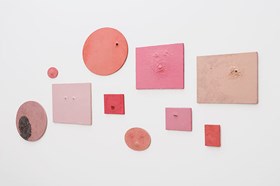
Gone are the machine guns and the theory and in their stead MacGarry anchors himself where many of his contemporaries have recognized as a fitting place to bring on board artistic sustenance; that is to say a reflection on childhood. Recently Georgina Gratrix, Chad Rossouw and Khaya Sineyile have all had exhibitions in which the theme of childhood played a prominent role. The similarities of course do not end there for, like those artists, MacGarry too employs humour. What makes his work different, however, is the clear lack of sentiment and nostalgia.
Making up much of the show is a series of polyurethane sculptures, with a collection of various childhood objects which are ‘assemblaged’ into sculptures of busts and body casts. Cricket pads, fairy cakes, toy boats, monkey nuts, sausages, golf balls, waffles, chocolates, the odd toy castle, a beer barrel here and there, seashells, all make up the various objects that form the coagulating shapely-misshapenness of his sculptured molds.
Yet in their form and presentation they are not underpinned by any sentimental sojourn. For unlike so much of what might be called the ‘hipster’ generation’s concerns, MacGarry seems to handle these objects without the slightest wistfulness. Rather, in MacGarry’s hands, they become the carbuncles and deformities that twist and distort his sculptures out of shape. As he has written about his current exhibition: ‘[m]y basic, animistic intent is to articulate and remake the products, objects and physical things I owned and experienced during my youth in the last century, projecting, manufacturing and assembling these things for the second half of the 21st century - a time when I will be dead.’
The absence of sentiment becomes an almost open hostility as he renders and melds them into his sculptures. In The Price of Being Wrong the bust’s eyes are covered with discs and an ancient ship, laden with clotted matter protruding from a headdress. And again in Dutch Coward a waffle and dice project themselves from the cocked hat atop a face bearing a Groucho Marx nose, creating a terrifying whole. These toys of childhood play and imagination become visions of a deformed and disturbed creation; distorted cyborgs of some future genetic malfunction. And it is this jumble of disturbed objects - with their titles also seemingly collected and thrown in from that untidy heap of ‘culture’ - with which MacGarry confronts his audience.
It is here that he pays homage to Dada. For where he shares some of the concerns of somebody like Rossouw about the corrupting and manipulating potential of the objects children are given to play with, he seems to share nothing of Rossouw’s obvious affection for them. MacGarry’s Dadaist attitude echoes what Duchamp suggested was at the heart of the movement. Something he felt that got misplaced in the future movements, as when he said: ‘[w]hen I discovered the ready-mades I sought to discourage aesthetics. In Neo-Dada they have taken my ready-mades and found aesthetic beauty in them.’
This dismissal essentially seems to be MacGarry’s pronouncement: the objects of youth are not sentimental, aesthetically pleasing and beguiling totems. They are rather the very things that have been instrumental in launching us into our much-prefigured future dystopia. Of course, what is also at the heart of these creations is MacGarry’s own playful irreverence and ‘childlike’ lack of regard. And in some way this playful contempt and Dadaesque dismissal may go some way to explaining the poor finishes of many of the objects on the show. The welds, for example, on Motorbike Fetish are sloppy, the paint on some of the sculptures is cracked, his drawings are lazily completed. However, rather than detracting from the exhibition, this incompleteness adds to the general scorn for aesthetics that pervades the show.
The exhibition, like the song mentioned at the beginning, contains a bawdy jocularity that both celebrates and dismisses. And if at times the exhibition itself seems to be drunkenly singing out: ‘long live the academy’ (for what it is worth) ‘for our own death will come to us quickly and nobody will be spared, one can almost imagine MacGarry himself, sitting amongst the vile and coagulated detritus, adding that ‘and that death will be spawned from our own worship of worthless things.’