cape reviews
Wandering Styles in Yonder
Lien Botha at Barnard Gallery
By Chad Rossouw21 March - 01 May. 0 Comment(s)

Lien Botha
Graveyard, Kenhardt, Northern Cape, South Africa, September 2012,
2012.
Inkjet on cotton rag paper
674 x 500 mm.
It’s hard to place your finger on exactly what Lien Botha’s recent show ‘Yonder’ is all about. What can perhaps be said about it, is that it seems to be a purposeful sleight of hand, a shifting of meaning away from the concrete, which is at odds with the indexical nature of the photograph. This ‘sleight’ is in part achieved by a wandering style, a trawl through multiple modes of photographic representation. Throughout these styles, there seem to be four major themes.
art events calendar
VIEW FULL CALENDAR
buy art prints
edition of 60: R7,000.00
About Editions for ArtThrob
Outstanding prints by top South African artists. Your chance to purchase SA art at affordable prices.
FIND OUT MORE Editions for artthrob
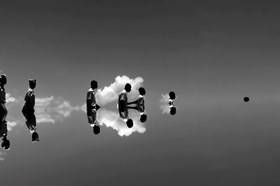

Lien Botha
Witdraai I, Kalahari, South Africa, September 2012
Photographic print
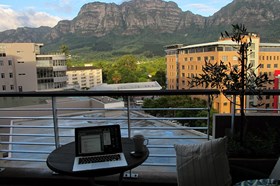
The first is the various ways in which animals are represented, from the museum, to the ornament, to the toy. All these representations are static, and hover between being pathetic and humorous. This is the least consistent theme in the show, present only through some of the works. The museum shots in particular make me think of the considered work of Hiroshi Sugimoto, though without the joy of illusion. The second theme is the way light falls onto static objects. Botha’s work consistently captures exquisite light. These images take on a contemplative feel, like Hotel Panari I or Bamako Airport, that is reminiscent of Uta Barth, though the consistent sadness is absent.
The third theme is the one signified by the title, ‘Yonder’, a sense of moving into that which is outside of Botha’s everyday experience. The title implies a Romantic or spiritual dimension, a Byronic investigation of interior states through moving in the world. This is emphasized by the framing of the images, each having GPS coordinates sandblasted onto the glass, and by the road-trippy feel. In images like Wolli Wolmarans Lioness, Kleinmond the composition reminds me of Pieter Hugo, while the concept of the road trip into the ‘Outside’ is a trope of South African photography, along with a fascination with small towns and decaying kitsch. It is the classic romance of the South African trip into the ‘unexplored’ land, from Thomas Baines through to Roger Ballen, in which emotion is transposed onto the landscape and its people.
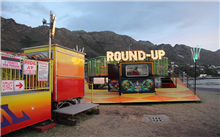
Lien Botha
Round-Up, Gordons Bay,South Africa,July 2013
2013
Inkjet on cotton rag paper
674 x 500 mm
The fourth theme gives the work its charm and mystery. There is a distinct sense of absence in all the photos. Some of these images, like Hotel Panari II, Nairobi, Kenya and Round-Up, Gordons Bay, have a revelry in the mundane, that reminds me of William Egglestone or Stephen Shore, though without the hard edge of criticism of the middle class. Most obviously there is a complete absence of human bodies. The images do however, contain traces of human interaction with the environment, sometimes barely there (a line of rocks, a fence) and sometimes more explicit (a giant swan, a stuffed lion). In these seemingly empty tableaus there is human interaction that is significant to the enigmatic nature of the work: an implication of presence by revealing absence.
Each of these images implies a bigger missing whole, just outside the frame. It operates on this level, with humans, but it also operates more generally as a fragment or a slice of time of the trip Botha was on, or of the place she was at. This idea is reinforced by the GPS coordinates, which are in a highly specific technical language, yet when freed from actually having to point to a place (they are etched into glass, not typed into Google Maps), become something beyond their use value, and signify a kind of ‘yonderness’.
The action of presence by absence is perhaps most strongly felt in the relationships of the photographs to each other. As I mentioned there is a wandering of style and subject matter throughout the images, and yet they are presented as a single body of work. The absence of an easily accessible unifying theme within this context implies a mysterious wholeness, one that is just out of reach. It is this yearning for closure and our mistaking formal completeness for meaningfulness that is at the heart of the show’s enigmatic quality. Yet there is a satisfaction in this quasi-closure.
As a final point, the formal completeness of the show was let down by occasionally sloppy post-production, visible sharpening and moiré effects. While it didn’t break the show, I was disappointed to see these lapses from such an accomplished photographer.