cape reviews
Mime: an Interview with Dale Washkansky
Dale Washkansky at Commune.1
By Chad Rossouw05 December - 23 January. 0 Comment(s)
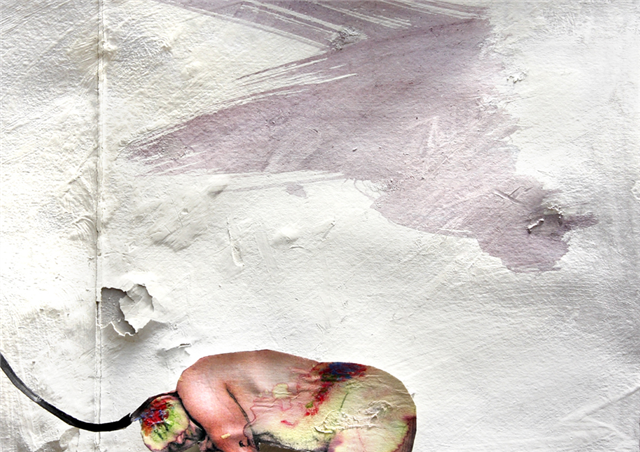
Dale Washkansky
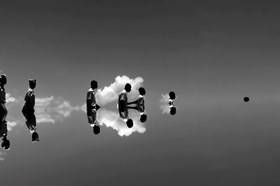
Untitled (Collage Series),
2013.
Lightjet photographic prints
42 x 59.4cm.
Dale Washkansky’s works often deal with Jewish and sexual identity, memory and post-memory, the holocaust and the language of photography.
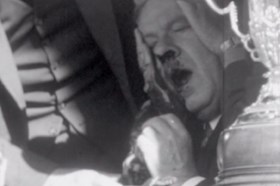
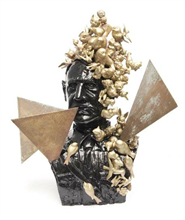
In his current exhibition, ‘Mime’, at Commune1, you enter onto a series of exuberant sculptural busts, which combine a traditional military form with bright interruptions. A black enameled man is covered with gold porcelain birds, and skewered by sheets of brass. In another work, a spray of plastic flowers emerges from its face, while the uniform is painted a lurid peach. As the series continues, the sculptures become increasingly abstracted. The walls surrounding this sculptural installation were filled with collages, which had been re-photographed and printed. Dale and I had an email exchange about his exhibition.
art events calendar
VIEW FULL CALENDAR
buy art prints
edition of 60: R5,000.00
About Editions for ArtThrob
Outstanding prints by top South African artists. Your chance to purchase SA art at affordable prices.
FIND OUT MORE Editions for artthrob
Dale Washkansky
Untitled (Sculpture Series)
2012
Ceramic, enamel paint, brass
60 x 60 x 23cm
Chad Rossouw: In the series of sculptures you seem to have two distinct aesthetics. The first is a juxtaposition between formal busts and an exuberant, campish kitsch, while the second seems to be a reworking of almost abstracted, Constructivist forms. Two questions: What is your interest in Kitsch, and why do you use it as an interruption? And, why do you reduce some of the forms to a geometric abstraction?
Dale Washkansky: I got the idea for the sculptures when I saw a picture of women in a factory setting making little Hitler busts. I imagined that they would end up in people's homes on their mantle pieces among kitsch domestic objects. So I wanted to play with that kitsch element as a means to debunk the busts. I then decided to play with the form to see, if I reduced it and abstracted it, if it will still read as a Hitler bust.
CR: The collages seem to have three major sources of images: popular memory, personal archive, and your own body. Why do you insert your own, often sexualised, body into these sites?
DW: I insert my body into the collages as a means to bring that history into the present, as a way to exhume the past. It is also a way to begin to create self-representations of the Jewish body, which has a long history of being represented by others. It also forms part of my intention of attempting to move towards the naked body, so the body is stripped of clothing and other signification that would mark it culturally and historically. The signification comes from its association with other images.
CR: How is the process of re-photographing the collages important?
DW: I re-photograph the collages to comment on the process of post-memory. I am very aware that the history I am working with has become taken over by representation. The viewer therefore does not have access to the original moment, only its copy. The original collage becomes a moment that is no more, so it was important to evoke a sense of instability with the compositions. In my previous work, I tried to dig beneath the surface, but here I was working with surfaces that were harder, perhaps more impenetrable, but more unstable.
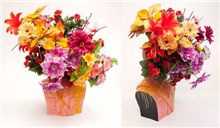
Dale Washkansky
Untitled (Sculpture Series)
2012
Ceramic, enamel, paint, artificial flowers
80 x 50 x 45cm
CR: The work refers to the trauma of the holocaust. How did your visit to the concentration camps affect your ideas of this history?
DW: Having visited some concentration camps it became evident how this past is inaccessible to me, that no matter how much I try to imagine it, it remains beyond my comprehension and imagination.
CR: In your previous body of work, ‘A Space Between’, there seemed to be a more visceral sense of violence, both direct and implied. It seems to be toned down in ‘Mime’, or at least infused with a sense of humour. There is also a joke piece on the show. Why is humour important?
DW: The humour is intended to work in a similar way that kitsch is employed. I am concerned by the notion that there are acceptable and unacceptable ways to remember. I am also concerned by the construction of iconography that stabilises the past. Humour and kitsch can debunk and unsettle previous representations and open up spaces for continued investigation and critique.