
cape reviews
Orders and Divisions
Gina Heyer at Brundyn
By Chad Rossouw22 August - 03 October. 0 Comment(s)
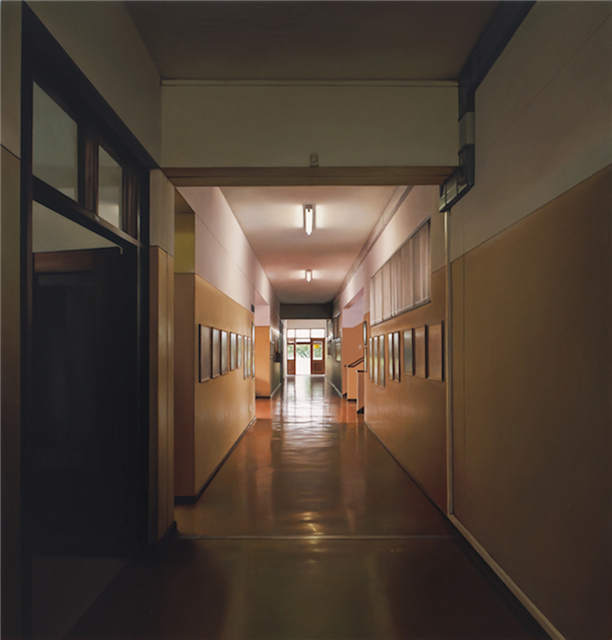
Gina Heyer
Single File ,
2011-2012 .
Oil on board
44 x 46cm .
I remember once when my mom was late to pick me up from school again. I’d spent my last 50 cents in the tikkie box only to connect to the answering machine; all hope of being picked up falling along with that coin. Kicking up and down the empty corridors, an unloved, lonely feeling came over me. This emotion was compounded by the absence of shuffling feet, ringing phones and shushed voices. This absence was only noticeable because of its implied presence, as if the building still echoed with these noises. It had sublimated the sound into dusty corners, cracked bricks, thinning linoleum and the glassy reflection of an ancient staff portrait. There’s nothing more lonely than a school at 4:30. (Mom, if you’re reading this, I know you didn’t mean it.)
Gina Heyer’s super-real paintings of school corridors in her recent exhibition, Order & Division, sharply invoked these memories. Not only in the representation of the corridors and staircases, which I think would strike almost anyone’s vestigial school nerve, but also in her pared-down compositions, her purposeful emptiness and her flat, smooth surfaces. In fact, so empty and clean are her forms and spaces that it borders on representational abstraction. An oxymoron to be sure, but there feels like something of the modernist’s abstract lurking in the corners of her careful perspectival figuration.
art events calendar
VIEW FULL CALENDAR
buy art prints

edition of 60: R8,000.00
About Editions for ArtThrob
Outstanding prints by top South African artists. Your chance to purchase SA art at affordable prices.
FIND OUT MORE Editions for artthrob

Take a step closer to the paintings though, and this smooth surface is interrupted by little specks of dust caught in the paint. For me, beyond the awe of Heyer’s technical ability (which is ridiculously accomplished), beyond the mawkish feelings of schoolboy sorrows, these little flecks of skin, mites and dirt embedded into the surface activated these paintings. They speak of time passing, of motes caught in the afternoon light and intimate the slow returning of objects and people to their inevitable state of decay. Settling onto the surface and getting caught in the oil, these specks reminded one that these works were rendered slowly and painstakingly in paint. Heyer’s processes are revealed further in both Upper Stairs and Lower Stairs where minuscule dams of paint have built up due to the masking process used to create the hard lines of the edges of the walls – these little flaws reveal the labour. And it is this painstaking technique of representing (crisp, super-real) which seems wholly appropriate to the subject matter: labouring painter matching labouring scholar, the endless lick and tickle of tiny brushes replicating almost perfectly the dents and draggings of students’ feet on linoleum floors. There seems to be a desire through work and time to penetrate the surface, to get under the linoleum to some concrete revelation beneath.
However, revelations of mediumness, when the medium reminds us that we are looking at a rendered surface, are a double-edged sword. In Basins I and II, the regular shapes of the basins distort towards the edges, replicating the curvature of the lens in her source material. It reminds one of the snappy quickness of a photograph, which seems to have no place in this quiet labour-intensive world. While of course, such intricate renderings could hardly be achieved without the use of photographs, seeing it laid bare breaks the suspension of disbelief.
Heyer’s title – ‘Order & Division’ – suggests that my semi-nostalgic feelings for labours past are not her main focus. Indeed her representations of funnels and passageways, surfaces and penetrations suggest that the main subject is the rhetoric of these kinds of spaces. There is the idea that the planes and sections of the architecture perpetuate certain behaviours: a division between students and staff, boys and girls, strong and weak. They take on an aura whose sentiment lies in a set of archaic beliefs handed down to us from the Athenian Lyceum via British public schools. These schools Heyer chooses so obsessively to portray become incubators of conservatism: no open-plan rooms, no mixing outside the playground. The contemporary gaudiness of this pretension of classical education and its rhetoric of conservatism is contrasted by the needs and deprivations of a modern, budget-constricted institution: easy-clean beige enamel paint, flourescent lighting, those little hygiene balls in the boy’s urinal, and aluminium windows.
Of course, these observations are neither new nor particularly perceptive. Here, the mediumness of painting rears its head: besides an intensive illusionism, what does super-real painting offer us in terms of a study of space? I am caught again by the dust. It must be a litany of labour, precise copying as an almost religious undertaking. Heyer’s studio is a medieval scriptorium, where knowledge is gathered to be endlessly and repetitively copied. An apparent contradiction strikes, though. Copying by hand is an essentially useless task today. Better technologies exist, as her photographic source material attests. What we are left with when the function is removed is the rhetoric of copying, of slowness and precision. It creates an effect of profundity and an illusion of careful thought. Rather than producing critical insight, it reflects the Protestant work myth which is drilled into us by these very schools. Work is good. The harder you work, the more you penetrate the mysteries of God. However, this ethic of moralistic labour, while possibly profoundly spiritual on an individual level, has collectively laid the foundation for modern capitalism.