cape reviews
The Ambiguous Life Sentence of Misheck Masamvu
Misheck Masamvu at blank projects
By M Blackman03 April - 03 May. 0 Comment(s)
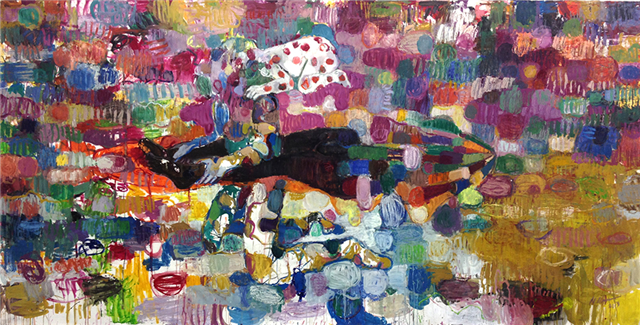
Misheck Masamvu
Munamato Wemusoja,
2013.
Oil on Canvas
210 x 400 cm.
I realise that what I am about to say is deeply conservative (and I can already hear my critics’ fingers rhythmically beating out a denunciating pamphlet of protest upon all the social networks known to the middle-class civilized world). However, in an art world that is descending into quasi-abstract expressionism – where blobby painting after blobby painting is produced in a tired repetition of three generations ago – what I really want to see in painters’ works is that they are in control of their medium. Show some skill – it’s a piece of old hat, but hats serve some purpose, both practical and aesthetic.
art events calendar
VIEW FULL CALENDAR
buy art prints
edition of 60: R6,000.00
About Editions for ArtThrob
Outstanding prints by top South African artists. Your chance to purchase SA art at affordable prices.
FIND OUT MORE Editions for artthrob
Having missed the Zimbabwean artist Misheck Masamvu’s first exhibition at blank projects at the end of 2012 meant that I hadn’t formed a complete opinion of his work. He seemed like he had potential. It looked like he ticked most of the boxes that are required for me to like an artwork. He was not scared to make statements and these statements did not seem to be obvious ones. What is more, he employed humour in doing so and his work was not caught up in anybody’s wake. There were no real signs of a derivative influence (no major signs of Richter or Basquiat or Pollock or Sekoto).
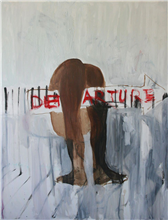
Walking into his exhibition, ‘Life Sentence’, on the opening night, the question of skill was answered. But what caught me first was the black humour. In Departure (2014) a half-formed body slumps over an arrow sign with most of the word ‘departure’ written, seemingly haphazardly, on it. It conveys something of the helplessness of the act of leaving – doomed if you do, doomed if you don’t. That same feeling of the flat thud of the futility of human action is twisted into something slightly different in the painting Aim or Maim (2014) in the next room. Here what seems to be conveyed is a brutish idiocy. An Oscar Pistorius-shaped body, with the bottom of an amputeed figure on ‘blades’, punctures a wall (perhaps a door) headfirst. With all the humour of a Shrigley, Masamvu at the same time conveys something a little more complex: the brainless rampaging-bull act of violence that is so distinctly Southern African.
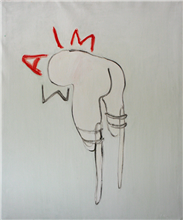
But what also adds to Aim or Maim (2014) is the form of the body. This is one of many examples of Masamvu’s figures in outline. What distinguishes his work from so many other painters today, who work in a similar genre, is that unlike the many ‘naïve’ figurative works of his contemporaries, Masamvu’s simple outlines contain just the smallest hint of a Renaissance attitude to representing the body. There is certainly something of Michaelangelo’s modeling in works like Naked Mind Project (2014); Munamato Wemusoja (2013); and, in particular, in the hand of the figure in Ngoma ndiyo ndiyo (beating the same drum) (2014).
But perhaps what is so appealing about Masamvu’s paintings is their ambiguity. They lack the sententious moralizing that is often overplayed by the political/social commentary that has pervaded so much of the last 20 years of Southern African art. This is not to say, however, that there isn’t something deeply political about his work; politics and social commentary are his very subjects. One gets the feeling that Masamvu is in a process of exploration. He has not simply read the newspaper or digested an essay by Foucault or Žižek and decided to reproduce it visually. Instead, he seems to be involved in a process of trying to express our emotional relationship to these social and political discourses. In ‘Life Sentence’ Masamvu mirrors a world of uncertainty, a world of imperfect information where identity and meaning are not quite what they are stated to be in popular expression.
In the work Ngoma ndiyo ndiyo (beating the same drum) (2014), a figure with a colonial-style redcoat stands proudly upright, in the pose of a military portrait – the Renaissance hand rests easily at his lower stomach. Large feet (which recur as big hands do in the work of Michael Taylor) seem to be made for trampling. A black body with a white leg – the human flotsam of Africa – lies over the figure’s shoulder. The head of the figure of hybrid identity is in disguise, in a Marx Brothers nose and glasses.
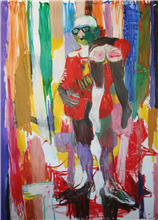
Misheck Masamvu
Ngoma ndiyo ndiyo (Beating the same drum)
2014
Oil on Canvas
210 x 150 cm
And yet I couldn’t help but feel – it was the first thing that jumped into my head – that underneath the disguise lies the head of Robert Mugabe. The squareness of brow and the Hitleresque mustache that sits under the nose may assist this reading of the figure. Here, it seems to me, the true post-colonial figure is produced, with all its ambiguities and hypocrisies representing the amalgam of the African experience.
I said at the beginning of the review that what first struck me was the black humour in ‘Life Sentence’. This is not entirely true, for what first struck me was Masamvu’s skill, both imaginative and technical. And it is these two attributes that set him apart from some of the other artists who are working in a similar vein. Certainly his influence can be seen in the work of his fellow studio mate in Harare, Portia Zvavahera, who was recently exhibited at Stevenson Gallery in Cape Town. Blank projects have done well bringing Masamvu into their stable; it is certainly a sign that many of the bigger galleries are missing tricks.