gauteng reviews
'1 mile squared'
Lee Griffiths, Kyla Davis, Anthea Moys and Sandra Hall at Johannesburg Art Gallery
By Anthea Buys01 October - 30 November. 0 Comment(s)
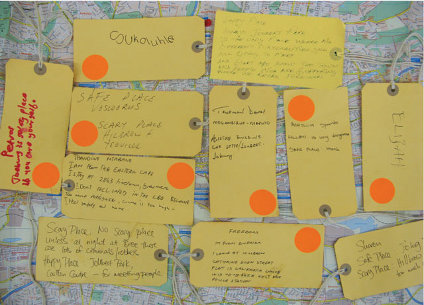
Documentation from '1 mile squared', Johannesburg,
2009.
mixed media
.
At the best of times, the Johannesburg Art Gallery is barely a blip on the gallery-hopper’s radar, a place to which one ventures only in support of an opening of a big name in the art world or a friend. These openings are packed to the rafters. The drudges serving canapés don’t quite make it through the kitchen door before they are descended upon by a pack of hungry culture vultures. However, the rest of the time, and for less important openings, the gallery’s halls tend to gape. After school hours and on weekends, children who live nearby, who have parents working at the gallery or who are just passing through (the single advantage of the gallery’s location is its proximity to the Noord Street taxi rank and market) sometimes stop in at the gallery and play in the foyer or downstairs. At other times, schools might be bussed in (again, only for important shows). But otherwise what happens in the JAG seems to stay there.
art events calendar
VIEW FULL CALENDAR
buy art prints
edition of 25: R4,500.00
About Editions for ArtThrob
Outstanding prints by top South African artists. Your chance to purchase SA art at affordable prices.
FIND OUT MORE Editions for artthrob
A recent project undertaken by Anthea Moys and performing artist Kyla Davis, in collaboration with two English artists, Lee Griffiths and Sandra Hall, is a case in point. Titled ‘1 mile²’, this project is a two-month long intervention in the city of Johannesburg, taking a square mile (or 1.6 km²) of territory around the JAG as its workshop. The Johannesburg leg of ‘1 mile²’ is part of a three-year programme, launched from the United Kingdom in 2009, that ‘addresses the interrelation between culture and the environment within diverse societies, and provides creative learning opportunities through a process shaped by artistic practice’, according to the project’s official statement. What is essential to these ‘interrelations’ in each instance of the project is the participation of ‘the community’, that evanescent entity hanging out in the wings during every socially-engaged art project ever staged.
In ‘1mile²’ the community - which comprises individuals who live near, or bide their time in, Joubert Park – assist the artists in creating various maps of their experiences of the neighbourhood. These maps, like the psychogeographic records created by the Situationists in Paris in the 1950s and 1960s, suggest that the apparent character of the city is derived from ambulatory truths – things discovered in the thick of Joubert Park’s frenetic street life – rather than from official historical narratives.
One map documented the presence of trees around Joubert Park and was flavoured by individual narratives telling of the personal significance of trees for each participant. Another catalogued locations identified as ‘safe’ and ‘scary’ by a group of children. Hillbrow was almost unanimously voted ‘scary’. In response to this, the artists devised an intervention in which flowers begged from gardens in the well-to-do suburb of Parkview were used to decorate the outdoor ring at George’s Boxing Gym (George’s) on Claim Street. Moys has a long-standing professional relationship with the proprietor, George Khosi, and while the boxing ring itself is not a particularly scary place (in fact it is very pleasant, thanks to the general pleasantness of George), its transformation is symbolic of the defenceless taking charge of those aspects of Hillbrow which make it frightening.
The connections established between Hillbrow and Parkview were tested when the donors of the flowers and the project participants were invited to attend the finale event held at the JAG on November 1. The event was attended by several of the participants but comparatively few of the Parkview flower-donors. This encounter was rewarding for some, particularly for one lady from Parkview whose flowers had been adopted by an elderly tenant in a building near George’s. The display in the JAG project room, which throws some visitors because it simply doesn’t look like ‘art’, serves as a live archive of the project until the end of November. Moys squeezed and served fresh orange juice (the orange skins are now pinned to the wall), while Kyla Davis took boxing lessons from Khosi in the centre of the room. In the adjacent room, which is usually reserved for video projections, a giant hand-drawn map is taped to the floor with tree narratives adorning the walls around it.
Once these project traces are removed, the community engaged, or perhaps defined, by ‘1mile²’ will be connected to other, similarly construed communities around the world through the ‘1 mile²’ website. This seems a noble enough gesture, but I wonder how meaningful this ethereal network will be to Joubert Park’s residents and guests. More immediately, I wonder to what extent local participants in ‘1 mile²’ can be called a community? ‘1 mile²’ Johannesburg undoubtedly touched many of the project participants. This is evidenced in the fact that since the completion of the intervention phase, Banjoh Matonga, an artist and playwright who is also a Zimbabwean refugee, has taken over the project archive at JAG and continues to expand it through newly gathered stories and other bits of documentation. Hopefully Matonga will develop a lasting relationship with the JAG or another arts organisation. But if he doesn’t, what will become of him after November 30? Does this level of concern for a participant even fall within the scope of the project?
Before the era of socially engaged and ‘relational’ art, artists did not, of necessity, have to lose sleep over these questions. Art was there simply to point to something, to create an aesthetic experience, to push its own, or someone else’s limits. But the success or failure of socially engaged art seems to turn on its moral content, whether or not it upholds certain normative values approved by the art ‘community’ (another spurious entity). For example, if ‘community’ is prized, then getting along with other people is one of these normative values, and displaying a certain level of conformity, another. While these might not be bad values to espouse, perhaps giving artists and artworks the responsibility of espousing them is a tall order. Besides the fact that artists, like most ordinary people, are morally fallible, the subjection of art to strict yet often ill-defined external principles seems somewhat fascist. That is not to say, however, that ‘1 mile²’, and the efforts of those involved in the Johannesburg instance of the project, are not glowing with admirable intentions.