other reviews
'Body of Evidence'
Jay Pather at The Playhouse
By Peter Machen17 October - 19 October. 0 Comment(s)
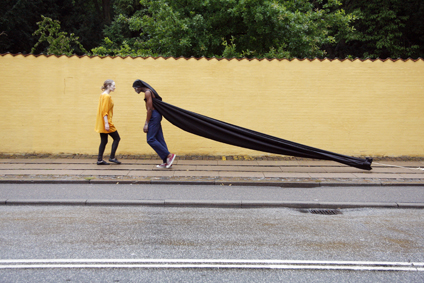
Jay Pather
Blind Spot, Metropolis Biennale, Copenhagen photograph 1,
2009.
Documentary Photograph
.
Dance me to the edge of art
Peter Machen talks to Jay Pather
Jay Pather is one of South Africa's most eclectic creative talents. Ostensibly a choreographer, he has taken his discipline to the very edge of expression, often blurring the division between dance and fine art in productions – both in traditional performance environments and in public spaces – which are invariably visually stunning, deeply thought provoking and emotionally honest. To this end, Pather has been involved in countless collaborations with the country's fine artists as well as other dance and performing companies, and often makes exquisite use of multimedia, costumes and props in his performances with his Durban based company Siwela Sonke. Although Pather currently lives in Cape Town and travels around the world with his productions, he remains an archetypal Durban talent. I spoke to him about his work, the impact of the past and his relationship to eThekwini.
art events calendar
VIEW FULL CALENDAR
buy art prints

edition of 10: R49,000.00
About Editions for ArtThrob
Outstanding prints by top South African artists. Your chance to purchase SA art at affordable prices.
FIND OUT MORE Editions for artthrob
Peter Machen: Hi Jay. Thanks for talking to me. Nearly all of the work I've seen of yours seem to be a fusion of dance and various forms of fine art. This is true, regardless of whether you have collaborated with artists on a work or not. Do you see dance and fine art as a continuum or do they remain discretely separate disciplines for you?
Jay Pather: Fusion is a double-edged sword – keeping the integrity of the original forms while bringing together different disciplines to create something new and layered is always a challenge. It's a fine line to walk, but I ultimately see them on a continuum, one complementing the other, while retaining their integrity as individual forms.
PM: Your work is usually accessible but seldom easy to interpret. Is it important that audiences are brought straight into a work, regardless of whether they understand it at the time? And how important is it that your audience take away a sense of meaning with them, rather than simply the pleasure of experience?
JP: You know, one wishes that an audience gets everything you put in. But I also have to accept that I might make a work over six weeks and an audience encounters it over sixty minutes, so much may get lost. All art requires a certain degree of patience and openness in order to allow meaning to be made. I try to work in certain key narrative elements, little islands that one can hang onto if one needs to. I also don't want to talk down to an audience and make meaning so readily available that it simplifies the issue I am talking about.
Ultimately, I have to trust that the work will make an impact of some kind and linger in memory. Meaning is also something that the body processes over time, and if making art is about accessing a subconscious field, meaning may not be immediate but it might occur later, perhaps in one's dreams.
PM: Dance, like film and theatre, is nearly always a collaborative art form, and you have pushed the notion of collaboration to the edge. How important is collaboration to you, and to what extent do you think that have you been influenced by the collaborative spirit of Durban?
JP: I think so much of the art-making of my generation has its roots in the response to apartheid. In response to the terrible separation, there was a strong need to collaborate, to create strategies to counter the divides. These divides that were not just about race and class, but also divides in cultural forms: what was 'classical', what was 'good' art and 'bad' art, what was so-called 'community' art, and what was professional.
I think we are still only beginning to find out what is possible in our communities, since so much has been negated and lost, and we have to be very conscious that we do not continue the legacy of apartheid in subtle forms. Art and culture reflect the unfinished business of redress prevalent in other aspects of our society. Working collaboratively engenders healing, dialogue and a way of developing, more than just a superficial understanding of diverse points of view.
PM: I haven't seen any of the productions you have done outside of Durban but from the photographs I have seen, it seems as if you are taking the spirit of eThekwini with you around the country and the world. Is there any truth to this? And how does your experience of the cultural life of Cape Town compare to that of Durban?
JP: My company, Siwela Sonke is based in Durban and I seldom do work without them, whether in Cape Town or Copenhagen. The 'spirit of eThekwini', as you call it, is a very strong, intoxicating, intense thing. You grow up with it, imbibe it, and it never leaves you, ever. It definitely pervades my work wherever I go.
I also think that people from other parts of the country, as well as abroad, want to have a sense of where you come from, a kind of signature in your work. For me that signature is unmistakeably crafted in Durban. Cultural life in Durban is on the street, in the arcades, all around one. This is less true in a place like Cape Town, which in many respects was an ideal apartheid city in that the different communities are so far away from each other. However, audiences in Cape Town are more developed in their capacity and do have a yearning for new work, especially work that takes risks. So the theatres tend to be fuller and more supported.
PM: You and your various dancers have appeared in productions all around the world. How important to you is it to produce work beyond the borders of South Africa? And how much of your experiences in your travels do you incorporate into your work? Is it important for you to retain a feeling of internationalism, even as you embrace local culture and idiom?
JP: For a long time I preferred to do most of my work in South Africa. I was big on audience development and developing a theatre literacy, hence productions in public spaces such as CityScapes. I still do a great deal of this kind of work but it has been gratifying to have the global interaction. It keeps me in tune with what is contemporary, with the 'state of the art' in a broad range of contexts. Additionally, you are challenged and pushed to discover your own limits and relook at your work in a more critical way because you are swimming in a much larger pond. I think one also needs to travel because one values 'home' that much more. You come to understand the ties that keep you in this country, and that these ties are not just sentimental but that they are meaningful, and run deep. My work does draw from this internationalism yes, but it remains rooted here.
PM: Something that is also a common motif in your work is the amalgam of rural and urban cultures, together with the fusion and intersection of tradition and modernity. This is one of the most wonderful things about Durban for me: seeing sangomas and inyangas in their traditional dress walking down the same streets as snappily dressed lawyers, Indian and African Moslems wearing kurtas and burkas, Zionists, Shembes and, of course, young people wearing South Africa's own sharply flamboyent interpretations of Western fashion. All of this comes through in your work. And while for you and I it represents our reality, for many South Africans who live in more compartmentalised realities, it is a foreign world. Is it part of your mission to bring the full diversity of South Africa into your work, and into the public spaces in which you intervene?
JP: Absolutely. It's not about something artificial. It is something real, palpable, as you describe it so vividly. I have also understood more and more the importance of both the 'mix' as well as the place of tradition - indigenous traditions for example, have been so disrespected in the past that they cannot just be played around with. One has to be quite careful how they are represented. The experience can be powerful and uplifting but, if not done with care, it can also be alienating and superficial. It is one of my missions to represent this rich diversity. But it has to have integrity, some kind of truth. And truth in a matrix of such diversity is hard work.
PM: Do you miss Durban? And do you think you will ever return to live here?
JP: Yes, I miss Durban when I am not here. As I mentioned earlier, the Siwela Sonke Company, who are essentially my extended family, live in Durban, as do much of my biological family. So I spend fairly large chunks of time here. I have a home here which I use every excuse to come and live in. And besides, in those moments when I do miss it, that intoxicating spirit of eThekwini you talked about, runs deep and very strong.
PM: Thanks so much for speaking to me Jay. See you in Durban.