cape reviews
'End of Cities'
Stephen Hobbs at blank projects
By Renee Holleman05 November - 27 November. 0 Comment(s)
Stephen Hobbs
End of Cities,
.
Installation View
.
Stephen Hobbs’ latest offering at Blank Projects is the final exhibition in a series of initiatives over the last three years centering on the cities of Johannesburg, Durban and Cape Town. In ‘End of Cities’, Hobbs draws on a body of photographic research in which he has documented, over time, numerous features of the urban landscape, including buildings, construction sites and various other kinds of urban debris. This forms the basis for a series of new works, focusing on Cape Town’s two infamously incomplete highway bridges as the central motif, and playing off blank projects’ new, not yet fully renovated space in downtown Woodstock.
Not surprisingly then, the exhibition, comprised of a number of photographs and photo-collages, sculptures and a sound installation of noises from beneath the bridges, has a decidedly unfinished feel to it. This is intentional: Hobbs takes on the transitional and incomplete as both subject matter and aesthetic in this body of work, giving many of the pieces a distinctly propositional status rather than aiming for a sense of completion.
art events calendar
VIEW FULL CALENDAR
buy art prints
edition of 60: R7,500.00
About Editions for ArtThrob
Outstanding prints by top South African artists. Your chance to purchase SA art at affordable prices.
FIND OUT MORE Editions for artthrob
Incompletion, as it is typically understood in the context of a city, is a signifier of failure – failed aspirations at best, and decay at worst. But in the various representations of incompletion that Hobbs offers up in this show, he suggests something altogether different. As anyone who has driven into Cape Town from the foreshore knows, the two unfinished bridges jutting off the highway are a site of fervent imaginative projection and fantasy. Captured in a formal black and white photographic study, titled Cape Town Foreshore:7am (2009), the first bridge appears like an ancient ruin, monumental and mysterious in the early morning mist. The second bridge, situated right in the centre of the city, is pictured in two photographic collages, Dive (2009) and Climb (2009). The first depicts the cut-off end as a diving board leading onto a sparkling pool below, while the second has a piece of pseudo-photographic scaffolding grafted onto it, the beginning of a new phase of construction with an indeterminate outcome. Hobbs picks this up again in Doodle: proposition for the unfinished highways (2009), consisting of two twisty Scalectrix race track ‘drawings’ fastened to the wall, one suggestively missing a section.
The other sculptural works on show have a similar working model feel to them. In Study for the Monument to the Third International #2 (2009), a zebra-striped wooden cloud tethered with builder’s line to a slightly clumsily put together scaffolding tower of dowel rods, Hobbs poetically re-imagines Vladimir Tatlin’s famous work, also only ever realized as a maquette. In doing so he pays homage to a particular aspirational modernist ideology regarding progress, the erection of monuments to it, and to the construction of very large buildings, endemic to cities the world over. Similarly fashioned, Dump (2009) and Shoot (2009) are less successful in their formal presentation, but as scaffolding structures detached from a building, maintain a sense of the wry absurdity that underpins the exhibition, much like the ‘useless’ road signs that Hobbs has photographed elsewhere, seemingly dislocated from the environment in which they appear.
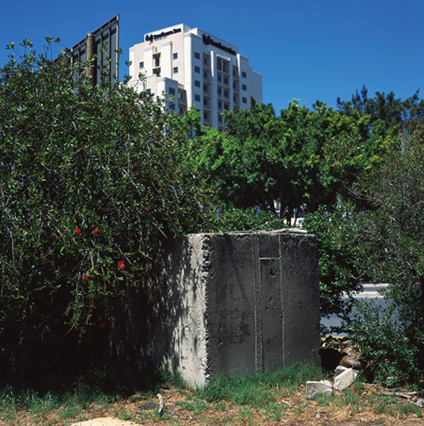
This feeling is echoed, a little more obliquely, in End of Cities Study 1 (2009). Here a worn block of cement, roughly one metre squared in size, lurks beneath a bush on the side of the road. The block is apparently a fragment of the foundation of a supporting pillar intended for the highway that was never built there. Redolent of a memorial, the form also suggests a potentially different function, another space, and thereby another possible city. Spatially then, the exhibition inhabits both the external physical environment of the city as well as the internal imaginative space of its inhabitants, and the sites and forms which Hobbs chooses can be situated somewhere in between the two. In Invisible Cities, the Italo Calvino novel from which the exhibition draws its title, the explorer Marco Polo entertains an aging Kubla Khan by recounting tales of cities that he has visited in his travels. As the story weaves from one city to another, the reader is left wondering whether the cities embody different features of a single city, different internal experiences of place, or something else completely. Yet Marco Polo describes only a single city - Venice - invisible because it is infinite in its number of pasts, presents and futures, and in its resulting multiplicity of forms.
The interplay between the singular and the multiple or infinite is explored most obviously in Every City (2009), a dense photo-collage of high rise buildings, singular entities which are ubiquitous landmarks of all cities today. Less overtly it is suggested by a small photograph of a pothole in a disused piece of road on the Cape Town foreshore with the highway visible in the distance. Photographed using a macro lens, the image comes into focus only at the very edge of the hole. In Searching for Alephs (2009), as well as Searching for Alephs-Model (2009), a mock-up of a photographic cyclorama of the foreshore, Hobbs references another master of post-modern fiction, Jorge Luis Borges. Borges’ ‘aleph’, visible only through slit eyes from the bottom of a staircase, is a tiny point which contains all times, all places, all events, the viewer of the aleph and the aleph itself.
Thus the space of imagining that Hobbs opens up for our consideration is a complex one. On the wall in one corner of the room is written a quotation from the last passage in Calvino’s Invisible Cities: ‘The catalogue of forms is endless: until every shape has found its city, new cities will continue to be born. When the forms exhaust their variety and come apart, the end of cities begins.’ Blocking the windows of Blank Projects, a cardboard screen is perforated by odd shapes, the spaces between buildings cut from a projection of a cityscape onto the surface and now removed. This installation, a collaboration with Thiresh Govender, with whom Hobbs also researched and conducted a walking tour of the foreshore site, makes visible an imaginative space as blank canvas. What Hobbs ultimately seems to suggest with this body of work, provisional and incomplete as it is, is that even the end of cities holds within it the potential for a new beginning.