other reviews
'Exile and Cultural Intersections'
Simmi Dullay at DUT Art Gallery
By Peter Machen01 March - 18 March. 0 Comment(s)
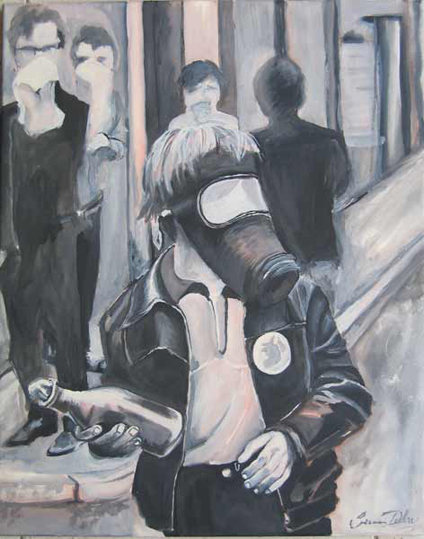
Simmi Dullay
Playing Games,
2009.
Acrylic on Canvas
55cmx 55cm.
Exile on a renamed street
Peter Machen speaks to fine artist Simmi Dullay about exile and revolution.
Artist Simmi Dullay grew up in exile in Denmark and returned to South Africa with her political activist family in 1992. Her work, which recently showed at the DUT Gallery in an exhibition entitled 'Exile and Cultural Intersections', explores the complex identity informed by that exile, the South African revolution and life in globalised post-apartheid South Africa. I spoke to her about some of these things.
Peter Machen: Your work includes a great deal of text, nearly all of it layered with images. But there is a lone piece of text which was, for me, very important and provocative in the context of the exhibition. In black ink on a white background you have written: 'I am a product of the South African revolution...not of the colonial entrenchment'. There are many people in South Africa, among them some of the country's poorest, who say that the South African revolution has become an extension of the colonial project (the neoliberal approach to economics, the unfettered embrace of wealth; the massive inequality which has intensified since 1994; the subservience of national sovereignty to corporations). What are your thoughts on this?
Simmi Dullay: A big part of the loss, dislocation and alienation of exile that my family and I encountered was not only in Denmark, but upon our return ‘home’ in 1992. Witnessing the betrayal of the South African liberation struggle perpetuated our sense of displacement, and not only for us, but significantly for the majority of people that are completely dispossessed. To me revolution and liberation struggles hold at their core love, justice and solidarity for all people. To equate South Africa’s current oligarchy, or is it plutocracy, with revolution, liberation, justice and equal rights would be funny if it wasn’t so sad.
art events calendar
VIEW FULL CALENDAR
buy art prints
edition of 60: R3,200.00
About Editions for ArtThrob
Outstanding prints by top South African artists. Your chance to purchase SA art at affordable prices.
FIND OUT MORE Editions for artthrob
That said, my criticism of the current government does not in any way compare apartheid's atrocities to the post-apartheid government. Conditions in South Africa have improved, but one hardly need make an effort to create an all-round better society in the face of apartheid. I somehow feel that we have been frozen by terror. Shocked, we stopped somewhere midway into Fanon's Black Skin, White Masks where the words mirror and internalize the hatred and anger, where words speak of rape and rupture and devour themselves, where black becomes white and the pages unwrite the cathartic process of culture as an act of revolution.
I made the statement ‘I am a product of the South African revolution, not of colonial entrenchment’ as a response to those who feel threatened by what I say and attempt to negate my voice by accusing me of being a product of colonisation. Some people go so far as to suggest (with a straight face) that I should be grateful for colonialism.
PM: I liked the video work you presented as part of your exhibition. It presents a complex reality in which hundreds of years of history coalesce into the small moments of family life. And yet each of those moments retains a significance that exists beyond the personal. Do you think that our personal lives can ever be separated from the political events and forces which help to form them?
SD: Thanks Peter. No, I don’t believe that one can separate the personal from the political, as even ordinary actions such as what we choose to eat, the clothes we wear, where we choose to live, how we interact with our environment, who we choose to share our lives with, have far reaching global consequences. The seemingly innocent act of buying flowers and chocolates on Valentine’s Day can implicate me in supporting the exploitation of the poorest labourers in Columbia.
I called the video PLACE (with an anarchist A) because I don’t belong to land, to place or community. My last trip on my eternal quest for home between Denmark and South Africa made me realise that I belonged in the connectivity of relationships. What really anchored me and confirmed a sense of belonging was the birth of my son in 2001.
The title also refers to the identity politics of my tricontinental exile, still embroiled in the colonial dispossession of country, kin and the negation of identity. The poet and scholar Meena Alexander captures it eloquently when she writes 'perhaps the most devastating effect of racism, is to render one homeless in one's own body'. I guess the video piece is part of making visible the complex layers of identity that represents a part of who I am beyond socio-political constructions of ‘race’, gender and nationality.
PM: We have spoken before of your South African and your Danish heritage. But what of your Indian heritage? How do you relate to the subcontinent, both personally and in terms of the politics of your work?
SD: I feel a strong connection to India, despite never setting foot there. I am inspired by Gandhi's civil disobedience. I applaud India for it was one of the few countries who defied conversion to Christianity under British rule. I discovered the etymology of many English and Danish words in Sanskrit which I explore in my art and my research. India seems like a country full of extremes, which I relate to. I also find that India holds a great feminist discourse, exploring and identifying female empowerment in the representation of the goddesses, especially Kali - embodying blood, guts, sex, creation and death, not some sanitized Virgin who no real woman of flesh and blood can identify with. I’m fascinated by a country that produces world renowned scientists and literary critics with international influence on contemporary critical theory, and still maintains the practice of ancient rituals transmitted through oral narratives. Regardless of the fact that I am descended from indentured labourers, I believe that South Africa and India could be dynamic if they looked to each other instead of always looking to the West.
PM: The exhibition includes several 20th century revolutionaries (and I use the word with consideration), among them Che Guevara, Steve Biko and Angela Davis, all presented in their iconic form. Guevara is now the planet's largest t-shirt icon. Angela Davis's image is often used on flyers for retro and hip-hop parties and even Biko has become a street and high-fashion accessory. Although I think that Biko retains a strong degree of political impact, Davis and Guevara have been eviscerated of all meaning for most people, reduced to stock-standard items of pop culture. Do you see this reduction as an extension of colonialism? Or is it a natural tendency, given the information flood in which we daily swim, to embrace meaninglessness?
SD: The iconography of the revolutionaries is not empty rhetoric to me. I would never buy a t-shirt with their images on. Rendering these freedom fighters meaningless is very much part of the reactionary neoliberal agenda. I love the romance and idealism of revolutionary figures, which defined my life from the very beginning. I wish I could remember - I was only a baby – but my parents told me that Biko carried me. Of course it was his ideology that was significant and not that moment I was in his presence, but it's still special to me.
By physically painting these icons, I reclaim yet another part of my history which is being appropriated and exploited by neoliberal corporations. Apart from Che, Angela and Biko, I also painted and drew images of the Palestinian freedom fighter Leila Khaled, the Mau Mau uprising, and an Irish child throwing a Molotov cocktail - all iconic images of people who dare to question and defy the existing power structures and work towards social transformation.
I feel the Hollywood co-option of Che is part of ideological warfare, seducing us into believing that the US cant be that bad if they are celebrating our hero, although the reality is that they are seducing us into spending money on a empty simulacrum of struggle, with the money going straight into their transnational bank accounts. To murder him and profit from exploiting his image, selling him long after he was buried, is tantamount to necrophilia.
Even here in South Africa after 1994, multinational corporations made adverts appropriating Black Consciousness struggle images and featuring iconic leaders such as Steve Biko, which makes me nauseous. The end of apartheid was meant to celebrate the emancipation and freedom of black people but the adverts signified that the only thing that was free was the new 'black market'. Black people no longer had to work as slaves, instead they had the 'choice' of being economically exploited, sucked dry through the soft seduction of the media spectacle.
And we all know that the means of communication (media) is controlled by those with economic power generated by the wealth of colonial exploitation. Not just in South Africa but across the world.
PM: Although there is a certain grittiness to your work, it is often also highly stylised. The images of your own face and body which populate the work are often expressed in a similar idiom to the Guevara image. Do you feel a tension or a conflict between the desire for aesthetic pleasure and the political content of your work?
SD: No, not at all. Some of the images are playing on the projected gaze of the exotic erotic and otherness; some are just playful and ironic. I have deliberately chosen images that are aesthetically pleasing because I like them and I don’t believe that representation is only about exposing an abject social realism before it's considered authentic. I feel that the whole romance with representing the abject, with dressing like a hobo and ‘slumming’ it, is a very white liberal thing - rebelling against their rich parents and the kind of aesthetic they were brought up with.
When we arrived in Denmark in 1978, in the throes of women’s liberation, women were dressing like men in order to be taken seriously. But not my mum, she was a feminist in knee high boots and miniskirts, who managed to live her life on her terms, not letting other people dictate how she should dress in order to be heard. She didn’t believe in conforming, just because it was in vogue.
PM: Finally, do you think that you will remain, on some levels, forever a soul in exile, pulled in various cultural directions? And do you think that it is possible for the self to transcend the forces that birthed it?
SD: The curse of exile is the accompanying loss and longing for the other place, the other life, the loved ones that I have been separated from. That rupture never grows back together again, because it is held apart by continents and an always-present separation. I measure and compare the present to my memories, to the past, against continents where cultures intersect; it is herein, in my imagination, that my reality of exile exists. The only way that I transcend the dislocation is through the cathartic process of art. Meena Alexander writes that ‘for the émigré art should be read as dwelling’. It is a place where I can map the different worlds that inhabit me.
The exile is distinguished by imaginative acts, in which the past home and the present host society exist within spatial instantaneousness. Edward Said describes this multiplicity as ‘the contrapuntual world’. The exile's senses are heightened as they are re-learning the world anew.