cape reviews
'History(n)'
Alan Taylor, Gavin Younge, Maria van Rooyen, Wayne Barker, Lauren Palte, Charles Maggs, Richard Chauke and Catherine Ocholla at UCA Gallery
By Sue Williamson23 September - 16 October. 0 Comment(s)

Richard Chauke
Winner Takes All,
2008.
Polyhromed Jacaranda wood
.
Appropriately, the cover of the catalogue for ‘History(n)’ is a replica of a scuffed school exercise book with some of the letters coloured in by a bored pupil. After all, wasn’t the school room the place where most of us became aware of that vast subject with so many more tiresome names and dates to remember than we possibly ever could?
Curator Andrew Lamprecht takes as a starting point for his group show the difference between 'History(e)', or history-as-event, referring to the events themselves as they occur chronologically in time, and 'History(n)' or history-as-narrative, referring to the written and drawn and recorded impressions of that event by those who are present as observers.
The artist as mediator and interpreter has as much to offer in throwing light upon an event, proposes Lamprecht, as does the official historian. In support of his case, he presents works by eight artists working in various media: Alan Taylor, Brett Shuman, Catherine Ocholla, Charles Maggs, Gavin Younge, Lauren Palte, Maria van Rooyen, Richard Chauke and Wayne Barker.
art events calendar
VIEW FULL CALENDAR
buy art prints

edition of 60: R8,000.00
About Editions for ArtThrob
Outstanding prints by top South African artists. Your chance to purchase SA art at affordable prices.
FIND OUT MORE Editions for artthrob
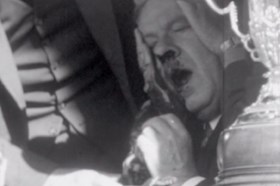
Nelson Mandela is featured three times: once in a poignant photo by press photographer Alan Taylor, listed as the first taken after Mandela was released from jail; once as a carved and painted wooden figure with a child in his arms (one of three, along with two emblematic colonialists, Jan van Riebeeck and Cecil John Rhodes in a sparky triumverate titled Winner Takes All carved by Zimbabwean artist Richard Chauke); and finally, and perhaps most movingly, in a scratchy recording of the speech from the dock before receiving the sentence which put Mandela in prison for 27 years.
The speech emanates from an old radiogram console, of the same fifties era as the Rivonia trial. The irony is, of course, that in its day that speech would never have been heard over the state-controlled airwaves of the South African Broadcasting Corporation. The radiogram is part of a multi-media installation by Wayne Barker entitled Yesterday, Today and Tomorrow, and as conceptually the strongest element in the installation could perhaps have been allowed to stand alone.
A fourth place one might have expected to find an image of Mandela is as the central design feature of the printed cotton kanga displayed by Kenyan artist Catherine Ocholla. Instead, the face at the centre is Michael Jackson’s, and the artist’s decision to put this piece on this show questions the real contribution of Michael Jackson to Africa. As he grew whiter and whiter her childhood admiration waned.
The valueless currency of Zimbabwe as a symbol of the disastrous economy of that country has been the subject of work by various artists in recent years. However, Maria van Rooyen’s The Smoke That Thunders, a representation of the Victoria Falls, constructed from hundreds of flaps of paper with shades of grey and black made from rubbings of old Zimbabwean and Rhodesian coins, has as many shades of colonial meaning as any. It satisfies both conceptually and visually.
Lamprecht’s catalogue text refers to the ‘genius’ of his artists. I wouldn’t go as far as that, but as a coherent work of curation, with fine works on display that raise issues on many aspects of contemporary history in Africa, 'History(n)' had a lot going for it.