other reviews
'Imprint: New Ceramics'
Carla da Cruz at KZNSA Gallery
By Peter Machen27 October - 15 November. 0 Comment(s)
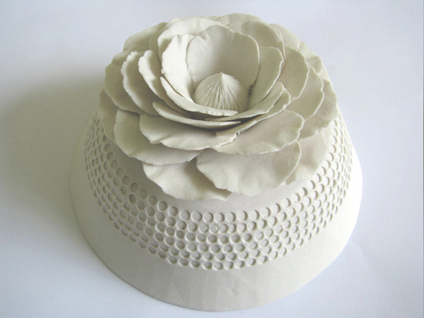
Carla da Cruz
Detail from the Wallflower series,
2009.
Porcelain
.
Carla Da Cruz's exhibition 'Imprint', which has just come down from the walls of the KZN's mezzanine gallery, is an example of how the sublime and the spiritual are capable of residing in fields that have been plowed many times, but which are still capable of delivering riches.
I have seen many bodies of work based on a variation of the decorated ceramic disc, often presented fairly small and en masse, as Da Cruz does here with her pantheon of delicately-wrought ceramic flowers. And in truth I have seen perhaps more than my share of such works. That said, on viewing 'Imprint', there is no sense of the tired, the jaded or the second-hand. Everything seems as fresh as morning flowers. The dew might be absent but it is implicit.
art events calendar
VIEW FULL CALENDAR
buy art prints
edition of 25: R4,500.00
About Editions for ArtThrob
Outstanding prints by top South African artists. Your chance to purchase SA art at affordable prices.
FIND OUT MORE Editions for artthrob


The notion of process has been raised aloft a great deal in the past decade, particularly amid the celebrations of handwork in both craft and fine art that have taken place. These have often raised the intricacy of such work to metaphysical levels. And there's something to this; looking at the work of artists such as Paul Edmunds, and also at the intricacy and structure of Da Cruz's petals and stamens, a certain serenity is required, surely?
It's a little obvious to compare Cruz's flower to snowflakes, but at the same time it's a comparison that's hard not to make. Both involve limited design parameters in which transcendence and beauty arrive courtesy of geometry and repetition, delicacy and grace. And I'm sure that if Da Cruz had the time and the ceramic resources, she could - like God or whoever it is that makes snowflakes - go on forever, creating works all of which bear a similarity, but each of which is unique.
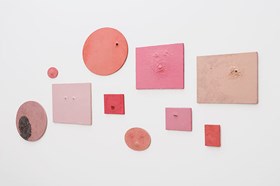
Hanging perpendicular to the delicate flowers is a series of ceramic rectangles, their corners rounded like used bars of soap. Each becomes a canvas for Da Cruz's organic textures, which have been granted the decadence of coloured glaze. I know you're not supposed to touch the art (I was very well behaved around the fragile flowers), but these lusciously-conceived slaps of texture simply call your fingers and palm to them, like a siren across the sea. I couldn't resist, of course, and the works felt – well, beautiful – calling to mind the role of touch in art, a generally unexplored terrain in a field that is so dependent on the untouchability of the archive. And while it's tempting to impose individual meanings or narratives onto the work, the simultaneously grand and lowly cycle of cellular growth (and by implication decay – which some of the works touch on) is all that's really needed.
It's tempting to describe this kind of work as 'decorative' – and in many ways it is. But to consequently deny its potential as an expressive form is to miss the point both of Da Cruz's work and of much other work which engages with the divine and the banal in order to generate transcendence.