gauteng reviews
'Mine'
Natasha Christopher at Standard Bank Gallery
By Anthea Buys10 February - 13 March. 0 Comment(s)
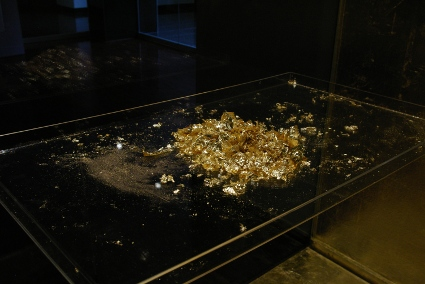
Natasha Christopher
Installation detail from 'Mine',
2010.
.
Very little dispute is ever indulged over the idea that exhibitions are, above all, scenarios for looking at pictures. And why should it be? Our typical behaviour with regard to pictures, in professional and personal contexts, seems to suggest that their proper home is amongst other pictures, in frames and on walls commanding enough of our attention to make this effort in décor notable for esoteric reasons. In social contexts, a revolution in image-publishing induced jointly by Facebook and cellular phone cameras has ensured that even in the moment of capture, photographs are taken with their display and dissemination in mind rather than only for the sake of posterity or nostalgia. One point holds, regardless of context: historically and conventionally we seem to want to look at pictures in their own right, as little worlds unto themselves, and this is especially so in the genre of photography.
art events calendar
VIEW FULL CALENDAR
buy art prints
edition of 25: R4,300.00
About Editions for ArtThrob
Outstanding prints by top South African artists. Your chance to purchase SA art at affordable prices.
FIND OUT MORE Editions for artthrob
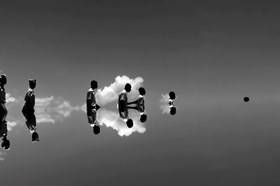
It is refreshing that a counter-example to this habitual tunnel vision should come from a photographer, and, to boot, one whose work generally broaches such loaded content. It is not that Natasha Christopher, in her current solo exhibition 'Mine', has abandoned her usual area of focus, which has until now been her relationships with members of her family. 'Mine' is very much soaked in her subjective experience of her first family home. What it does that is so exceptional (in the true sense of the word) is use individual photographs as ingredients in a total experience of images, materials, smells and sounds that evoke a place very much like 'home' in white middle-class South Africa in the 1970s and 1980s. In one section of the exhibition, alongside a pile of musty-smelling parquet flooring, photographs of mounds of earth and unspectacular industrial lots evoke the sort of banalities that come to be charged with emotion when they are attached to particular memories. Here, the pictures aren’t demanding or sacred. They step back. They are allowed to become a footnote to the enveloping smell and the mound of wood that occupies the centre of the room.
This at once familiar and particular place is conjured up in the downstairs section of the Standard Bank Gallery, an area far more faithful to its corporate furnishings than its makeshift purpose as an exhibition venue. Frankly, I do not envy anyone faced with the challenge of curating there, amongst the rough blue-grey carpets, the glass display cases, and the dried spaghetti prefabricated ceiling panels. Most visitors to the gallery give little more than a cursory glance to this awkward space and its sideshow exhibitions. The Standard Bank Gallery is best at stodgy exhibitions of works by historical painters, important contemporary artists and younger artists earmarked for influential careers. However, in the last few years a number of artists have transformed this ad-hoc gallery into captivating installation environments that are, in many instances, far more interesting than the headline exhibitions running upstairs in the main gallery, and 'Mine' is a case in point.
The contents of the exhibition can be divided into two large installations, each of which occupies a room flanking the street-level entrance to the gallery. The section nearest the door, ‘Memory Room’ is lined with and divided by the tricky display cases, which Christopher has dealt with by turning them into dioramas, lightboxes, and specimen jars filled with the matter of her past. The first display case is lined on the inside with goldleaf and contains a suspended Perspex tray piled with small golden scales. This case and the poem on an adjacent wall (which replaces the usual explanatory wall text) establish the mining metaphor which runs through the show, identifying a geographic location – Welkom, a mining town south-west of Johannesburg – and a reflective process. Christopher is mining her past, unearthing personal memories until now buried in time.
Another display case in the 'Memory Room' is lit from within and lined from the inside with large photographs of dreary curtains. They look dusty and forlorn, as if they have hung where they hang for so long that they are invisible. A third display case houses some more parquet, a block of ancient red carpet and a mattress propped up so that it stands vertically. The mattress has been soiled and sports an enormous brownish stain. Sound recordings of birds calling, traffic, construction drills and playground noises stream from stereo speakers mounted in the ceiling.
Aspects of the place that Christopher is recalling in this installation are oddly familiar. At times her photographs represent the most generic scenes: the child’s abandoned toy in the dust, a sky on the brink of a highveld storm. But with time spent in the exhibition space - listening to the sounds, smelling the smells and glimpsing now and then text fragments clinging to the walls in transparent vinyl – it becomes apparent that the place she wants to disclose is oppressive, downright miserable, even.
I left the show feeling thoroughly depressed. Thank goodness, I thought to myself. Not that I enjoy the doldrums. So few exhibitions manage to present an idea, an image, a tactic – anything – that does not threaten to induce an instantaneous coma in the viewer, that it feels quite miraculous when one is in fact emotionally stirring (a far greater feat than prodding the brain). Christopher’s curating of the space, with which she has evidently taken the greatest care, tweaks the orthodoxies of exhibition-making that ostensibly make the form of the exhibition intelligible to us. But what is clear from 'Mine' is that when the rules are bent and we are forced for once to explore a space, think about its elements and content and indulge in a more esoteric process of reading art, the ingredients still make sense.