gauteng reviews
'Parrot Parrot'
Colin Richards at Gallery AOP
By Anthea Buys08 October - 31 October. 0 Comment(s)
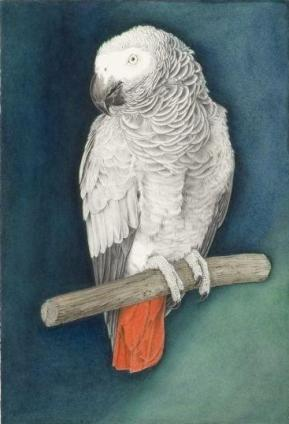
Colin Richards
Parrot (African Grey) I (detail),
2009.
watercolour
58 x 76cm.
Colin Richards’ exhibition ‘Parrot Parrot’, which opened at Art on Paper on October 8, has been three years in the making; six, if one counts all the time since his last solo exhibition as time spent stewing over the next. That seems like an awfully long time. However, poring over the meticulous pen hatchings in his drawings and the tiny rectangles of paper so perfectly stuck in their places in his book constructions, it is a wonder that the exhibition eventually came to be at all. Richards’ slowness and evident labour are staggering because almost no one in this age of pimp gallerists and fast-food multiples has the reserve to spend three years on a moderately-sized body of work. But in ‘Parrot Parrot’, patience is the law. It demands slow, studious viewing and an open ear, so to speak.
There isn’t an overriding narrative or theme in this exhibition as much as there is a ‘language’ of motifs with which one needs to become acquainted. An excellent place to start is with Slow Literature, a watercolour painting of two tortoise shells flanking one another like the leaves of an open book. These carapaces, which in nature take ages to grow into the bony shields worn by old tortoises, are analogies for the concentrated endeavour of writing or making a work of art. But the open ‘pages’ of the figurative book are also an invitation for us to ‘read’ them, and the other works in the room, in a similarly measured way. Carapaces are also naturally deceptively ancient-looking things, and this pair intimates that the collection of works has an ancient history, one that reaches much further back than the years Richards took to compile the exhibition. That is not to say that this ‘history’ is autobiographical (there is almost nothing overtly autobiographical about the show) or even ‘real’, a possibility that comes under attack increasingly as one moves around the room. It is quite palpably there though, but as a sort of chronological ghost – a ‘past that has never been present’, to borrow Derrida’s phrase.
art events calendar
VIEW FULL CALENDAR
buy art prints

edition of 60: R8,000.00
About Editions for ArtThrob
Outstanding prints by top South African artists. Your chance to purchase SA art at affordable prices.
FIND OUT MORE Editions for artthrob
The image on the invitation card, and the clue to the most resonant motifs in the body of work, is a watercolour painting of an African Grey parrot. This picture, which is reminiscent of 18th and 19th century ornothological studies drawn and painted by imperial explorers, is the centrepiece of a triptych titled Parrot (African Grey) I. The parrot is a pretender on two levels: first, it is pictorial semblance of a real creature, an illusion. Second, a real parrot is in imitator in its own right – it learns and repeats speech without necessarily knowing what it says. It uses language without having ‘acquired’ it in the same way that a human subject comes to understand and be able to use language. Whether or not the parrot’s speech constitutes valid language, it is proliferated as if it were: a human listening in on a parrot speaking in a human language would be able to make sense of what is being said. This suggests that words have meaning and a legacy even when their connection to a conscious source is severed by time or translation, as is the case when words are read as text, for instance.
The text that appears in two paper constructions, Ivory Tower and Marginal Book, has been gleaned from apartheid-era law books, and reappears in these works fragmented, shuffled and interrupted, but repeated nonetheless. One gets an inkling, when reading this haphazard poetry, of the legacy of apartheid legislation and social theory – another spectre haunting this exhibition. The presence of these text fragments is particularly unnerving because, as Ivory Tower and Marginal Book evidence, it is possible for words used as the foundation for a deadly political system to undergo a semantic resurrection. They breathe again, differently and less dangerously, but with the dust of their previous life still in their lungs.
This slow meditation on different forms of life and agency is complicated by two digitally rendered, life-sized images of bookshelves hung in the window area of the gallery. Lives of Animals is a row of scanned spines of books on philosophies of animal rights, animal consciousness and human-animal encounters. This casts doubt on the initial impression in the show that the parrot is merely a mindless fraud. What if the parrot does in fact think and could use language in a way that approximates or even matches our own use of it? Which creature, human or animal, is in a position to decide what constitutes legitimate consciousness and agency in the first place?
On the facing wall, the second shelf, Library of Lies, packed with titles on cloning, conspiracies and art, suggests that even our traditional guarantors of authenticity and reality – living creatures that we can see and touch, the artistic genius and signature – are imitable. And if, as this work and the adjacent two drawings He Is Barehead and He Is Barehead II suggest, ‘reality’ is imitable, then distinguishing between the truth and a lie might not be of any consequence. Whether or not the parrot utters the word ‘parrot’ honestly, with intent, it still conjures up a mental image of the bird that goes by that name.