
gauteng reviews
'Stills'
Karin Preller at ArtSpace
By Michael Smith06 June - 27 June. 0 Comment(s)
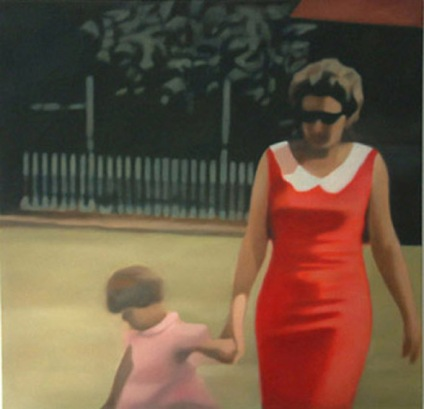
Karin Preller
Red dress, Langlaagte, 1960’s,
2009.
oil on canvas
100x103cm.
In the catalogue for the Hayward Gallery’s 2007 ‘The Painting of Modern Life’ 2007, New York artist Judith Eisler said that her work was about find peripheral moments in narratives that would otherwise remain undetected. ‘I want to hear the sound of a pause’, she stated. Describing her methodology of painting from film stills, Eisler stated a resistance to the notion of appropriating the film’s narratives and structures in her works. Rather, she is ‘interested in the new narratives that inevitably emerge within the frame of the painting’.
Karin Preller’s paintings are arguably kindred spirits of Eisler’s. With ‘Stills’, her 2009 exhibition at Johannesburg’s Artspace, Preller mines personal history and nostalgia for her subject matter, using still images from old 8mm home movies made by her family.
Yet the works are also crucially about the act of slowing down the moving image, and providing the viewer with a chance to ruminate on the frozen moment. Preller’s decontextualised images paradoxically evoke the terms of memory (images in the Brixton, 1960’s series is literally rose-tinted, and the rough edges of detail softened) and deny its operation (narratives separated out from their flow, fragmented, and images arbitrarily cropped).
art events calendar
VIEW FULL CALENDAR
buy art prints

edition of 60: R8,000.00
About Editions for ArtThrob
Outstanding prints by top South African artists. Your chance to purchase SA art at affordable prices.
FIND OUT MORE Editions for artthrob
Like their most obvious South African predecessor, Penny Siopis’ video installation My Lovely Day, Preller’s works extend beyond nostalgia into the political, albeit subtly. Their depictions of sanitized suburbs Brixton and Langlaagte underscore the gulf between apartheid Johannesburg of the 1960’s, and the harsher realities of the postcolonial megacity. Certain images, such as the third panel of the Brixton, 1960’s series, seem permeated with the very particular anxiety felt by the fragile idyll’s inhabitants. As such, this body of work sets up a revealing dialogue with works by David Goldblatt, Guy Tillim and even Ismail Farouk, all of whom have tracked changes in the city’s character and inhabitants.
A noteworthy development in Preller’s work is her increased willingness to push the figure to the periphery of her images, in one case, Montgomery Park, 1960’s, almost excising human presence entirely. This represents potentially fertile new territory for Preller, whose previous bodies of work have chosen the more immediate route of predominant figuration.
This shift also allows the banality of suburban architecture to emerge from its role as muted backdrop to play a more pivotal role in establishing the temporal character of the exhibition.
Overall, ‘Stills’ marks an important progression for Preller, and one which will hopefully catapult her to greater profile in the Johannesburg scene.