other reviews
'Structure'
Jeremy Wafer at KZNSA
By Peter Machen16 August - 05 September. 0 Comment(s)
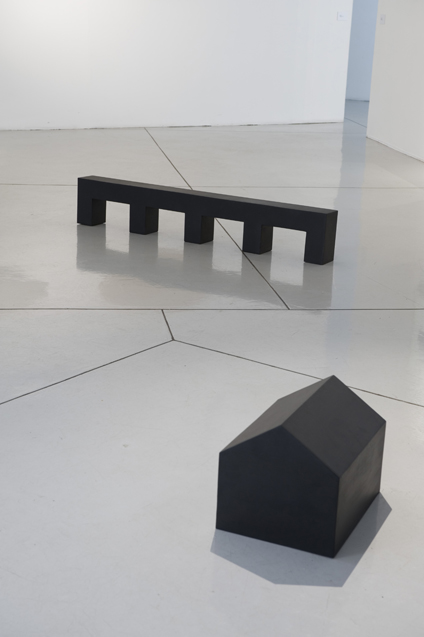
Jeremy Wafer
Black House,
2009.
Steel
40 x 30 x 30cm.
The Structure of Things
Peter Machen talks to acclaimed former Durban artist Jeremy Wafer, who was back in his home town recently with a retrospective exhibition at the KZNSA Gallery.
Peter Machen: Hi Jeremy. Firstly, what led you in the aesthetic and conceptual direction you have taken over the course of your career? Do you think that you would have produced similar work if you hadn't lived in Durban? And do you think that you were influenced to any degree by the pseudo-Soviet aesthetic of the old South Africa?
Jeremy Wafer: A big question which involves one's whole biography probably! The work of artists I was looking at in art magazines in the 70’s – Carl Andre, Eva Hesse, Mary Miss, conceptual art, land artists digging holes in the ground, photographing water towers etc. – All this seemed to offer a different way of being after the bleakness of school and army.
My work has been very much about place: the industrial Jo'burg landscape of mine shafts and dumps, the richness of Durban: Cato Manor temples, Maydon Wharf, the pier, Warwick Triangle. I don’t know about the aesthetic of the old South Africa but I love the Soviet artists Tatlin and Rodchenko. I think one's sensibility is formed in place and time. I was born in Durban and spent my first year or so in the naval barracks on the Bluff, then boarding school, and later teaching at Tech for about 20 years.
PM: Many of your works have a strange dual effect on me. On one hand, the singularity of the work suggests to me a certain brutality and violence; and at exactly the same time, I find the work transcendent, almost peaceful. I have the same response to freeway interchanges, cooling towers, water towers and highways. Is my response to your work a common one, and is it any way part of your intention?
JW: I am drawn to things which have a plain functionality, not just in a modernist form/function way, but the directness of ordinary things like warehouses, bridges, containers etc. I don’t always know what my intention is but I do like a wall to be wall, a cube a cube, a hole a hole etc. And I do see these as somehow fundamental qualities. It is a quick slide from fundamental/ essential to metaphysical perhaps. It's always a bit awkward using terms such as ‘transcendent’ but maybe there is something in the ‘truth=beauty=truth’ thing. (Or maybe its just a Catholic upbringing!)
art events calendar
VIEW FULL CALENDAR
buy art prints

edition of 25: R4,300.00
About Editions for ArtThrob
Outstanding prints by top South African artists. Your chance to purchase SA art at affordable prices.
FIND OUT MORE Editions for artthrob
PM: Other structures which effect me emotionally and which relate to your work are roads, railway lines and telephone poles. They are in a way, the world wide web of the old, non-digital world. Their resonance is obvious on one level, in that they point to narratives of travel, escape and connectedness. But it seems that there is something deeper embedded in their forms, something which perhaps is connected to our – possibly biological – desire to worship form itself.
JW: Looking back at the work on exhibition does make me realise how much of it is about connectedness/separation: fences, borders, the mapping and marking of place. These are, at times, obvious ‘content’ but I think that you are right in seeing something else. This relates perhaps to my answer to your previous question.
PM: The structures you document in the show – which reflect the aesthetic embodied in your work – seem to be increasingly at odds with the aesthetic of the 21st century. Factory precincts have given way to industrial parks, cities to malls, and water towers, well, I don't know where water towers have gone. Additionally, those places which do still contain such examples of industrial beauty – such as airfields, harbours and water works, are increasingly places of high security in a post-911 world? The fact that I can no longer explore the intricacies of Durban Harbour, for example, has fundamentally changed my relationship to the city. Do you think that your work – particularly your post-apartheid work – remains political in that the very notion of pointing to underlying structures seems to be, in the 21st century, a political act?
JW: I also feel a sense of loss in not being able to walk next to the ships on Maydon Wharf, or look into the dry dock. But in answer to \the question: I increasingly feel that modernism’s radical political agenda has been overshadowed by later interpretations, and also by the art market.
PM: Your work seems to force an intellectual assessment of it precisely because it is so undidactic, because there are no clues as to its meaning. We are faced with objects that are both profoundly elegant and profoundly unornamental, yet at the same time the functionality that we might assign to similar objects is not evident. Your works seems both to claim the status of art, even as it rejects that notion.
JW: Thanks for the compliment! I suppose that having to think is only brought on by uncertainty. This is partly my modernist upbringing: Brecht’s verfremdung etc.
PM: Even as your work presents objects and shapes that are highly abstracted, they also seem entirely related – as in not separate – from the space they occupy. To what extent does your work become reborn – new for you – when it enters a new space?
JW: I think all work is spatially defined, particularly sculpture, which derives its sense of self from the relationships it has to its surroundings and to the viewer. The work is definitely new in each space.
PM: One thing that I get from your work is that it suggests that one of the projects of abstraction within artistic modernity – the desire of minimalism to remove all notion of associations – is one that is ultimately doomed to failure precisely because we live in a world from which it is impossible to abstract any object or shape entirely, since everything is both physically and semiotically connected. Ivor Powell captures this well when he says that your forms acquire the ‘experiential presence of archetype’.
JW: Nothing is without association. The project of the kind of minimalism that I am interested in was to escape the strictures of narrative, of depiction, to claim a more independent space for the object, to let it breath, not to render it meaningless. I am not sure about ‘archetype’ but I do think that things have meaning in themselves, not only as referents. Nevertheless, a lot of my work has some fairly obvious readability. The wax and steel Arc, for example, clearly has a soft hence vulnerable inside within a hard hence protective outside. This can lead, in a fairly straightforward way, to a series of metaphoric connections to all sorts of political/psychological situations.
PM: I am struck also by a persistent failure of language with regards to your work. There is much to say about your work – in fact it asks to be written about – but at the same time, there is something wordless – inaccessible by the linguistic mind and I am reminded of the monolith in Stanley Kubrick's 2001: A Space Odyssey. To what extent is your work also an exploration of spirituality? I realise that this is a word that has been corrupted, but your answer has resonance in the context of traditional African abstraction often having spiritual roots.
JW: I suppose it has to do with different kinds of meanings. There is the kind which is exemplified by language - and there are those who insist that this is the only kind – but art is impossible without the ‘wordless’ kind. ‘Love’ or ‘dread’, to take somewhat extreme examples, are like this surely. Spirituality is a difficult thing to work with. Things can be many things at once: water can be turned into wine.
PM: Finally, do you miss Durban?
JW: Yes, and hope to be back soon.
PM: Thanks so much for chatting to me Jeremy!