gauteng reviews
'The Binding'
Christine Dixie at Gallery AOP
By Anthea Buys08 May - 29 May. 0 Comment(s)
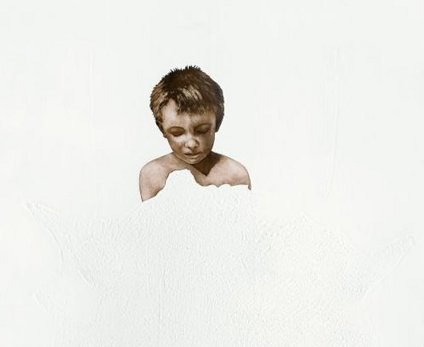
Christine Dixie
Offering (detail),
2009.
etching and collograph
.
At the entrance to Christine Dixie’s exhibition 'The Binding' at Gallery AOP, are two open books, spread out flat like pressed butterflies, framed and hanging against the wall. They are digitally printed scans of two canonical stories in the history of western culture. The first is the biblical narrative in which Abraham ties his son Isaac to a sacrificial alter on God’s command. God puts a halt to this activity just as Abraham is about to slaughter his son. The other story in the pair is a case study from Sigmund Freud’s 'The Interpretation of Dreams', which tells of a father who dreams that his deceased son stands at his bedside and whisper to him, 'Father, can’t you see I’m burning?' In the adjacent room, where the son lies in his death shroud, a candle has fallen over and had begun to burn the boy’s arm. The father has fallen asleep after a long vigil over the dying boy, and the dream, according to Freud, represents the fulfilment of the Father’s wish to see the son alive once more.
These two stories frame Dixie’s exhibition in place of an explanatory wall text, and the viewer is expected to read the symbols that emerge in the works that fill the room through this double lens. An indirect sequel to her 2007 exhibition ‘Parturient Prospects’ which looked at historical social constructs of maternity, ‘The Binding’ suggests that paternity and patriarchy are figured in Western societies by the passing down of sacrificial behaviour.
art events calendar
VIEW FULL CALENDAR
buy art prints
edition of 60: R5,000.00
About Editions for ArtThrob
Outstanding prints by top South African artists. Your chance to purchase SA art at affordable prices.
FIND OUT MORE Editions for artthrob
The exhibition comprises an installation of six large etching and collograph prints mirrored in each instance by a mock-altar. The prints are life-size portraits of Dixie’s six-year-old son, and in all but one, the boy lies on a bed swathed in blankets impressed into the page as a blind collagraph. The exception is a print called Burning in which the boy is entirely exposed, awake and stares at the viewer eerily. The series of prints is book-ended to the left and the right by two prints called To Sleep and To Dream respectively. This framing mimics the covers of the two open books that introduce us to the exhibition, and we are led into a highly allusive world of tactility, suppressed violence, disconnection and the threat of death and loss that for Dixie characterises the socialisation of sons and son-like behaviour in European-influenced societies.
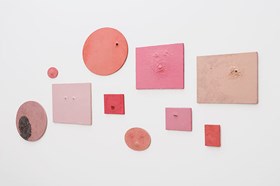
Particularly, ‘The Binding’ considers how son-ness is constructed with reference to paternity. Fathers, in this exhibition, sacrifice their sons to war and other great causes. The mock-altars which couple each print bear large silhouetted relief images of boyish bodies lying either as if slain in war or with amputated limps. The relief is constructed from plastic toy soldiers who are arranged in their throngs in such a way that they collectively articulate different parts of a single body. A row of pointing guns forms a spine in one image and the angle of the tiny soldiers’ heads, a shoulder blade. In an artist statement published in a brochure that accompanies the exhibition, Dixie recalls that she sometimes had to saw limbs off these plastic soldiers, which was, for her, an enactment of the kind of brutality that the subjects of this body of work would endure in a real war situation. The socialisation of boys, through toys such as plastic guns and soldiers, passes the yoke of violent sacrifice from father to son. In this sense, the father is inevitably involved in a complex and paradoxical relationship of attachment to his son through cutting-off or killing.
In both Freud’s text and the biblical narrative of Abraham and Isaac’s tale, the son character is brought back from the brink of death or from death itself. In the story of Abraham and Isaac, Isaac, having been bound to the sacrificial altar, has to come to terms with the inevitability of his own death. God spares him from his father only because Abraham’s sacrifice had already been made through his genuine intention to kill his child. In ‘The Interpretation of Dreams', the son appears to his father as an emissary, alerting him to the burning body in the room next door. Years after Freud, Lacan reads the father’s dream of his burning son as more than wish-fulfilment. For Lacan, the dream represents 'the impossibility of an encounter, of the inevitability of the missed encounter between the father and the child' (Varney, S. 'Oedipus and the Modernist Aesthetic' in Bueno, Hummel and Caesar [eds.] Naming the Father: legacies, genealogies, and explorations of fatherhood in modern and contemporary literature [2000] p269).
‘The Binding’ is replete with clues to the sort of missed encounter that Lacan reads into Freud’s case study: the amputations of the toy soldiers and the composite silhouettes they make up; the blind blankets that dismember and efface the bodies of the sleeping boys in the prints; the wakeful boy in Burning who hovers, disconnected from any ground or material objects. If, as Dixie suggested in ‘Parturient Prospects’, maternity is construed in terms of sustenance and connection, paternity is a mode of relating by corrosion and loss. Subversively, through its magnetically sumptuous textures, an installation of coherent, relating pairs, and seamless presentation, ‘The Binding’ tells a story of irrecoverable unbinding.