cape reviews
Thomas Mulcaire
Thomas Mulcaire at Goodman Gallery
By Tim Leibbrandt01 June - 15 June. 0 Comment(s)

Thomas Mulcaire
A Luta Continua,
2003.
neon installation
40 x 450 cm.
‘He is, it seems, a great believer in the meaning of meaning…The elaborate biology of sexual differentiation in the fetus [sic], the religious system of the Mormons, the infinitely convoluted esotericism of freemasonry and of the ancient Irish myths - it’s all so blatantly meaningful’ (Birnbaum, 2005: 65) [original emphasis]
Upon viewing Thomas Mulcaire’s exhibition, this quotation from Daniel Birnbaum’s 2005 essay Chronology came vehemently to mind. Whilst Birnbaum was referring to the work of Matthew Barney (specifically his Cremaster Cycle), the sentiment of ‘production of meaning as meaning’ nonetheless presents itself when considering Mulcaire’s work. In fact, this is exactly what he proffers, an assortment of signifiers titled and assembled with the express purpose of being ‘blatantly meaningful’.
art events calendar
VIEW FULL CALENDAR
buy art prints

edition of 25: R4,300.00
About Editions for ArtThrob
Outstanding prints by top South African artists. Your chance to purchase SA art at affordable prices.
FIND OUT MORE Editions for artthrob
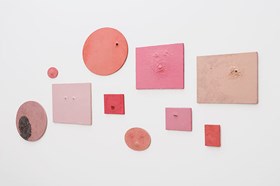
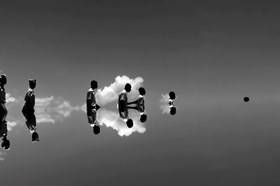
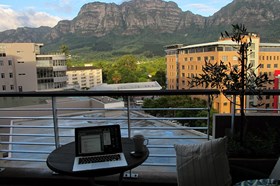
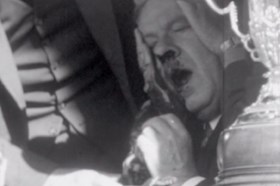
This is not to say that the works are obvious; far from it. Rather Mulcaire suggests that they present a set of definitive connotations with the intention of facilitating a translation of meaning that transcends these initial responses. Thus whilst a lightbox depicting a logo for the Institute of Contemporary Art Cape Town (Bracket 1999-2006) seems a static signifier, the idea of the institute for contemporary art is very much the language that Mulcaire is dealing in, the post-Dickie forsaking of form in favour of an ever-fluctuating function.
Just as the Ultrachrome on Canvas series in the main gallery space seemingly depicts images far removed from the sources from whence their titles derive (‘Zama and 1stborn Wiring the Air–X’ etc) so too does Mulcaire examine the ‘snowballing’ of meaning as it descends the alpine slopes of discourse.
This makes for a pretty unyielding exhibition for viewers more at home with instant gratification. While the body of work is visually compelling on a formal level (rand with its reflective floor the Goodman Gallery Cape is surely the ideal space for the exhibition), it resiliently refuses to surrender anything of a theoretical nature without a fair degree of contemplation on the part of the viewer. This is a sentiment Mulcaire emphasizes throughout, the ‘it takes two to tango’ collaborative element fundamental to the production of meaningful discourse. Nonetheless, one has to actually want to do so and thus an area of audience contention potentially arises.
As if mindful of this disputation, the press release contains illuminating description of the trips that produced FRIDAY (2009), Solaris (2007) and Study for Solaris (2007) as ‘two collaborative expeditions to Antarctica in 2006-2007 and 2008-2009, to install a mobile wind and solar-powered research base for artists and scientists.’ Thus one is provided with a key to accessing Mulcaire’s somewhat playful sentiment. The notion of the translation of light plays into the exhibition’s visual pun of ‘enlightenment’ through the fundamental application of light throughout the works, be it lightbox display evidenced in most of the works, neon light (A Luta Continua 2003) or the actual production of light (Solar Constant 2009).
Antarctica seems to have provided Mulcaire with an ideal neutral commons in which these notions of translation and projection could be explored. Referencing Stanislaw Lem’s 1961 tome of the same name, the works Solaris and Study for Solaris provide an intriguing inquisition into the retrospective translation of experiential recollection so fundamental to Lem’s text. The combination of the two brings to mind the assertion that ‘all that is solid melts into air’ by Marx and Engels in The Communist Manifesto, the physicality of experience translated into the intangible ambiguity of memory.
A more humorous take on this idea is evidenced in FRIDAY wherein the arranged urine bags testify to the experience of the Antarctic expedition, an organic recontextualising of ‘the ice we melted with the wind and the sun to make water, our DNA, and traces of everything we ate and drank’ (again referring to the press release). All that is solid faces infinite collaborative translation.
Continuing these implied biographical aspects is Odradek: Liam Gillick’s Odradek Wall reflected in Donald Judd’s Blue Stack Piece; 23 September 1998 (1998). Here one is presented with photographic documentation of Gillick and Judd’s works in a state of ‘enlightened dialogue’ initially facilitated by Mulcaire in the ‘Odradek’ exhibition he curated in 1998. Playing with contemporary curatorial models (as well as the curator/artist relationship through the presentation of the image within a solo exhibition) Mulcaire presents a veritable Matryoshka doll of evolving authorial discourses awaiting their next permutation. ‘A Luta Continua’, as the neon installation of the same name purports.
This open-endedness becomes something of a burden on the exhibition as a whole. Solar Constant’s presentation of a finite quantity of light doesn’t necessarily work within this context; the notion of a specific measure of sunlight (however constant globally) translated into fluorescent light reads more as ‘a luta conclui’ than anything else. Also the impact of the Ultrachrome series is arguably diluted by an excess of individual entries that don’t necessarily add to the overall sentiment.
It is this overarching mutability of sentiment that will polarize audiences. There is little arguing that the show is appealing formally, but without engaging with its ideas, the appeal remains abstract. Perhaps this comes with the territory when one produces a show where the work is somewhat secondary in its demonstrative relationship to the concept, as opposed to vice versa. Taking a cue from FRIDAY however, if one elects to undertake the expedition into Mulcaire’s commons, the resultant spoils far exceed mere urinalysis.
Tim Leibbrandt is an Honours student at Michaelis.