gauteng reviews
'Transcend'
Diane Victor at Goodman Gallery
By Anthea Buys15 April - 22 May. 0 Comment(s)
Diane Victor
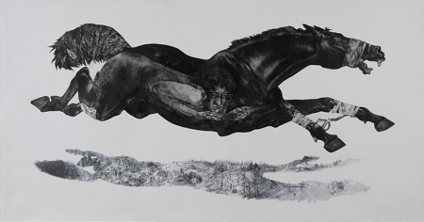
4 Horses: Baited,
2009.
etching and digital print
.
On visiting Diane Victor’s solo exhibition 'Transcend', which runs at the Goodman Gallery in Parkwood until May 22, I was struck for some time by a verbal paralysis. I don’t mean that I was ‘speechless’, in the colloquial sense. Of course Victor’s pictures are always remarkable; they always induce in me some feeling of awe and jealously, whether or not I happen to like them. But what made it so difficult to catch any words that I could pin to them is, quite simply, that they are pictures, and, for whatever reason – postmodernism, modernism, envy, the imperatives of newspapers – a critic’s default position on pictures is that they are tiring and impenetrable. The artist herself conceded the trouble pictures make when she shared with the audience at her walkabout of 'Transcend' on May 1, ‘One of my worst habits is that I’m a picture maker.’
art events calendar
VIEW FULL CALENDAR
buy art prints

edition of 60: R8,000.00
About Editions for ArtThrob
Outstanding prints by top South African artists. Your chance to purchase SA art at affordable prices.
FIND OUT MORE Editions for artthrob
One quiet Friday afternoon after I had recovered from the fanfare of Victor’s opening, I made one circuit of the exhibition, found my notepad blank, and tried again. Very slowly, hoping that some work would impart a useful word, I trawled the contours of the show as if I were scraping off a film of soup from the inside walls of bowl just used. When I reached the series of works that shares a title with the exhibition – six portraits in charcoal and ash of ancient, papery bodies – I took out my pen and wrote down three questions. After that 'Transcend' began to open up.
Can art invoke ghosts?
The flesh of the frail bodies in Transcend I - VI hangs onto the bones underneath so tenuously that if any of these furrowed creatures are alive, they are only just. 'Transcend’ is a series of life-size portraits of elderly subjects, naked or in their underwear, either standing on the ground, holding out their frail limbs for inspection by the viewer or floating upwards as if gravity is no longer applicable to them. Their images are dusted onto sheets of paper a metre and a half long, with fine granules of crushed charcoal and ash from burnt old books. These dust speckles sit on the surface of the paper, which in four of the portraits is unframed and buckles in places. The little powdery mounds wouldn’t survive a brush of the hand. The work is on the brink of survival and destruction – or life and death – just like its spectral subjects.
Perhaps the question of whether or not these are pictures of ghosts is less important than the ghostliness they already impart. A ghost hovers between life and death; it seeps out of the edges of life. In the same way, the figures we see in the ‘Transcend’ series float somewhere just beyond the marks on the paper, because these pictures are not entirely intact. They do not hold onto their content as perfectly as Victor’s other pictures do. At close range, the images diffuse and break down. This suggests a process of decay, which is echoed in the remarkable similarity between the look of the charcoal and ash speckles and the sort of mildew spots that grow on paper works that are improperly preserved. In the case of ‘Transcend’ the ‘decay’ gives rise to the picture as a form of life after death.
This series has much in common with Victor’s ealier smoke drawings, and not just because of their shared association with fire and their allusive, slightly vague rendering. The smoke works also come out of a process usually associated with destruction – burning. In both cases there is a blow to the material of the work that unleashes another sort of entity. In a sense, Victor’s labour constitutes killing in order to let the work live.
Almost all of the works on the exhibition show a comparable act of violence, or the evidence thereof. However, Victor is not always the perpetrator. The violence in the ‘Birth of a Nation' series, for instance, tends to be perpetrated by a subject who exists within the world of the picture, whether or not this subject is visible to the viewer. For instance, in The Rape of Europa (Africa), a large sepia drawing replicated as a drypoint etching, a young Chinese woman in a military uniform sits on top of a slain rhinoceros. She may or may not have killed the creature but, whichever way, the killer is someone who exists in the narrative world of the picture. In The Bull-killing, we are shown a man driving a lance into a bull’s head via its ear opening, while another man holds the head still. Less obviously, in Apollo and Daphne, a drawing in which Daphne sprouts thorns to deter Apollo from raping her, Daphne’s auto-violence preserves her safety at the level of pictorial narrative. Because the surface of the picture is so intact, closed even (unlike that of ‘Transcend’), one tends to think of the world it represents as intact as well. Any ghosts let loose in 'Birth of a Nation' are likely to remain in their own world.
If art invokes ghosts, whose ghosts are they?
Another of Victor’s walkabout confessions reveals that she is a horse enthusiast, an unsurprising trait given the ubiquity of horse drawings on this exhibition. 'In university, I was one of those students who was always getting rapped over the knuckles for drawing horses,' she says. Horses appear in the ‘4 Horses’ and ‘Inglorious Bastards’ series as the bearers of different eras. In the striking ‘4 Horses’, a set of four etchings with additional digital printing on the show, three of the four horses carries within its own body a human figure folded in on itself like a foetus. The fourth horse, in a work titled Bearer, carries a diminutive female figure strapped to its back. She appears to be deceased and her journey on horseback may be to her own funeral or grave or to an afterlife. In the other works in this series, the metaphor of gestation is central. The possibility that a beast will give birth to a human is ominous insofar as it is contrary to ‘nature’, an order in which humans are superior to animals. Moreover, gestation is a state in anticipation of the future – a future, in this case, which is neither obviously safe nor obviously threatened. At the same time, these horses traverse history in one leap: the shadows they cast are rendered as detailed aerial views of historical landscapes, from European villages to barely developed veld scenes.
This long view of time links these works to the ‘Inglorious Bastards’ series, a body of work based on Albrecht Dürer’s Four Riders of the Apocalypse and historical imagery of boer horsemen in the South African frontier landscape. In this series, drawings of dismembered and shattered horsemen and horses are scattered over found pages of the Afrikaanse Taalatlas, a collection of maps tracing the changes in Afrikaans dialects across South Africa.
These views of time in the exhibition relate to my second question – one of inheritance - in that they imply historical and future communities, and, accordingly, communal experiences, narratives, secrets, shames; a communal haunting by the past or the future. This sense of shared narrative and time has a mythic quality which is more transparent in the ‘Birth of a Nation’ series, whose imagery is drawn predominantly from ancient Greek and Roman myth.
Should we believe in what we see?
Put differently this question might ask: 'Can we trust these pictures to impart something that is true?' Are there really any ghosts here at all?
Again at her walkabout, Victor offered a revelation that I am still struggling to reconcile with 'Transcend': 'There is a lot of humour in the work. That is very important.' I did not recognise it initially, although in ‘Disasters of Peace’, a series of seventeen cartoon-like etchings based on current and recent events in the news, there is the occasional whiff of satire. Victor, however, pointed out the work Bearer from ‘4 Horses’ as a noteworthy instance of her humour. Finding this one of the more morose works on the show, I still fail to see the joke. It seems sensible to me, based on this, that I may have invented the ghosts that I saw in this exhibition, that the whole project is much lighter, much more grounded in the land of the living than it appeared to me to be. Is there not perhaps a vein of trickery – intentional or otherwise – running through this body of work that mimics more or less the trickery inherent in the genre of the picture? In order for us to believe in the picture-window world we are invited into by ‘Disasters of Peace’, for instance, we need to suspend our disbelief in the same way that we need to make an imaginative leap animating an exhibition like this with the undead. Far more than a gathering of images or a showcase of technical prowess, 'Transcend' is an invitation for us to make-believe with art, to conjure with it, to risk our thoughts in it and to go beyond mere looking.