other reviews
'Unit of Measure'
Vaughn Sadie and Bronwyn Lace at Durban Art Gallery
By Peter Machen12 November - 16 January. 0 Comment(s)
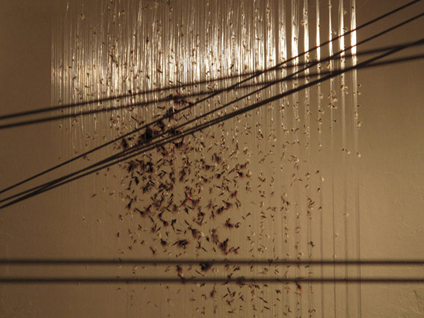
Bronwyn Lace and Vaughn Sadie
detail from Unit for Measure,
2009.
2000 Fishing Flies, 9000m Fishing Line, 5mm Perspex and 1.5mm Galvanized Steel Wire Rope (6 x 7) and an African Monarch Butterfly; 1800 m of 4mm Galvanized Steel Wire Rope (6 x19), 74 x 38mm Double Awning Pulleys, 910kg Poltry Worm Gear Winch, 150CWR/V25 Wheel and TF6 Fixed Assembly; 100w and 60 w R80 Spot Lights, MK-T-S/31 Turbo Spot Lights and 0.75 mmsq x 3 co white PVC Cabtyre
dimensions variable.
Bronwyn Lace and Vaughn Sadie's joint exhibition, 'Unit of Measure', currently on show at the Durban Art Gallery, is an astounding and somewhat overwhelming meditation on structure, fragility and control. A strange tenderness lurks in its midst, yet this remains elusive, constantly slipping through one’s fingers. While the show functions beautifully on the level of visual artifice, that same artifice very quickly and fluidly moves the mind into the realm of the social and the political, exploring the ways in which we are all capable of being lured and pinned down, like the Monarch butterfly to which Lace devotes thousands of metres of fishing wire with that express purpose.
In the large colonial space of the gallery's central chamber, Lace presents three vertical grids of fishing wire held together on either end by squares of perforated Perspex. In one of the grids, two thousand fishing lures are attached to the fishing wire, creating a delicate filigree of light. The remaining two grids devote all their wire to the pinning down of a single monarch butterfly. The three pieces intersect with – are kind of immersed in, in fact – Sadie's work, which fills virtually the entire space of the gallery, allowing only a walking space below; one in which you need to mind your head.
art events calendar
VIEW FULL CALENDAR
buy art prints

edition of 60: R4,800.00
About Editions for ArtThrob
Outstanding prints by top South African artists. Your chance to purchase SA art at affordable prices.
FIND OUT MORE Editions for artthrob
Sadie has threaded 1.8 kilometres of galvanised wire rope around the genteel baroque rectangular space, creating a zig-zagged, acidified spiderweb whose tension can ostensibly be tightened by turning the handle of a pulley attached to a winch (in reality, only the first four or so sections of wire will visibly tighten – friction gets the better of it after that). Although it is easy to see that Sadie's and Lace's works are structurally separate within the shared space, it's hard to feel that separation viscerally, hard not to experience them as a single work. It's like those optical illusions which contain two images. You can't see both of them at the same time.
The result is extremely affecting, both visually and emotionally. Aesthetically, the work is beautiful, but it's also cold and chilling, probably made all the more so by the overcast day on which I viewed it. The contrast between the colonial grandeur of the building and the work's insistent modernity seems more like emotional fact than cerebral discussion. That may seem a strange turn of phrase, but it speaks to something that is central to so much of the work in whose lineage ‘Unit of Measure’ follows. Contemporary art is viewed by most people as something profoundly cerebral, but in fact it's often about gut reaction which is then related, post-experience, into an avalanche of words, phrases and theory. And, some might say, justification – for falling for its magic.
The work also overwhelms for a more obvious reason: the viewer is granted so little distance from it that in fact the viewer is in the work, not separate from it. It's easy to say that though, because Lace and Sadie primed me with a quote from Priya Hemenway on the way into the gallery which states: ‘In a world that for twenty-five hundred years has developed an extraordinary compendium of knowledge based on principles of logic and rational thought, we find ourselves faced by the realization of physicists that experience, not knowledge, is the real key to discovering universal principles.’ And so it's also easy to say that the work echoes a post-millennial scientific spiritualism - which insists there is no real separation - without feeling embarrassed.
The lure is an easy allegory, although outside of fly fishing, it's one that I don't see much reference to. Here Lace uses it to dizzying effect, and it's not much of a conceit to compare the dazzling effects of the lures and lines interacting with light itself to the infinite lures of post-modern capitalism. Like both consumerism and religion, Lace makes use of the shiny and shimmering to suggest the possibilities of transcendence. Whether they are empty illusions or not is always a personal tale.
Sadie provides perhaps his answer to that question in proposing in the first place that such a complex web could be tightened or loosened with the handle of a pulley. We can control only those things we can control, which here is little more than our immediate connections. Further down the line, we lose control and the system takes over.
And so the metaphor, the story, I extract for myself, as a member of a global society of nearly seven billion people ruled not by people but by structure, is just how difficult it is to exact fundamental change in any kind of system without that change being not only disruptive but ultimately destructive – which perhaps sometimes it needs to be. That's my story. And I am so distracted by shiny things.