gauteng reviews
'Wonderland'
Nontsikelelo Veleko at Standard Bank Gallery
By Jacki McInnes10 June - 18 July. 0 Comment(s)
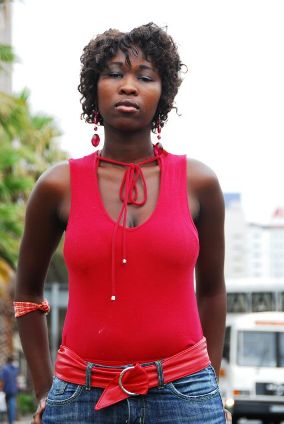
Nontsikelelo Veleko
Girl on Strand,
.
pigment print on cotton rag
.
Standard Bank Young Artist of the Year for 2008, Nontsikelelo ‘Lolo’ Veleko’s photographic exhibition, ‘Wonderland’, envisions a place in which Veleko, and her fellow urban hipsters, can be precisely who they want to be. Veleko has never made any bones about the fact that this place is essentially a construct, but the terms for citizenship are real enough – and they’re about ‘the look’. If you’ve got it, you’re in, if not, ah well...
Not that this is necessarily a problem: frankly, it’s quite refreshing that this photographer chooses to focus on the more upbeat aspects of South African society (inevitably overlooked in a country which, 15 years post-democracy, continues to excel in representations of inequality and socio-economic tragedy). Veleko routinely poses her subjects in recognisable cityscapes, with Newtown in Johannesburg and Cape Town’s Long Street and surrounds being favourites. Durban gets a fair mention but Pretoria, Bloemfontein, East London, etc., ah well... Of course this may simply be a matter of practicality, but it seems to me that this point begins to reveal certain failings with respect to the ‘Wonderland’ endeavour.
art events calendar
VIEW FULL CALENDAR
buy art prints
edition of 60: R6,000.00
About Editions for ArtThrob
Outstanding prints by top South African artists. Your chance to purchase SA art at affordable prices.
FIND OUT MORE Editions for artthrob
Veleko’s message that her wonderland is a credible vision of contemporary South Africa - and there for the taking - is quite explicit. ‘Wonderland’ is described as ‘…a cat; it’s prejudice, it’s love; it’s rejection; it’s tea or coffee; it’s anything’. Her concept of this utopia is further underscored by the graffiti she chooses to photograph: ‘Gatecrash your own fantasy’ and ‘Adventure without risk is Disneyland… Risk is full’. But just how inclusive is this ‘Wonderland’ really?
We have already established that inclusion is contingent on a very clearly defined look, and that this look supposedly only occurs in our major cities. The look is eclectic, zany and trendy; it’s certainly not mainstream and achieving it is not without risk for its adherents since it flies in the face of traditional expectations, especially those ordinarily imposed on young black South Africans. It was clear to me from the start that I did not have the credentials for Wonderland citizenship, but what of other visitors to the exhibition? Would they identify with this world or feel, somehow, a little let down? With this in mind I approached two black youths, freelance photographers in fact, for their opinions.
Both were emphatic in their praise for the technical aspects of Veleko’s work. They felt that the bold colours and confident, expressive poses of the subjects, their clothing and their environments achieved exactly what one would expect of a photographic record of the inhabitants of this Wonderland. They also believed that framing and perspectival strategies had been cunningly used. By boldly imposing the subjects onto soft-focus backgrounds and by shooting the pictures from a low point, Veleko, in their opinion, presents a race of beautiful, tall, proud people; almost a super-race.
They expressed no doubt that Veleko’s exhibition was slick, professional and successful, representing something of an aspiration for them. And not only in terms of her photographic prowess, but more significantly in the depiction of this utopian existence that she so tantalisingly dangles before her audience. But did they feel a part of it?
Their response to this question was considerably less sure. They felt that there were ‘gaps’. 'How exactly? Where exactly?' I prodded. To which they replied that while Veleko’s work certainly provides a much-needed view of South Africa’s contemporary cultural makeup, this view is too narrow. And while Veleko’s work aspires to provide a mirror for the ways in which young black South Africans have re-imagined and recreated themselves in response to the country’s greater inclusion in the outside world, it is a selective glimpse indeed.
‘Wonderland’, while it is a refreshing and uplifting body of work, has somewhat of an advertorial air about it. And the inclusion of a number of discordant pictures such as that of an older, fat, imperfect lady, snippets of ominous graffiti, and a series of threatening stormy skies, does little to dispel Veleko’s Wonderland myth. But my issue is not with this myth; after all, what law states that an artist’s view should be all-inclusive, or even rooted in reality? What does induce a measure of queasiness, however, is the seemingly glib equation: Veleko’s ‘Wonderland’ equals a credible view of contemporary South Africa in which ‘all people and all things are possible’, to quote Tracy Murinik. If this is indeed true, why is the representational cross-section of Wonderland’s population, as seen in this exhibition, so exclusive?
With thanks to Kwame Pooe and Refiloe Mokoka for their insights.
Jacki McInnes is Johannesburg-based artist, writer and curator