gauteng reviews
'Works on Paper'
Anton Kannemeyer at STEVENSON in Johannesburg
By Marc Rees12 November - 15 December. 0 Comment(s)
Anton Kannemeyer
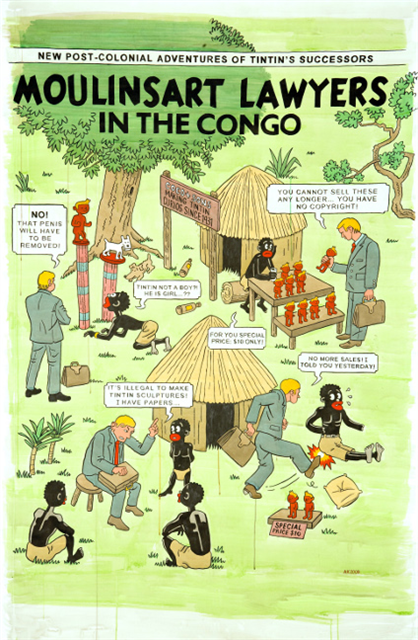
Moulinsart Lawyers in the Congo,
2009.
black ink and acrylic on paper
250x130cm, image courtesy of Brodie/Stevenson.
There are many exhibitions where one spends only a few seconds at each artwork before trotting off to the next. Those few seconds are often filled with thoughts such as ‘Is that it?’ or, ‘Does it do anything?’ or, ‘It’s just like the last one; let’s hope the next piece will be different.’ This is not the case with the selection of works by Anton Kannemeyer at the Brodie/Stevenson gallery. Each work is quite fresh, and it captivates us with its humour, insight, complexity and, sometimes, quite a bit of text to read.
Kannemeyer is well known for his work, under the alias Joe Dog, in Bitterkomix, a South African satirical magazine. Many of the works in the exhibition are these Joe Dog style cartoon prints and paintings on paper, all of which are infused with cynicism and humour that comment on the state of a postcolonial African society. He sees our society, especially with regards to race, politics and sex, as hypocritical and depraved. However, he is careful not to condemn the society, for if he moralised then he himself would be a hypocrite, as many of his pieces mock the moralists for their unreflective hypocrisy. He avoids the position of a judge and instead assumes the role of an aloof anthropologist who is amused by the follies of the cultures he studies.
Many of the images assume colonial iconographies and styles, from etchings akin to those found in Victorian travelogues to illustrations which show a Tintin-like figure. However, all these artworks are contemporary, intended for a contemporary audience and meant to comment on postcolonial cultures. The overarching message is that colonial attitudes have been inherited by the postcolonial society. The postcolonial society does not supplant the colonial one, but instead is just a sophisticated version of the colonial society, with all its bigotry, hypocrisy, greed and other negative traits.
One cartoon strip, entitled Pappa and the Black Hands (2009), depicts the white colonial male shooting down scores of black natives then proceeding to cut off their hands, all done without the slightest moral compunction. The white man is not portrayed as evil but rather as morally vacuous.
art events calendar
VIEW FULL CALENDAR
buy art prints
edition of 60: R6,000.00
About Editions for ArtThrob
Outstanding prints by top South African artists. Your chance to purchase SA art at affordable prices.
FIND OUT MORE Editions for artthrob
The giant painting on paper, Moulinsart Lawyers in the Congo (2009), depicts postcolonial white lawyers pestering the Congolese ‘savages’ over their copyright infringements of Tintin. In colonial times the weapons of the colonisers were brutish—shotguns and knives. In postcolonial times the weapons are more refined—paternalistic moralising and the law. In both cases, the Europeans are utterly dismissive of native African people.
For the most part, Kannemeyer’s works do not have much interpretive depth, but this is not to their detriment because it permits them to have a refreshing lightness. Many of the pieces are one-liners; but these one-liners are very insightful and are cleverly executed. He illuminates nuances of postcolonial society which we had possibly not previously considered, and he presents them in an accessible way and from an original angle. For example, the piece W is for White (2008) consists of lexical definitions for the word white beneath an image of a beamish middle-aged white male. The definitions for white include, ‘innocent’, ‘pure’, ‘honourable’, and so on. The message is simply that the white writers of the dictionary esteem themselves, as whites. This is especially obvious when the piece is compared to B is for Black (2008), where the definitions of black are pejorative ones, such as ‘dirty’ and ‘sullen’. Kannemeyer’s audience is not intended to be art critics, who have the remarkable ability to interpret a convoluted postcolonial discourse onto a stop sign. He aims to speak to an informed public; for them to understand him and thereby for them to understand themselves.
In order to grasp the conceptual element in many of these works, we are required to have some understanding of both the history of colonialism and the social state of a postcolonial society as well as a few relatively obscure references. Despite this, even if we do not fully understand the conceptual aspect of the works, they still have something to deliver. They have a delightful quirkiness in the exaggerated characters, stylised representation and the playful, though edgy, text which comprises many of the pieces. The images themselves are well composed and bold. The details in the illustrations invite us to explore the images and to savour their intricacies.
Kannemeyer’s interests run broader than the socio-political. The exhibition also includes some prints of commentated pornographic etchings that deal with issues regarding sex and the relationships between individuals. These show the same astuteness as the more political works. Our Parents are Addicted to Lies (2004) is captioned as it is titled and explicitly represents a girl riding a large phallus. She turns to the viewer then turns away and continues to enjoy her situation. With his usual finesse, Kannemeyer takes a subtlety of the state of being human and presents it to us to contemplate: in this case it is the phenomenon of parents denying the facts of their children’s sexuality.
Representing the subtleties of the human condition is what Kannemeyer does best. The exhibition includes a small series of portraits of literary figures, such as Lewis Carol and George Sand. These portraits do well what a portrait is meant to do: represent a particular person with consideration of their character, and with extra points given for expressing a nuance of that character. Kannemeyer does the same when the portrait is of a society, of a culture, of a period in history or of a point in time; and he surely earns those extra points.