cape reviews
're.collections'
Rose Shakinovsky and Claire Gavronsky at Goodman Gallery
By Andrew Lamprecht18 February - 13 March. 0 Comment(s)
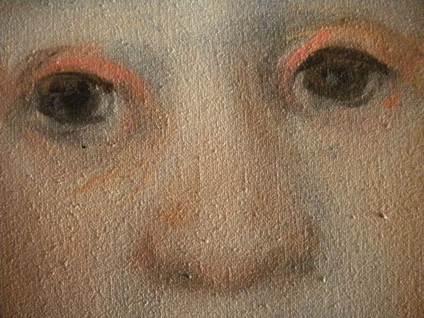
Claire Gavronsky
Catching the sign by the tail,
2009.
Oil on Canvas (detail)
.
rosenclaire: A Subtle Pairing
Twenty-five years ago, Rose Shakinovsky and Claire Gavronsky left South Africa for Italy, where they established an art teaching programme in Tuscany that has become the stuff of legend. In a recent Goodman Gallery Cape exhibition entitled ‘Re-collections’, their first show in their country of origin since that time, the duo present a body of new work that draws upon that decade-and-a-half’s teaching, learning, living and most of all engaging with art.
Although they have, since the fall of apartheid, spent several months a year in South Africa, their work has remained comparatively unknown in this country. One notable exception is their Soap Boxes outside the Iziko South African National Gallery, which has become one of the best-loved works in that institution’s collection and the site of many artistic interventions, fully in keeping with its creators’ intentions. I suspect that until this exhibition the few locals who knew of rosenclaire thought of them chiefly as facilitators and educationalists, but ‘Re-collections’ is bound to change those perceptions.
art events calendar
VIEW FULL CALENDAR
buy art prints
edition of 10: R20,000.00
About Editions for ArtThrob
Outstanding prints by top South African artists. Your chance to purchase SA art at affordable prices.
FIND OUT MORE Editions for artthrob
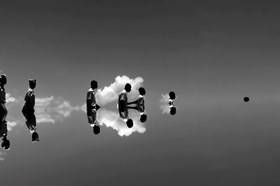
With over seventy individual works by them individually and together as the artistic entity rosenclaire, the show is unusual in its seamless marriage of ‘traditional’ drawing and painting (Gavronsky’s forte) with conceptual, photographic and sculptural works that indicate Shakinovsky’s concern with contemporary theory and discourse. This is not to say that conceptual elements are absent in Gavronsky’s painting, and a strong aesthetic element suffuses the work of Shakinovsky. I suspect, rather, as the title of the exhibition implies, that theirs is a deep collaboration that sees each draw from the strengths of the other and in so doing makes their work – individual or collaborative – much greater that the sum of its parts.
In Seismograph, a portrait by Gavronsky is paired with a found object, in this case an old stethoscope folded into a shape that dialogues with the face in the painting, to make a work where each component draws out something that may have been overlooked in the other. Thus rosenclaire, in pairing an easel painting with a quotidian object, have broken down the barrier between the ‘traditional’ and the conceptual and presented us with something that forces us to reconsider these categories anew. This strategy continues through several works on the show, including Punctuation and Liaison. One can see this sort of dialogue in other works too, such as the large cluster of Gavronsky’s small drawings on one wall, where one can almost hear the conversations (or lack thereof, because the artists have recently commented that much of the creative collaboration needs no verbalising after decades) that underpin these works. Frequently referencing the art world itself, this large installation of individual works not only demonstrates Gavronsky’s mastery of her medium but, taken as a whole, gives a clue to the concerns underpinning the rest of the show.
For me this is a concern with the state of art today, something that is of great concern to these lifelong educators and practioners, and what I suspect rosenclaire see as a lack of rigour and engagement with so much that passes itself off as ‘cutting edge’ and engaged today. Engagement is an important theme and can be seen in the political nature of so much of their work, whether referencing recent wartime atrocities, such as in Gavronsky’s Beslan or the legacy of apartheid in Shakinovsky’s I Spy. These are artists who are both engaged deeply with theory and the history of art and their commitment to the artistic process is clear in all that they do.
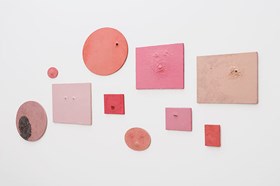
Works such as Shakinovsky’s for derrida xxx #2 (ZA), which comprises a wall-mounted composition of used pencil erasers, and Every Three Minutes similarly made up of dolls shoes and a single cut-out image, show this pairing of theory and the horror felt at South Africa’s child rape statistics. To be able to make works that are equally moving and beautiful and share the same formal qualities is not so much a tribute to artistic competence in dealing with disparate subject matter, but rather a brilliant understanding of the links between such seemingly different things.
It would seem that characterising rosenclaire as educators is never too far off the mark. Whilst never didactic, their work teaches us all about what too often is neglected in contemporary art practice: that current theory is predicated on centuries of tradition and that tradition, in its turn, has always at its best been deeply engaged with theory and the things, both beautiful and horrible that surround us, and to which we are so often blind.