 |
|
|
|
|
EUROPE
18.06.03 Frances Goodman's Intimate/Inanimate Moments in Dublin
18.06.03 Sue Williamson's first European solo show extended
18.06.03 Kendell Geers' 'Terrorealism' in Zurich
18.06.03 The African Exile Museum in Zurich
18.06.03 Sue Williamson, Minnette Vari and Tracey Rose, in Brussels
18.06.03 Philipp Krebs in Amsterdam
01.06.03 Langa, Charles, Chinzima, Gwintsa and Ledochowski at Venice Biennale 2003
01.06.03 Candice Breitz and Kendell Geers in Göteborg
01.06.03 Frances Goodman on group show in Luxembourg
01.06.03 David Goldblatt: 'Fifty-One Years' Visits Brussels
01.06.03 Liz Crossley in Berlin
01.06.03 Kentridge and Oguibe at Casino Luxembourg
01.05.03 Marlene Dumas in Venice
01.10.02 South African Family Stories in Amsterdam
UNITED STATES OF AMERICA
01.06.03 Berni Searle Explores The Space Between
01.06.03 Zulu beadwork from Maphumulo in New York
01.02.03 Coexistence: Contemporary Cultural Production in South Africa
|
|
|
|
|
|
|
 |
 |
|
|
|

Frances Goodman
Incident on a Welsh Beach, 2003
Object and narrative
With Anthony Goodman
|
|
|
|
Frances Goodman's Intimate/Inanimate Moments in Dublin
Frances Goodman is fast making a name for herself as an artist to watch. She has already exhibited on a number of group shows, including her own curatorial effort 'Juncture', which showed in both London and Cape Town, and featured Berni Searle. Moshekwa Langa and Erika Tan. (The Johannesburg Art Gallery recently acquired Goodman's sound piece from the show.) In 2001 she exhibited alongside Mona Hatoum and Helen Chadwick on 'Fluid', at the Wolverhampton Art Gallery.
For this series of work produced on an art residency in Dublin, Frances Goodman explores the notion that an object has the potential to have a voice - that it has the capacity to tell it's own story. For 'Intimate/Inanimate Moments' she has invited a number of writers, from many different backgrounds, to collaborate on the project. People were invited to choose an everyday object and write its history. It was then up to her to visualise the object - to make it, and find its voice and -someone to retell the story.
In the artist's characteristically magical prose, the project is described as follows: "To remember a fleeting moment of the day when lying in bed just after you turn the light out. To recall an incident to a friend, only to forget it five minutes later. To find yourself smiling on the bus at something you have remembered for the first time in years. All of these constitute our histories and our personal memories. And each memory is made up of hundreds of random, obscure objects. Therefore every object has a history. Yet they have no capacity for recollection due to their very inanimate nature."
Her collaborators on this project include: [Oaisikl] on Ou', Neil Dundas on Half Jack, Anthony Goodman on Incident on a Welsh Beach, Peter Lemmens on The Plastic Bag, Richard Penn on The Window People and On Guilt and Divine Judgement, Jennifer Ritchie on The Water Cooler and Nedko Solakov on The Toothbrush.
Opens: May 29
Closes: June 24
The Process Room
Irish Museum of Modern Art
Royal Hospital, Military Road, Kilmainahm, Dublin 8, Ireland
Tel: (+353) 1 612 9900
Fax: (+353) 1 612 9999
Email: info@modernart.ie
Website: www.modernart.ie
|
|
|
|
|
|
|
|

Sue Williamson
The cover for 'Selected Works'
|
|
|
|
Sue Williamson's first European solo show extended
Sue Williamson has been a driving force in South African art since the early 1980s. This, her first solo show in Europe, is a focussed retrospective of the artist's work.
Included on the show is her recent From the Inside series, a project that traces its lineage back to July 2000. From the Inside offers a visual document of how Sue Williamson responded to an invitation to make work relevant to issues then being discussed at the 13th International AIDS Conference in Durban.
The initial result was a series of site-specific messages dealing with South Africa's AIDS crisis. Each of the graffiti messages in the series condenses into epigrammatic form the personal core of a belief or insight of an individual diagnosed HIV-positive. Presented as a series of double images, From the Inside consists of a black and white subject portrait accompanied by a colour landscape photograph of the subject's message inscribed in a public place.
Other works on show include: the interactive video installation piece Can't Forget, Can't Remember, first presented on 'Artery' at Joao Ferreira in 1999; her Truth Games wall pieces; as well as older works such as photographs of the installations Mementos of District Six and Out of the Ashes, and For Thirty Years Next to his Heart.
This exhibition also marks the launch of a new monograph on the artist, titled Sue Williamson: Selected Work, and jointly published by Centre d'Art Contemporain, the Goodman Gallery of Johannesburg, and Double Storey Books, in Cape Town, a division of Juta Books.
Due to the large number of visitors to the show, as well as substantial press interest, the show has been extended by two weeks until the end of June.
Opens: April 23
Closes: June 30
Centre d'Art Contemporain
63 Avenue des Nerviens, Brussels 1040, Belgium
Tel: +32 2 735 05 31
Fax: +32 2 735 51 90
|
|
|
|
|
|
|
|
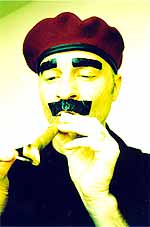
Kendell Geers
from 'Terrorealismus', 2003
Invite Image


Kendell Geers
from 'Terrorealismus', 2003
Installation view
|
|
|
|
Kendell Geers' 'Terrorealism' in Zürich
Throughout his career Kendell Geers has constructed simple, poetic situations in which a destabilising and often violent moment is inherent, and which in their direct confrontation challenge observers to position themselves, to 'relate themselves' to them. The room-filling installations are characterised equally by antagonism and the attempt to acquire the conceptual tradition of the modern.
Since the end of the 1980s, Kendell Geers has been working on a linking of conceptual and political approaches, but without the self-conception of a political artist. Politics here must be seen as everyday politics, denoting those decisions that are made day by day in order to live and survive. Politics is both an element of his art and of his life, and it is his answer to the cold conceptualism of the 1970s.
The Migros Museum for Contemporary Art in Zurich is showing the work 'Terrorealism', which has been specially designed for the museum. 'Terrorealism' is cell, prison and temple, all at the same time. The outer fa�ade, pierced by pieces of broken glass, blocks any view of the interior - it is impossible to fathom whether knowledge of this interior signifies a threat or protection.
Only upon entering the room do three neon tubes become visible, forming the words BORDER, DANGER and TERROR. A physical error causes a semantic short-circuit which allows new levels of meaning to arise, which designates and simultaneously negates cause and effect. The same subtle sense of humour which transforms the fragments-concrete combination into a room-filling sculpture, also characterises the new word constellation ORDER, ANGER and ERROR. That too is a possible answer to systems and their attributions.
This exhibition is part of the project 'NEXT FLAG - an African sniper project for European spaces'. It has been made possible through the cooperation of: Migros Museum for Contemporary Art, Zurich; B.P.S.22 Espace de Cr�ation Contemporaine, Charleroi; Casino Luxembourg Forum d'Art Contemporain, Luxembourg; Palais de Tokyo Site de creation contemporaine, Paris; Espacio C Arte Contempor�neo, Camargo Cantabria; W�rttembergischer Kunstverein, Stuttgart; and Kunstverein f�r die Rheinlande und Westfalen, D�sseldorf.
Opens: June 7
Closes: August 10
Migros Museum for Contemporary Art
Limmatstrasse 270, CH-8005 Zürich, Germany
Email: info@migrosmuseum.ch
Website: www.migrosmuseum.ch
Hours: Tues/Wed/Fri 12 - 6pm, Thurs 12 - 8pm, Sat/Sun 11am - 5pm
|
|
|
|
|
|
|
|
|
|
|
|
The African Exile Museum in in Zürich
To coincide with his show 'TERROREALISM', at the Migros Museum for Contemporary Art in Zürich, Kendell Geers presents 'The African Exile Museum'.
This group show is a mobile exhibition platform for contemporary African art. Eighteen artistic positions tell a story about the social changes that are currently taking place on the African continent. It concerns questions of multiple identities, of the close interweaving of urbanity and the collapse of social systems as well as the personal stories about them.
The invited artists are: Willem Boshoff, Lisa Brice, Loulou Cherinet, Soly Cisse, Kay Hassan, William Kentridge, Moshekwa Langa, Toma Luntumbue, Zwelethu Mthethwa, N�Dilo Mutima, Aim� Ntakiyica, Olu Oguibe, Tracey Rose, Berni Searle, Yinka Shonibare and Minette Vári, with Geers also contributing a work.
At the beginning of the 20th century, aesthetic revolutions occurred with the Dadaist and Surrealist movements. For their strategic actions the poet Léopold Sédar Senghor coined the term "franc-tireurs entrenched behind the enemy" - those who as vanguard start a new world order on unsecured ground. The initiators of 'NEXT FLAG - an African sniper project for European spaces' use this image of Senghor's franc-tireurs in order to express their desire for a new artistic and social space.
That the initiators are Africans is due to the Marxist concept of historical materialism. This states that no changes of circumstances can be derived from those who have
profited from the contrasts of this world. In an act of post-postcolonial occupation, NEXT FLAG has made it its aim to represent contemporary African art in European exhibition rooms. The project thus makes the attempt to bring together existing contradictions under a new - the next - flag, not in the sense of unity but as the establishment of a new, emotional geography, detached from physical actuality.
The 'The African Exile Museum' is the result of collaboration between the initiators of NEXT FLAG - Fernando Alvim and Simon Njami - and Heike Munder. The following collections are participating in the exhibition in the Migros Museum for Contemporary Art: Hans Bogatzke's collection of African contemporary art, Germany; Costa Reis compilação de arte africana actual, Angola; and Espacio C Collection, Camargo, Cantabria, Spain.
Opens: June 7
Closes: August 10
Migros Museum for Contemporary Art
Limmatstrasse 270, CH-8005 Zürich, Germany
Email: info@migrosmuseum.ch
Website: www.migrosmuseum.ch
Hours: Tues/Wed/Fri 12 - 6pm, Thurs 12 - 8pm, Sat/Sun 11am - 5pm
|
|
|
|
|
|
|
|
|
|
|
|
Sue Williamson, Minnette Vari and Tracey Rose, in Brussels
"Is contemporary art the domain which best reflects the complex relations between Africa and the rest of the world?" In a bid to answer this question, curator Toma Muteba Luntumbue brings together several recognised and emerging visual artists using different medias (installations, sculpture, video, painting and photography) in 'TRANSFER(T)S', Africalia '03.
'TRANSFER(T)S' depicts the permanent flows of people, capital, goods and ideas which characterise our world. Two sub-themes underlie the exhibition, without systematically determining the layout. The first one, "the death of otherness ", is a deliberately provocative thesis, which refers to the discourse on the homogenisation of the world. The second theme tackles the "acceleration of history": disasters, terrorism and wars are given ample media coverage, creating feelings of permanent anxiety and urgency. But do they also influence the course of history?
A number of items were especially designed for this large exhibition, which will cover some 1600 square meters in a dynamic layout that induces visitors to engage in a process of questioning and experimentation. The artists invited to take part include: Brahim Bachiri, Hicham Benohoud, Bili Bidjocka, Sue Williamson, Minnette Vari, Keith Piper, Tracey Rose, Pascale Marthine Tayou and Fatimah Tuggar.
The exhibition, to be accompanied by a catalogue, will also comprise a remarkable video section, shown at the Nova Cinema, focusing on home videos produced in Ghana and Nigeria.
Opens: June 21
Closes: September 14
Palais des Beaux-Arts de Bruxelles (The Centre for Fine Arts)
23 rue Ravenstein, 1000 Brussels, Belgium
Tel.: 0032 2/ 507 84 45
Fax: 0032 2/ 507 85 15
Email: sophie.lauwers@bozar.be
Website: www.bozar.be
|
|
|
|
|
|
|
|

Amsterdam Artwork III.jpg
Philipp Krebs
'Flying Tunnel Amsterdam', 2003
Mixed media
|
|
|
|
Philipp Krebs in Amsterdam
Cape Town-based Swiss artist Philipp Krebs is due to launch his third balloon project, this time in Amsterdam. The installation is large, and comprises 120 balloons, each with a diameter of 3 metres. The project was initiated by the General Consul of Amsterdam, Bruno Widrig, who asked Krebs to design a suitable concept. Krebs has responded to the brief with his 'Flying Tunnel Amsterdam'.
www.flyingwalls.com and www.surprisingswitzerland.com have updates of the project as it progresses.
Running concurrently with this outdoor installation is an exhibition of Krebs' projects, at a well-known gallery in Amsterdam - Galerie Parade, Prinsengracht 799.
For further information contact: Philipp Krebs on 083 686 12 70 or philipp@flyingwalls.com.
|
|
|
|
|
|
|
|
|
|
|
|
Langa, Charles, Chinzima, Gwintsa and Ledochowski at Venice Biennale 2003
Moshekwa Langa, Clifford Charles, Pitso Chinzima and Veliswa Gwintsa are the four South African artists participating on 'Fault Lines: Contemporary Art and Shifting Landscapes' at the 2003 Venice Biennale. Curated by Gilane Tawardos, in collaboration with the Forum Africa Contemporary Art, the show brings together contemporary artists from Africa and the African diaspora whose works trace the outlines of fault lines that are shaping contemporary experience locally and globally.
Says Tawardos: "These fault lines have been etched into the physical fabric of our world through the effects of colonialism and postcolonialism, of migration and globalisation. Their reverberations echo through contemporary lived experience and in the work of these 14 artists working across a range of media from painting and sculpture through to these 14 artists working across a range of media from painting and sculpture through to architecture, photography and installation. Their works span five decades, four continents and three generations, resisting any notion of an authentic or one-dimensional African experience."
"The nationalist struggles of the first decades of the twentieth century gave rise in the second half of the century to post-colonial independence and a new self-determination in Africa and beyond that articulated itself in a heightened political consciousness but also in new forms of visual and architectural practices. These new practices sought to negotiate the difficult and, as yet, unexplored terrain between tradition and modernity, between formal concerns and political contingencies.
"We have become accustomed to thinking about modernism and modernity in Western terms as a decisive break or rupture with the past and yet it is almost always experienced as an uneven negotiation between past and future that can remain unresolved. This exhibition explores the ambivalent space where tradition and modernity, past histories and future possibilities are mapped out in the work of contemporary artists.
"This exhibition proposes a space where we can engage with these complexities of lived experience through the work of artists who have embraced the ambiguities and inconsistencies of the contemporary world through art works that are by turns witty and serious, monumental and understated," concludes Tawadros.
Pitso Chinzima's installation, in collaboration with Veliswa Gwintsa, perfectly illustrates Tawadros' aims. Originally titled At The Same Time, the installation has been renamed At Least One Person Who Killed for its Venice outing. In a recent newspaper interview, Chinzima explained that the installation was about coming to terms with death. In 1998, he survived an attack at his home in Lenasia, south of Johannesburg. He said a gun was pushed into his mouth while attackers ransacked his home. "You can't avoid death in art," he claimed. "The spiritual aim of the exhibition is to build a visual monument to communicate with dead people, like visiting a grave."
Clifford Charles, a member of the Magnet collective (that comprises artists drawn from South Africa, Brazil, China, France, Britain, India, Mexico, and Puerto Rico), was the first "non-White" student to attend the University of Witwatersrand School of Art in 1987. Charles has been involved in a number of local initiatives aimed at bridging the gap between community arts, practiced in the townships, and the work of professionals well established in existing gallery spaces.
Chris Ledochowski is the only other South African participating on this year's Venice Biennale. The photographer has been invited to exhibit on 'The Structure of Survival', a show focussed on favelas, and curated by Carlos Basualdo.
Opens: June 15
Closes: November 2
Venice Biennale 2003, 50th International Exhibition of Art
Giardini di Castello, Venice Arsenale, Venice
Tel: +39041 2714747
Website: www.labiennale.org
Hours: Daily 10am - 6pm
|
|
|
|
|
|
|
|
|
|
|
|
Candice Breitz and Kendell Geers in Göteborg
Candice Breitz and Kendell Geers are two of the 27 artists appearing on the second G�teborg International Art Biennial in Sweden. Curated by the Swedish artist and composer Carl Michael von Hausswolff, the G�teborg 2nd International Biennial for Contemporary Art reflects and comments on reality - "that preposterous, inexplicable and occasionally invisible reality we'd most of all like to escape."
According to organisers, the exhibition will achieve this with art that refuses to provide an alibi - "Art not for decorating, apologising or glossing over, but for never giving up hope and never giving in." The two South African artists will be inauspicious company, the Biennial hosting a range of well-known avant-garde musicians, including Kim Gordon (USA), Russell Haswell (United Kingdom), Phill Niblock (USA), Ryoji Ikeda (Japan) and Pita (United Kingdom/Austria), as well as bad boy porn auteur Richard Kern (USA).
The exhibition comprises shows at G�teborg's Konsthall, Konstmuseet, the Hasselblad Center, and at Konsthallen, part of the Museum of Bohusl�n in Uddevalla. Additionally, there will be a number of outdoor works in central of Göteborg. The exhibition is entitled 'Against All Evens'.
Opens: May 24
Closes: August 24
Göteborg 2nd International Biennial for Contemporary Art
Norra Hamngatan 8, SE-411 14 Göteborg
Tel: +46 31 611039/615035
Email: asa.nohlstrom@kultur.goteborg.se
Website: www.biennal.goteborg.se
|
|
|
|
|
|
|
|

'Something About Love'
Invitation image
|
|
|
|
Frances Goodman on group show in Luxembourg
'Something About Love' is the title to a group show opening at the Casino Luxembourg. Quite literally themes around the subject of love, exhibitors Sue Webster and Tim Noble, as well as former Wits graduate Frances Goodman. Currently on a residency in Antwerp, her Luxembourg outing offers a good opportunity to become acquainted with the artist's emotionally vexed and highly personal work.
Its curator, Enrico Lunghi, capably describes the context of this show. All the participating artists talk about love. They may be the implementation of feelings and situations lived or imagined by the artist. There are also those that show, in a more indirect and abstract manner, the complexity of human relations, as soon as love, the desire to be loved and the quest for a life in which love would occupy a central place are involved. 'Something About Love' offers narrations, mises-en-sc�ne, allusions and metaphors, in the form of photographs, videos and installations, all variously serving to express and project sentiments of love.
Opens: July 4
Closes: September 21
Casino Luxembourg - Forum d'art contemporain
41, rue Notre-Dame - B.P. 345 - L-2013 Luxembourg
Tel: (+352) 22 50 45
Fax: (+352) 22 95 95
Email: casino-luxembourg@ci.culture.lu
Website: www.casino-luxembourg.lu
Hours: Wed - Mon 11am - 6pm, Thursday 11am - 8pm
|
|
|
|
|
|
|
|

David Goldblatt
A farmer's son with his nursemaid, Heimweeberg, Nietverdiend, Western Transvaal, 1964
Black and white photograph
|
|
|
|
David Goldblatt: 'Fifty-One Years' Visits Brussels
After having successfully shown in New York, Barcelona, Rotterdam, Lisbon and Oxford, David Goldblatt's 'Fifty-one Years' visits the Centre for Fine Arts, in Brussels. Curated by Corinne Diserens and Okwui Enwezor, 'Fifty-one Years' includes more than 200 of Goldblatt's black and white photographs, as well as a series of colour images of contemporary Johannesburg especially commissioned for the recent 'Documenta XI'.
David Goldblatt's photographs have documented the prosaic details of South African life for over five decades now. Whether photographing the stolid white suburb of Boksburg, or recording the invisible assault of apartheid by taking an early morning bus ride with the transported of KwaNdebele, his photographs have consistently impressed because of their eloquent humanism.
Born in 1930, he is the son of Lithuanian Jews who fled the pogroms in the 1890's. His family ran a small men's wear business in Randfontein, a gold mining town southwest of Johannesburg. Although he took serendipitous photographs during his youth, his first obligation was to the family business. After the death of his father Eli Goldblatt in 1962, he sold the family business to pursue a career as a full time photographer. He compares the elation of his release from the duties of the family business as one of letting loose an untied balloon.
David Goldblatt's unerring photographic records of South African life have concentrated on landscape and structure, people and context. His output is predominantly rooted in that most turbulent of times, high apartheid. Goldblatt, however, remains a prolific talent and his recent shift to colour photography has only served to enhance the photographer's revealing portraits of apartheid's aftermath - South Africa today.
As his contemporary, the South African writer Nadine Gordimer has observed: "These photographs have an unstated political significance that goes beyond the obvious images - they reveal the violence against human beings repeated, endlessly, in the continuity of daily life. They are 'evidence for historical occurrences' whose devastation mounts as one opens oneself to the quiet, inescapable force of what Goldblatt's photographs of dispossession, material and of human dignity, mean. The recognition that is the photographer's form of inspiration is an epiphany David Goldblatt reveals to us in the meaning of human lives, their time, their place."
Opens: April 8
Closes: June 15
Centre for Fine Arts Brussels
23 Ravenstein Street 1000 Brussels
Tel.: 02/ 507 84 44
Fax: 02/507 85 15
Email: ann.flas@bozar.be
Website: www.bozar.be
|
|
|
|
|
|
|
|

Liz Crossley
This was a city, 2001/2
Acrylic on canvass
200 x 170cm
|
|
|
|
Liz Crossley in Berlin
Land and its archaeological development is a central theme in the works of Liz Crossley, a South African artist and long-time resident of Berlin. Born in Kimberly in 1949, and educated at the University of Cape Town and Rhodes University, Crossley uses painting, drawing and projection as mediums for expression. She is able to closely identify with her subject through an approach that melds mythology and anthropology.
In her show 'This was a City' she deals alternately with the themes of land, its people and the history of their relationship. Part of the artist's own history is reflected in the ancient rock engravings of the Khoi-San people, engravings that correspond to Celtic symbols of her origins. Political and social perspectives are the filters through
which the works of this multi-faceted artist must be viewed.
Crossley has widely, including shows at London's Whitechapel Gallery and Royal College of Art, Cape Town's AVA and Berlin's Haus der Kulturen der Welt. You can view examples of Crossley's work at:
www.SouthAfricanArtists.com
wwol.is.asu.edu/crossley.html
Opens: May 24
Closes: June 21
Peter Herrmann Gallery
Torstr. 218 D-10115 Berlin
Tel: + 49-(0) 30-88 62 58 46
Fax: + 49-(0) 30-88 62 58 47
Mobile: + 49-(0) 1 72-720 83 13
Email: info@galerie-herrmann.de or Liz.Crossley@t-online.de
Website: www.galerie-herrmann.de
|
|
|
|
|
|
|
|
|
|
|
|
Kentridge and Oguibe at Casino Luxembourg
Advance Notice: William Kentridge, the stellar South African artist who shot to international prominence following 'Documenta X', will be participating in a two-person show with Nigerian artist Olu Oguibe.
Oguibe is a prolific talent. Aside from his artistic practice he ranks alongside Okwui Enwezor as one of Africa's foremost commentators of art practice. Oguibe, in conjunction with Enwezor, co-edited Reading the Contemporary: African Art from Theory to the Marketplace. His essay 'Art, Identity, Boundaries: Postmodernism and Contemporary African Art' deconstructed a text by Thomas McEvilley on African artists at the Venice Biennale in 1993, exposing the peculiar attitudes and assumptions of critics about African art and artists. He is also a prominent force behind Africa's foremost visual arts publication - Nka: Journal of Contemporary African Art.
Opens: July 3
Closes: September 20
Casino Luxembourg - Forum d'art contemporain
41, rue Notre-Dame - B.P. 345 - L-2013 Luxembourg
Tel: (+352) 22 50 45
Fax: (+352) 22 95 95
Email: casino-luxembourg@ci.culture.lu
Website: www.casino-luxembourg.lu
Hours: Wed - Mon 11am - 6pm, Thursday 11am - 8pm
|
|
|
|
|
|
|
|

Marlene Dumas
'Purple Pose', 1997
lithograph 30/50
136x80
Collection: BHP Billiton
|
|
|
|
Marlene Dumas in Venice
Cape Town born Marlene Dumas has never held a solo exhibition in an Italian museum. 'Suspect' is therefore an important show by one of the most acclaimed painters of recent times.
Presented at Fondazione Bevilacqua La Masa, and curated by Gianni Romano, 'Suspect' includes recent works as well as some new paintings realised specifically for this Venetian venue. The Fondazione Bevilacqua La Masa is situated in the fascinating ambience of Palazzetto Tito, located in the historic artists' quarter called Dorsuduro. It is one of the liveliest areas in town, and quite close to the Art Academy, the Pinacoteca, the University of Venice and campo Santa Margherita.
Despite being heralded as an artist who anticipated the figurative trend, which has characterised so much painting and photography of the last decade, Dumas's images, as well as the texts she writes, refuse easy interpretation. The models in her paintings and drawings seem to refuse their traditional passive role by fostering a sort of role-playing with their audience. In her 'Suspect' works everything becomes suspicious, from the painted models to our own attitude as visitors.
Opens: June 12
Closes: September 25
Fondazione Bevilacqua La Masa
Palazzetto Tito, Dorsoduro 2826, 30123 Venice, Italy
Tel. +39 041.5207797
Fax +39 041.5208955
Email: info@bevilacqualamasa.it
|
|
|
|
|
|
|
|

Popo Molefe, Tsholo Molefe, Boîtumelo 'Tumi' Plaatje
Foto: David Goldblatt, 2001
|
|
|
|
South African Family Stories in Amsterdam
The rich narrative history of nine South African families is revealed in a significant exhibition opening at the KIT Tropenmuseum in Amsterdam.
'South African Family Stories: A Group Portrait' describes the origins of South Africa through the experiences of nine individual families. Each family story unfolds across four or five generations, with one or two persons representing each generation. Some of the families selected for the exhibition include well-known public figures, such as Sol Plaatje, Marthinus Steyn and Dolly Rathebe, but in general most of the families claim no special public significance. The exhibition is presented as a multimedia presentation, using artwork, photography, film, sound, original documents and objects. A different team of South African artists, photographers, writers and designers was employed to produce each of the nine family stories.
Penny Siopis and photographer Ruth Motau worked on the Plaatje family, while Sam Nhlengethwa and photographer Mothlalefi Mahlabe present the family story of the singer Dolly Rathebe. David Goldblatt paired-up with Claudette Schreuder to profile the Steyn family, Berni Searle interpreting the experiences of the Manuel family from Simonstown. Andrew Verster worked on the Juggernath family from India, while photographer Paul Weinberg and artist Langa Magwa focussed on the family of Zonkezizwe Mthethwa, a respected sangoma living near Ngudwini. The overall composition of the families selected aims to be representative of the social, cultural and geographical variety of people in South Africa.
The exhibition is complemented by a 240-page publication featuring the output of nine writers-researchers interpreting the major moments in the respective families' lives. Each contribution is illustrated with the individual artworks and photographs commissioned for the project. The book also features an introductory essay by Cape Town University's Njabulo Ndebele.
In an effort to offer audiences as comprehensive a portrait as possible of South Africa, the exhibition includes an independent exhibit known as 'the archive'. The installation, supervised by Penny Siopis, offers visitors a chance to browse through a variety of books, magazines and audio-visual material, the hope being that the archive will offer a contemplative space for visitors wishing to answer questions raised during the exhibition.
South African Family Stories: A Group Portrait appears at KIT Tropenmuseum from October 4, 2002. After is closure in September 2003, the show will travel to South Africa where it will run at Johannesburg's Museum Africa from January 2004.
Opens: October 4, 2002
Closes: September 21, 2003

KIT Tropenmuseum, Linnaeusstraat 2, Amsterdam, The Netherlands
Website: www.zuidafrika.tropenmuseum.nl
Hours: Daily from 10a.m - 5p.m
|
|
|
|
|
|
|
|
|
|
|
|
 |
|
|
|

Berni Searle
Snow White, 2001
2 x Video Projections
Maximum scale 157" x 118 1/8"
DVD Format
|
|
|
|
Berni Searle Explores The Space Between
Berni Searle engages issues of race and syncretism at the Davis Museum in Massachusetts. The exhibition 'The Space Between: Artists Engaging Race and Syncretism' opened on March 18 with Searle delivering the opening address.
The forced dispersal of millions of Africans into foreign lands during the African slave trade created the African Diaspora, a global community of Africans and their descendants living outside the African continent. 'The Space Between' explores how artists across the African Diaspora have negotiated and reconciled a variety of cultural and racial heritages and identities.
Berni Searle uses a variety of media to confront the conditions of apartheid in South Africa and to address themes of identity, gender, and body image. Before the abolition of apartheid Searle was classified as coloured, a median racial category created for people of mixed racial descent. Searle dynamically confronts and engages colour and racial politics by using substances such as henna, spices and pea flour in her work to color herself as she pleases. In the exhibition's video installation Snow White, the artist is showered alternately with pea flour and water, rendering her white, and makes and kneads dough with these materials.
Paul Vanouse, the other featured artist in the exhibition, questions the use of science to determine race and racial hierarchies. He uses information technology to create interactive cinema and biotech installations to address the impact of contemporary culture on aspects of race, gender, and class.
'The Space Between' refers to W. E. B. Du Bois's notion of double-consciousness, first introduced in 1903 in his seminal work The Souls of Black Folk (which incidentally is celebrating its hundredth anniversary this year). In it he proposes that the black is perpetually aware of the inner self as it is seen by the white viewer, producing a divided self that must be constantly negotiated and reconciled. According to curator Anne Collins Smith, this struggle becomes particularly complex when a mixed racial makeup puts the individual outside or between the categories of black and white.
The exhibition's title refers to postcolonial theorist Homi K. Bhabha's theory of the "third or in-between space" as one negotiation of double-consciousness in this syncretic racial landscape. Art from the museum's permanent collection, including works by Maria Magdalena Campos-Pons, Ellen Gallagher, Glenn Ligon, Lorraine O'Grady, and Adrian Piper, enrich this dialogue of artists across the Diaspora.
'The Space Between' is the fruition of Anne Collins Smith's appointment as the Andrew W. Mellon Foundation Curatorial Fellow at the Davis Museum and Cultural Center.
Opens: March 18
Closes: June 8
Davis Museum and Cultural Center
Wellesley College, 106 Central Street, Wellesley, Massachusetts
.
Tel: (781) 283 2034
Email: lcollins@wellesley.edu
Website: www.davismuseum.wellesley.edu
Hours: Tues, Fri and Sat 11am - 5pm, Wed and Thurs 11am - 8pm, Sun 1am - 5pm
|
|
|
|
|
|
|
|

Shawl, Itete
Zulu, Maphumulo Region
Glass beads and cloth
54.5cm x 67 cm
|
|
|
|
Zulu beadwork from Maphumulo in New York
Recently opened is 'Glass Lace', the first show ever to focus on the distinctive beadwork style used by Zulu-speaking clans in the Maphumulo region. 'Glass Lace' offers collectors an opportunity to select from the world's largest collection of these rare items, dating from the 1940s to the 1960s.
The Maphumulo style is noted for its lacy, ruffled texture, built up with overlapping bands of beads. Zulu custom dictated that a bride, after taking up residence at her husband's homestead, don the blackened leather skirt of marriage and cover her shoulders as signs of respect for her husband's parents and ancestors. On ceremonial occasions, beaded capes and aprons worn over the leather skirt underscored this religious function and communicated personal flair and status. A wife could commission a specialist leatherworker to make a back-skirt for her husband. These expensive and prestigious gifts were also worn only on special occasions.
As with other regional Zulu beadwork styles, Maphumulo beadwork employs a restricted palette. The background colour is white, and in older pieces this dominates the composition. The background is ornamented - often in sequenced bars or blocks - with turquoise, navy, black, and deep green. This five-colour palette can be highlighted with touches of red, orange, yellow, or pink but no other colours are used.
Other Maphumulo motifs are crosses, a crosshatch design that may symbolise ancestral protection, and motifs that combine triangle and/or diamond shapes. In some Zulu communities, the diamond motif alludes to the Zulu shield and symbolises protection, while the triangle symbolizes love because the same Zulu word is used for both "triangle" and "heart" (Boram-Hays 2000). Though the rectangular compositions of women's fabric aprons and capes invite comparison with abstract painting, these objects obviously were intended to be draped on the animated human body and combined in full costumes, as is demonstrated by a work on a podium in the centre of the gallery.
New York's Axis gallery is the only gallery in the US to specialise in the art of South Africa. The gallery has rapidly gained a reputation for its interesting contemporary shows, such as the recent 'Circumcised, Circumscribed'.
Opens: April 4
Closes; June 28
Axis Gallery
453 West 17th Street, 4th Floor, New York, NY 10011
Tel: (212) 741 2582
Fax: (212) 924 2522
Email: axisgallery@aol.com
Website: www.axisgallery.com
Gallery Hours: Tues - Sat 11am - 6pm
|
|
|
|
|
|
|
|
|
|
|
|
Coexistence: Contemporary Cultural Production in South Africa
One often underestimates the difficulty of presenting South Africa internationally, more particularly contemporary South African art. This is amply borne out by this cursory overview of the press release to a new show at the Rose Art Museum at Brandeis University in Massachusetts. 'Coexistence: Contemporary Cultural Production in South Africa' is a show which presents contemporary art from South Africa, "where artists have played a significant role in redefining the social and political identity of the region. This show promises art that reflects both Third World history and First World influence on this area, challenging African and Western notions of art."
Quoting further: " 'Coexistence: Contemporary Cultural Production in South Africa' presents a wide range of creative activity in the young nation. South African policymakers have recognized the value of art and artists in the social, economic and educational development of their young nation. In the decade since the abolition of apartheid in 1990 art in South Africa has shifted from resistance art to art committed to the social transformation of the country.
"The works in 'Coexistence' represent the various ways in which the categories of "European" and "indigenous" arts are coexisting and mutually influencing each other. Six major works from the South African National Gallery (SANG) collection, all from 1995, form the exhibition's core. As a group, they contrast the vastly different spaces of the suburb, the township, the rural village, and the central city, and the racial and economic divisions that they mark. With one foot firmly planted in the Third World and the other striding forth into the First World, the art of contemporary South Africa challenges both African and Western notions of art."
'Coexistence' will feature artist Sue Williamson, amongst others, and is co-organized by The Rose Art Museum, Brandeis University, and the South African National Gallery, Cape Town, and curated by Pamela Allara, Associate Professor, Fine Arts Department, Brandeis University, Marilyn Martin, Director, Art Division, Iziko Museums of Cape Town, and Zola Mtshiza, Assistant Curator, SANG. There will be an exhibition catalogue.
For those unfamiliar with the Rose, it houses Brandeis University's collection of modern and contemporary art. Widely recognized as the finest collection of twentieth century art in New England, the collection includes pieces by the leading artists throughout the century, focussing on post WWII American art including de Kooning, Johns, Rauschenberg, Warhol, Mangold, and Taaffe. Portions of the collection are always on display at The Rose.
Opens: January 22
Closes: June 29, 2003
Rose Art Museum at Brandeis University
Lois Foster Wing and Mildred S. Lee Gallery
415 South Street in Waltham, MA 02454, USA
Tel: 781. 736 3434
Fax: 781. 736 3439
Website: www.brandeis.edu/rose/exhibits-current.html
Hours: Tuesday to Sunday, 12 p.m - 5 p.m
|
|
|
|
|
|
|
