 |

Artist Unknown
George Harrison
Settler's Park, Johannesburg
Bronze on stone
SEE NEWS


Michael Betancourt
untitled study from 'Aesthetic Hazard' , 2001 - 2003
Location Variable
SEE PROJECT

W. Janse van Rensberg
untitled, 2003
from 'Camera Obscura'
SEE GAUTENG LISTINGS
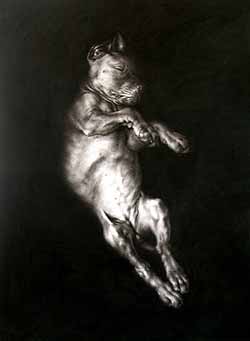
Elizabeth Gunther
Mourning, 2003
Charcoal on paper
SEE REVIEWS
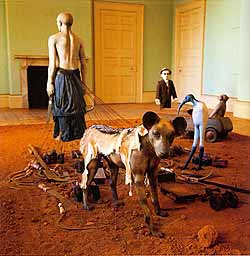
Jane Alexander
African Adventure
1999-2002
Installation view, Cape Town Castle
SEE REVIEWS

Kendell Geers
from Scorched Earth series, 2002
Photograph
SEE GAUTENG LISTINGS
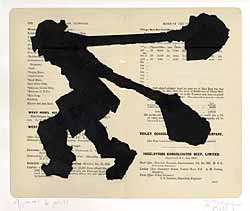
William Kentridge
Village Deep
Chine-colle on paper
26 cm x 19 cm
SEE EDITIONS for ArtThrob
 |
|
 |
Supporting grant from the Royal Netherlands Embassy |
|
Web hosting |
|
|
|
 |

As one exits the airport highway and enters Johannesburg's inner city from its eastern edges, a rather prosaic statue greets one. It is a piece of public art that commemorates a mason, George Harrison, the man who discovered Johannesburg's Main Reef. The mesmerised prospector holds a piece of prize earth above his head, perpetually oblivious to the ebb and flow of the life force that surrounds him. But it is not old Harrison's statue that intrigues, rather his plinth: both its plaques are missing. Where there used to be an edifying public narrative, now there is an odd emptiness, like a missing tooth. In all likelihood an enterprising prospector - of the contemporary ilk - pilfered the precious metal of the plaque. (Bronze has its value with scrap metal traders.) Beyond the mundane details characterising this scene exists an apt truth: Johannesburg is a city without a defining master narrative. This conundrum might have escaped Cape Town to some extent, but as this look at public art in South Africa reveals, the inner city is a contested space. This fact accounts for the many initiatives aimed at asserting ownership of the post-Apartheid city. The goal: to forge a new narrative, one that will replace that old - not really missed - one proclaimed by those missing plaques.
Sean O'Toole
We are delighted to announce that William Kentridge is our featured Editions for ArtThrob. We are currently offering readers a rare opportunity to acquire an original artwork by this stellar South African art personality, Village Deep a chine-colle silhouette image collaged on to the page of an old book.
Next Update: May 30, 2003
|
|
 |
 |
|
CAPE
'Contact Zones', the inaugural show at Michael Stevenson Contemporary, explores the dynamic and creative role of artists negotiating European and African identities in times when realities continue to evolve and alter rapidly. Also on: Alan Alborough at the Sasol Art Museum; Sanell Aggenbach at the AVA; Gladys Mgudlandlu's Retrospective at the SANG; Ilona Anderson at Joáo Ferreira; and Andrea Desmond-Smith at Art.b. Also don't forget 'Voicing the Abstract' at CAP, a welcome show by three emerging black women artists based in Cape Town; as well as the shenanigans set to take place in Cameron Platter's bathroom.
GAUTENG
The intersection at Jan Smuts Avenue and Bolton Road is host to a number of important shows: Kendell Geers at the Goodman Gallery, and 'Art & Urbanisation' at Warren Siebrits. the trinity session (sic) reveal elements of their working method at their first, at the Standard Bank Gallery; Jürgen Schadeberg's lesser-known work is on show at PhotoZA; Joachim Schönfeldt is at the Bag Factory; and Shui White fuses influences in her pen and ink drawings, at the new HH gallery.
KWAZULU-NATAL
Scott Bredin exhibits recent paintings and drawings; Ingrid Winterbach addresses issues of display, displacement, relocation and documentation of the human form; and Jan-Henri Booyens is concerned with notions of 'organised' chaos and disturbance, and the 'static' created by these frictions - all at the NSA. Vaughn Sadie investigates identity as construct at the Cupboard Gallery, in the recently opened Home.
INTERNATIONAL
As summer moves north, so to does Sue Williamson. A prominent local artist since the 1980s, Williamson has her first solo show in Europe. She is also on show in the US, on a significant group show titled 'Coexistence'. In Italy, Marlene Dumas gets ready for her first solo show, set to coincide with the summer influx of art tourists to Venice.
|
|
|
 |
|
We reprint critic Holland Cotter's New York Times review of 'Coexistence', an important group show featuring SA
artists in the US. Maren Ziese concludes her two-part review of Jane Alexander, celebrating the artist's variety, flexibility, fluidity,
immateriality and cultural hybridity. In an age of bored hyper-realism, Elizabeth Gunter's lifelike work has the ability to
engage, writes Melvyn Minnaar.
Student Reviews: 130 years of collecting is laid bare at the SANG as curator
Hayden Proud bravely acknowledges that the city's collection is a product of
history. Kerryn Greenberg assesses the successes of 'ReCollection'.
|
|
|
 |
|
Who owns the city? According to Zayd Minty:
"Whoever wants to own it, owns it". Speaking at a recent Michaelis debate,
he prefaced his comment by stating: "It is the Wild West out there." Paul
Edmunds gives substance to this claim in his short history of post-Apartheid public art
projects in Cape Town's inner city. Sean O'Toole similarly focuses his
attention on public art, in Johannesburg.
Other news: Michael Stevenson
Contemporary is the newest kid on the block, and occupies a space in a renovated industrial
building in one of Cape Town's trendiest areas. To coincide with its launch
the gallery has produced a sumptuous catalogue, which prompts our measured
look at South Africa's wild surfeit of new art
books.
|
|
 |
 |
|
After a successful opening in Belgium Sue Williamson returns home - and encounters the winter flu gremlins.
|
|
|
 |
|
The postal weavings of twentieth century mail art are not simply about the literal journeys travelled by paper envelopes. For the artist Kim Lieberman mail art traces pathways, a multitude of unforeseen and emotionally meaningful pathways. We celebrate an artist whose habitual stitching of squares on stamp paper with silk thread have, according to Clive Kellner, ruptured the male modernist grid.
|
|
|
 |
|
The web is an invaluable resource for anyone interested in public art. We point out the Jhb Art City project website, as well as Sheffield Hallam University's Public Art Research Archive.
|
|
|
 |
|
Two public art projects have intrigued us: The Art of Being in Danger is an online project confronting homelessness, hunger and deprivation, while the Aesthetic Hazard Project offers an interesting online document of a project that hijacks very real everyday public spaces.
|
|
|
 |
|
Do you think you can produce an outdoor work that responds to and is inextricably connected with the topography and features of Spier Estate. If you do then Public Eye would like to hear from you: proposals are invited for Second Spier Outdoor Sculpture Biennale. The deadline for applicants seeking Arts and Culture Trust funding is looming.
|
|
|
 |
|
Send us your feedback on this issue's investigation of public art.
|
|
 |
 |
|
William Kentridge is a name that requires little introduction. A man who comfortably shoulders the accolade genius, ArtThrob is particularly proud to announce that William Kentridge has agreed to be our featured Editions for ArtThrob artist. We are currently offering readers a rare opportunity to acquire an original artwork by this stellar South African art personality, Village Deepa chine-colle silhouette image on watercolour paper.
|
|
|
 |
|
Our archive is again fully functional. Browse through past editions of ArtThrob.
|
|
 |
 |
|
We're small, we're scattered, but we like to think we are always near to what's happening in contemporary South African art. Find out who we are.
>> CONTACT US
|
|
|
 |
|
Subscribe to our monthly email update.
|
|
|
|
|


|
 |
