
gauteng reviews
The Woods
Candice Breitz at Goodman Gallery
By Michael Smith23 February - 30 March. 0 Comment(s)

Candice Breitz
The Interview,
2012.
Film still
.
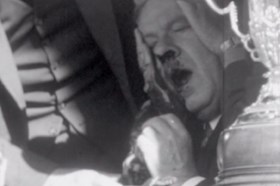
Bizarrely enough, Hedy Lamarr wasn’t just a Golden Age screen siren, infamous for simulating orgasm in Gustav Machaty’s Ecstasy in a time when such libertine displays would have got you strung up anywhere outside of California. She was also a gifted mathematician, co-inventing (with George Antheil) spread spectrum communications and frequency hopping, both apparently integral to wireless communication.
But, inevitably, Lamarr was more famous for flashing her goodies onscreen and making breathy statements about the glamorous life. Like this pearler: ‘To be a star is to own the world and all the people in it. After a taste of stardom, everything else is poverty.’
art events calendar
VIEW FULL CALENDAR
buy art prints
edition of 60: R6,000.00
About Editions for ArtThrob
Outstanding prints by top South African artists. Your chance to purchase SA art at affordable prices.
FIND OUT MORE Editions for artthrob



Eighty-odd years on, and despite the bad press that stardom and the star system keep getting, the queue of people lining up to fling themselves onto the ever-rising pile of bodies in Los Angeles remains endless.
Stardom is primarily about evasion: evading work-a-day drudgery, conventional morality and anonymity. And in that sense, Candice Breitz’s new show ‘The Woods’ at Goodman Gallery Johannesburg is completely in line with her previous bodies of work.
The ‘woods’ of the title is an obvious reference to the suffix accompanying ‘Holly’, ‘Bolly’ and ‘Nolly’ – a all three of which are represented here. But at a press preview on the Saturday before the show opened, Breitz also spoke about the woods as a mystical, frightening place of childhood stories and myths.
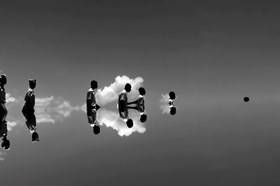
The show comprises three video installations, The Audition, The Rehearsal and The Interview. All feature child actors speaking directly to the camera. The razor-sharp editing and the perfectly-timed interactions between these talking heads have become Breitz’s trademark, making 'The Woods' as close to a gold standard in video art as one is likely to get.
In The Rehearsal, six Indian child actors who have achieved a certain modicum of fame in their home country appear alongside each other, apparently spontaneously answering questions about stardom, fame and ‘being a brand in my own right’. But it turns out, at the behest of Breitz, each is simply repeating responses that Shah Rukh Khan, a famed Bollywood actor and no stranger to false self-deprecation, gave in a previous interview. The resulting suggestion of the child actor as proxy, or less charitably as ventriloquist’s doll for the words and values of the adult, is chilling.

A similar effect happens in The Audition. Cameron Kasal, a young American child actor, performs a fake audition with Billy Joel’s 1980 soft rock hit You May Be Right, a song he would have no way of knowing if not for the coaching of an over-enthusiastic stage parent. The performance of childhood, or at least a non-threatening, nostalgic take on childhood and adolescence, is at play here. Alongside Cameron, a young preteen girl sings an excruciating version of I Was Born to Entertain, with all the vocal gymnastics and affectation the Glee generation seems to hold so dear. Her desperation is palpable; our complicity in this industry is front-and-centre.
The Interview features Chinedu Ikedieze and Osita Iheme, two adult actors from Nigeria who have paradoxically achieved fame by acting the parts of children, and who recently appeared in a DStv advert flighted in South Africa. The two take turns to pontificate on vague ideas around quality, Africanness and being stars; again, more loudly than their own voices, one hears the machinations of an industry that foists on its adherents an odd mixture of nonchalant arrogance (detectable in body language and the off-the-cuff wisdoms) and craven zeal (a complete absence of critical thought about the nature, terms and excesses of the film and television worlds).
With incisive observation, Breitz sets up childhood as the last bastion of Otherness, a stage that necessarily must be corralled, tamed and told what to say. The carrot dangled before the wannabes is, of course, something of the order of Lamarr’s notion of stardom: wealth, comfort, and an escape from the poverty of insignificance. Breitz manages to ask tough questions about why childhood needs to be reprogrammed in this way, and what this says about those of us buying the tickets at the multiplexes.